
What the numbers mean
Bull sharks and American crocodiles share estuaries, mangrove creeks and river mouths from Florida to South America, and they share an ability most of their relatives lack: both can move between salt water and fresh water without harm. That is a harder trick than it sounds. An animal's tissues sit at a fixed internal concentration, and water crosses membranes toward whichever side is saltier, so living in an estuary means solving a chemistry problem twice a day.
The two solved it in unrelated ways, which is what makes the pairing worth examining. A shark and a crocodile are separated by hundreds of millions of years of evolution and start from opposite baselines: the shark's blood is already about as concentrated as seawater, while the reptile's is far more dilute. They arrive at the same creek mouth from opposite directions and hold themselves there by adjusting entirely different organs.
Two solutions to the same chemistry problem
Most sharks cannot regulate their internal chemistry outside the sea, because their bodies are tuned to a single concentration. The bull shark adjusts on the move, changing the work of its kidneys and rectal gland to shed salt or retain urea as conditions change, which lets it cross the salinity gradient of an estuary within a single tide. The record of that flexibility is written into the animal: chemical signatures laid down in its vertebrae preserve the salinity it lived in, so researchers can reconstruct whether an individual grew up in a river, an estuary or on the open coast.
The crocodile starts from the opposite side of the problem. Its blood is far more dilute than seawater, so its difficulty is getting rid of salt rather than holding on to water. Glands on the tongue excrete concentrated sodium, and the skin loses comparatively little water, an arrangement that allows the species to occupy coastal lagoons saltier than the sea, including hypersaline lakes in Hispaniola. Hatchlings are the constrained stage, since they dehydrate quickly and depend on pockets of lower salinity to grow.
The same ability sends the two animals in opposite directions. Bull sharks use theirs to travel inland, with records far up the Amazon, in Lake Nicaragua and in the Mississippi River as far north as Alton, Illinois, roughly 1,700 miles from the Gulf of Mexico. The sharks of Lake Nicaragua were long thought to be a landlocked species of their own until tagging showed they were ordinary bull sharks working up the San Juan River in stages. Crocodiles use theirs to move seaward, into tidal flats and out to offshore atolls.
Built for shallow, murky water
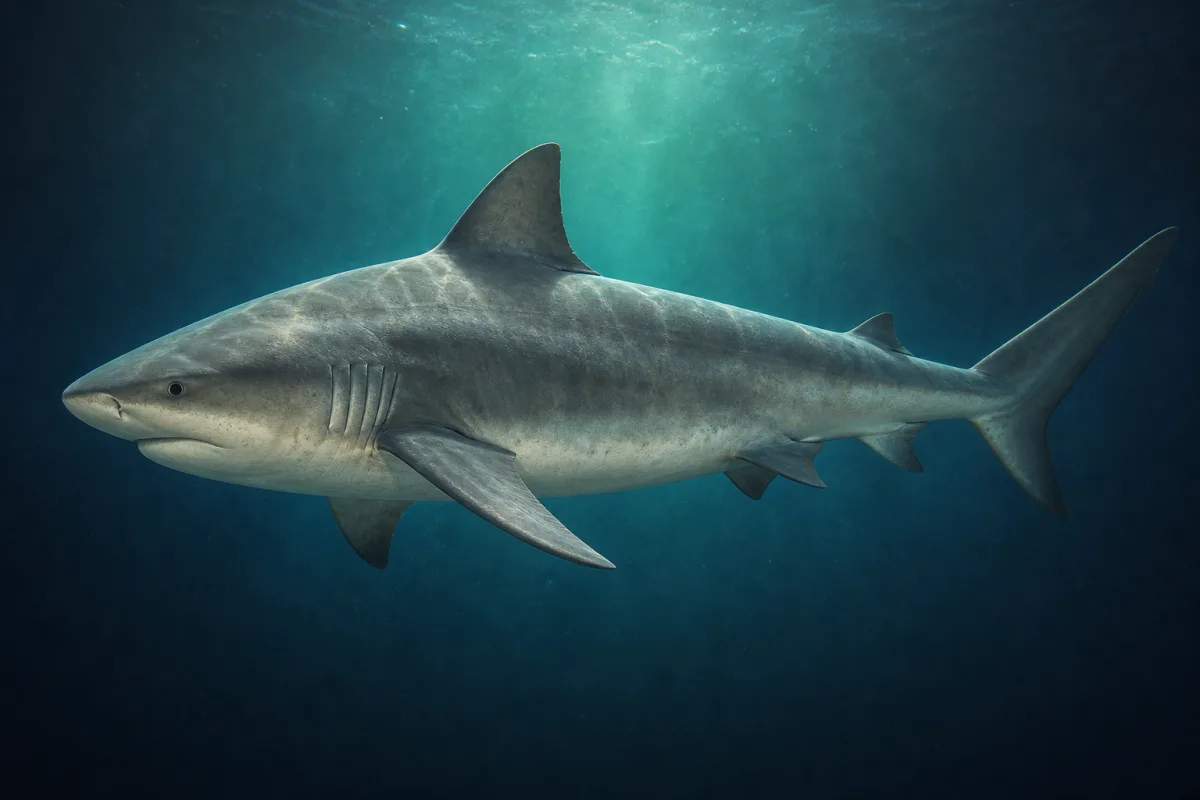
The bull shark is stocky where its relatives are slim: a deep body, a short broad snout, small eyes and a tall triangular first dorsal fin. Females grow larger than males and commonly reach 7 to 9 feet, with the largest well-documented individuals close to 11 feet, and the species is unusually heavy for its length. Reports approaching 13 feet appear in older records but are not well supported, a caution that applies to both animals in this comparison.
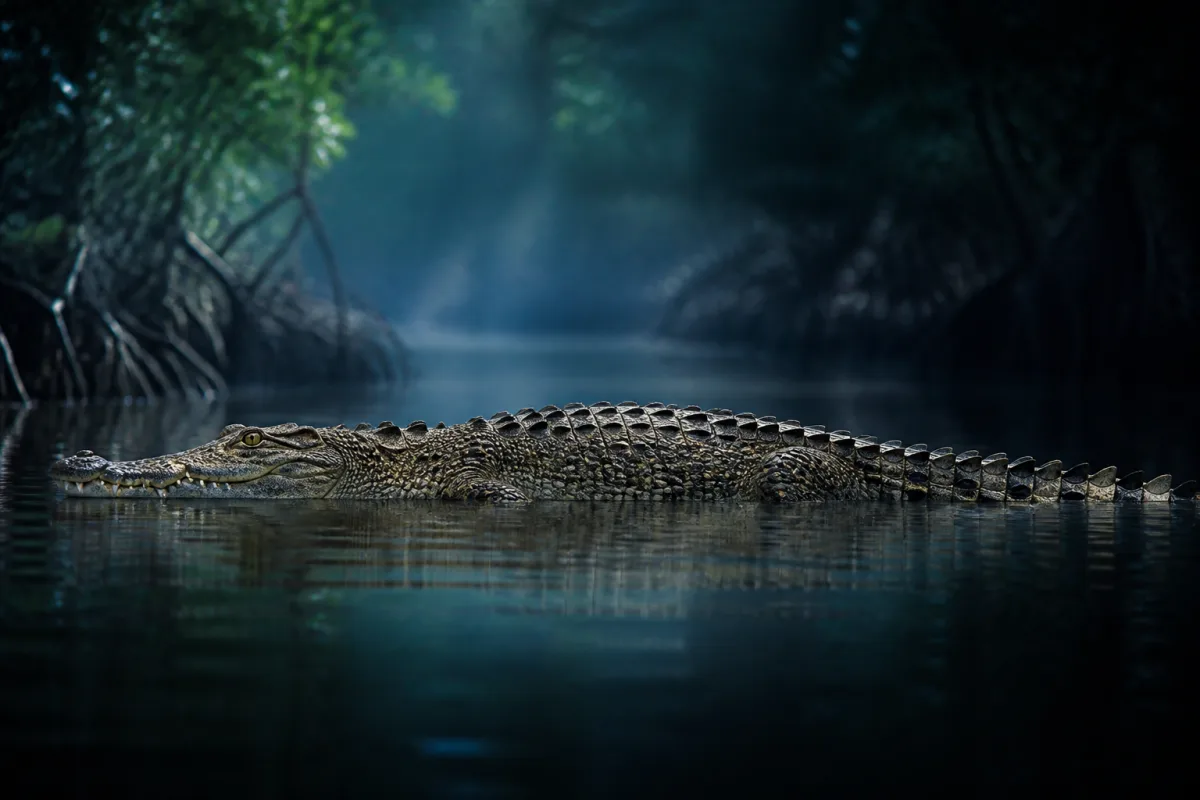
The crocodile is longer and narrower. Adult males usually measure 10 to 13 feet and a few hundred pounds, with females smaller, and individuals near 16 feet are documented from Central and South America. A raised bump in front of the eyes and irregular, widely spaced back scutes distinguish it from the American alligator, with which it shares part of its Florida range. Older accounts describing animals well past 20 feet rest on dried skins and eyewitness estimates rather than measurements.
Both hunt in water they largely cannot see through, and both have converged on non-visual detection. The shark closes the final stretch using the ampullae of Lorenzini, pores that register the weak electric fields produced by muscle and nerve activity. The crocodile relies on pressure receptors in the scales along its jaws, which pick up movement in water thick with mangrove sediment and marl. Two unrelated sensory systems solve the same problem in the same creeks.
The same channels, often the same hours
Bull sharks patrol channels, sandbars and river mouths where currents concentrate fish, and their feeding often peaks on falling tides, when prey is flushed out of marshes and mangroves. Bony fish make up most of the diet, with mullet, catfish and jacks prominent in stomach studies, along with rays and smaller sharks taken regularly. Their broad triangular upper teeth and short, heavily muscled jaws suit prey with tough skin or hard parts, and diet shifts completely between a river population and one feeding on offshore reefs.
The crocodile works the same tidal logic from a stationary position. It holds at a creek mouth or channel where a falling tide concentrates fish, then takes prey with a sideways sweep of the head, mostly after dark. Fish make up most of the adult diet, including mullet, tilapia and gar, alongside crabs, snails, wading birds, turtles and small mammals such as raccoons that forage along the shoreline. Smaller items are swallowed whole; larger ones are held and worked apart at the surface.
The overlap in prey is real but partial, and the two animals do interact. Crocodilians are recorded taking juvenile bull sharks in some estuaries, which is one of several reasons young sharks are vulnerable in their nursery years, though such events are seldom observed and their frequency is unknown. Adult bull sharks are rarely preyed upon by anything, and the larger risk to a young shark comes from bigger sharks, including adults of its own species.
Two kinds of nursery in the same water
Bull shark embryos are nourished through a yolk-sac placenta once the initial yolk supply is exhausted. Gestation lasts about 10 to 11 months and produces 1 to 13 pups, each roughly 2 feet long, born in estuaries and river mouths in late spring and summer. Females appear to reproduce every second year. The young then stay in low-salinity nurseries for several years, in water too brackish for most larger sharks to follow, which turns the species' chemical flexibility into a form of shelter.
The crocodile invests in a nest instead. Females lay 30 to 60 eggs in the spring dry season, either in a hole dug into sand, marl or shell or in a mound of vegetation where the substrate is poor, choosing whichever the ground allows. Incubation runs about 85 to 90 days and nest temperature determines the sex of the hatchlings. The female opens the nest when she hears the young calling and carries them to water. Nest flooding and predation take most clutches.
Both strategies stake everything on the same stretch of coast. A shark pup and a crocodile hatchling spend their most vulnerable years in mangrove creeks and brackish lagoons, which are also the parts of the shoreline most heavily altered by people. Dredging, damming, mangrove clearance and changes in freshwater flow affect both animals at once, and they do so at precisely the life stage when neither has any margin. Coastal runoff compounds the problem for the shark, exposing juveniles to contaminants during their slowest-growing years, while for the crocodile the risk is more direct: a nest built above the tide line that floods anyway.
Two trajectories under the same pressures
The bull shark was reassessed from Near Threatened to Vulnerable in 2020 as evidence of regional declines accumulated, and its trend is decreasing. It is fished for meat and fins across much of its range and caught incidentally in gillnets, longlines and trawls, while beach protection nets and drumlines remove a further share. The structural problem is that the species is exposed at every life stage, because its nurseries sit in the most heavily developed coastal waters. The requiem shark family was added to CITES Appendix II in 2022.
The American crocodile is also assessed as Vulnerable, but its trend is listed as increasing. The global category reflects an inferred decline of about 30 percent over three generations from historic hunting and habitat loss, while several monitored populations are now recovering. South Florida is the best-documented case: fewer than 300 crocodiles remained when the species was listed as endangered in the United States in 1975, and protection of nesting shoreline helped numbers reach an estimated 1,500 to 2,000 non-hatchlings, with the federal listing for that population reduced to threatened in 2007.
The difference in trajectory comes down to what can be protected. A crocodile's reproductive output depends on a countable number of nesting sites, and safeguarding them produces measurable results; the cooling canals at the Turkey Point power plant in Miami-Dade County became one of the three main nesting sites in the United States, with a record 33 nests in 2022. A bull shark's adults range along an entire coast and through fisheries no single protected shoreline reaches. Both species now depend on the same water management decisions, since crocodile nesting success and hatchling growth track the salinity of Florida Bay, which depends in turn on how much water moves through the Everglades.