Overview
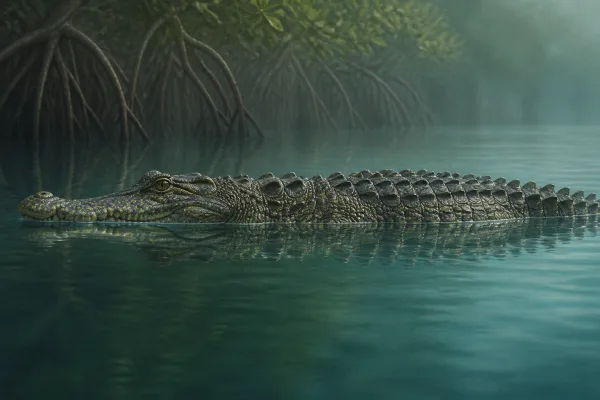
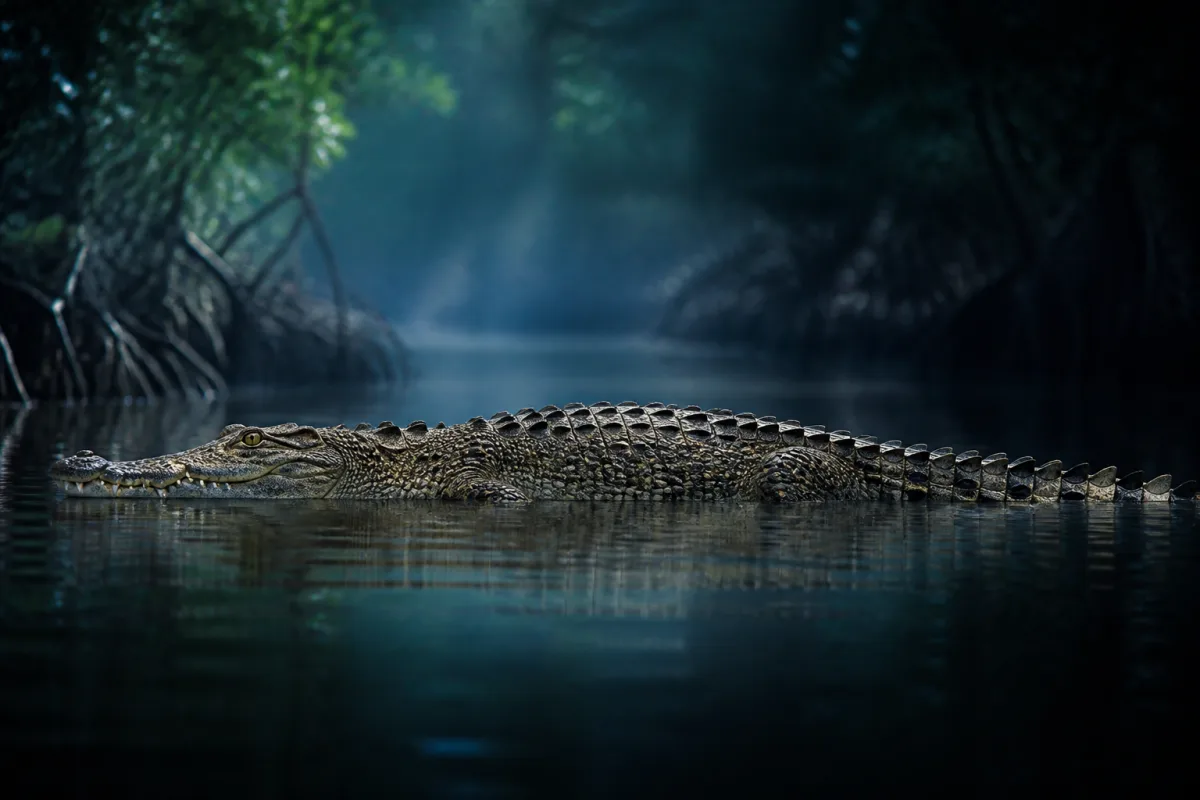
The American crocodile is a narrow-snouted crocodile of brackish and coastal water in the tropical Americas. Adult males usually measure 10 to 13 feet and a few hundred pounds, and females run smaller. Individuals near 16 feet are documented from Central and South America, and older accounts describe animals well past 20 feet, though those rest on dried skins and eyewitness estimates rather than measurements. A raised bump in front of the eyes and irregular, widely spaced back scutes separate it from the American alligator.
Like its Indo-Pacific relative, this species handles salt water using glands on the tongue that excrete concentrated sodium, and it occupies places freshwater crocodilians avoid: mangrove creeks, tidal flats, coastal lagoons saltier than the sea, and a few offshore atolls. Hatchlings are the constrained stage, since they lose water quickly and depend on pockets of lower salinity to grow. Nesting method follows the ground available, with females digging holes in sand or marl in some areas and building vegetation mounds in others.
South Florida holds the northern edge of the range and the best-monitored population. Fewer than 300 crocodiles remained when the species was listed as endangered in the United States in 1975, with 10 to 20 nests a year. Protection of nesting shoreline, together with cooling canals at the Turkey Point power plant that proved to be excellent nesting ground, helped numbers reach an estimated 1,500 to 2,000 non-hatchlings. The federal listing for that population was reduced to threatened in 2007.
Where it lives
Coastal Central and South America and the Greater Antilles: both coasts of Mexico, the Caribbean coast south to Venezuela, the Pacific coast to northern Peru, and Cuba, Jamaica and Hispaniola. The United States range is confined to the southern tip of Florida, chiefly Florida Bay, the Everglades coast, the Keys and northeastern Florida Bay.
Habitat
- Estuaries & river mouths
- Mangroves & lagoons
- Coastal waters
- Sandy flats & seagrass beds
What it eats
Fish make up most of the adult diet, including mullet, tilapia and gar, along with crabs, snails, wading birds, turtles and small mammals such as raccoons that forage along the shoreline. Juveniles feed on insects, shrimp and small fish. Diet is opportunistic and reflects whatever the local creek system produces rather than any narrow preference.
- Bony fish
- Crustaceans
- Seabirds
- Land mammals
- Sea turtles
How it hunts
Hunting is patient and close-range, done mostly after dark in shallow water. The crocodile holds position at a creek mouth or tidal channel where a falling tide concentrates fish, then takes prey with a sideways sweep of the head. Pressure receptors in the scales along the jaws register movement in water too turbid to see through, which suits an animal that spends its life in mangrove sediment and marl. Smaller prey is swallowed whole; larger items are held and worked apart at the surface.
Behavior
Social structure: Mostly solitary
Adults occupy overlapping home ranges but stay apart, and males become territorial in the breeding season. Females respond to calls from inside the nest and escort hatchlings to water, after which the group disperses within weeks. This species is generally less social than the American alligator, with which it shares parts of the Florida range.
Active period: Nighttime
Most movement and feeding takes place at night. Days are spent basking on banks and levees or resting in shaded water, which regulates body temperature at little energetic cost.
Reproduction
Eggs laid on land.
Females lay 30 to 60 eggs in the spring dry season, either in a hole dug into sand, marl or shell, or in a mound of vegetation where the substrate is poor. Incubation runs about 85 to 90 days, and nest temperature determines the sex of the hatchlings. The female opens the nest when she hears the young calling and carries them to water. Nest flooding and predation take most clutches.
Predators and ecological role
Adults are effectively free of predators. Eggs and hatchlings are taken by raccoons, crabs, herons, large fish and, in Florida, by American alligators, and larger crocodiles kill smaller ones, so mortality in the first year is very high.
The species is the top predator of mangrove and estuarine food webs across its range, and in Florida it doubles as an indicator of freshwater flow: nesting success and hatchling growth track salinity in Florida Bay, which in turn depends on how much water moves through the Everglades. Dens and dry-season pools dug by crocodiles also hold water that other animals use.
Conservation and threats
Vulnerable Assessed 2012 · population increasing
The global assessment inferred a decline of about 30 percent over three generations from historic hunting and habitat loss, while listing the current trend as increasing, since several monitored populations are recovering. The Florida population was reclassified from endangered to threatened under United States law in 2007; the remainder of the range stays listed as endangered, and CITES keeps most populations on Appendix I.
Clearing of mangrove shoreline for development, aquaculture and tourism removes nesting habitat throughout the range, and altered freshwater flow changes the salinity that hatchlings depend on. Illegal killing for skins and meat persists in parts of Latin America. In South Florida, where both crocodile and human numbers have grown, management centers on relocating animals that settle in canals and marinas, and on giving residents accurate information about how to live alongside them.
Main pressures
- Habitat loss
- Coastal development
- Illegal trade
- Hunting & persecution
- Human disturbance
Notable details
- The cooling canals at the Turkey Point power plant in Miami-Dade County became one of the three main American crocodile nesting sites in the United States, with a record 33 nests in 2022.
- Annual nesting in Florida rose from 10 to 20 nests in the mid-1970s to more than 100, and the federal listing for that population was reduced from endangered to threatened in 2007.
- Salt glands on the tongue allow the species to live in coastal lagoons that are saltier than seawater, including hypersaline lakes in Hispaniola.
- A female may dig a hole nest in sand or marl, or build a mound of vegetation, choosing whichever the ground at her chosen site allows.
Sources
-
The IUCN Red List of Threatened Species
International Union for Conservation of Nature
Global conservation assessments, population trends and threat classifications for every species profiled here.
-
U.S. Fish & Wildlife Service
USFWS
Listing decisions and recovery planning for protected marine and coastal species.
-
Animal Diversity Web
University of Michigan Museum of Zoology
Referenced accounts of anatomy, reproduction, behavior and life history.
-
Convention on International Trade in Endangered Species of Wild Fauna and Flora
CITES Secretariat
Appendix listings governing international trade in the species profiled here.
-
Smithsonian Ocean
Smithsonian National Museum of Natural History
Peer-reviewed public science writing on marine life, ecosystems and ocean change.
Figures on this page were last checked against these sources on .