Overview
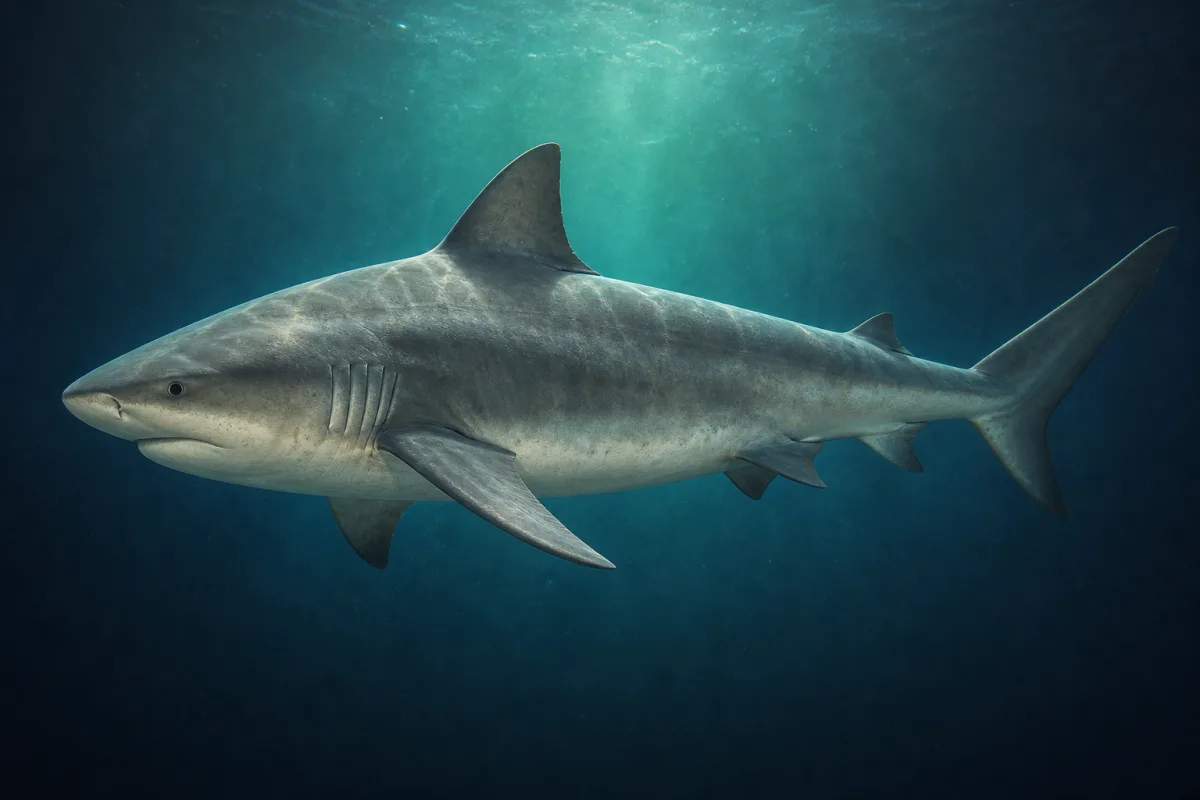
The bull shark is a stocky, blunt-nosed requiem shark of shallow, often murky coastal water. Its proportions set it apart from its slimmer relatives: a deep body, a short broad snout, small eyes and a tall triangular first dorsal fin. Females grow larger than males and commonly reach 7 to 9 feet, with the largest well-documented individuals close to 11 feet. Reports approaching 13 feet exist in older records but are not well supported.
What makes the species unusual is its tolerance of fresh water. Most sharks cannot regulate their internal chemistry outside the sea, but bull sharks adjust the work of their kidneys and rectal gland to shed salt or retain urea as conditions change. That flexibility lets them move up rivers and into lakes. Individuals have been recorded far up the Amazon, in Lake Nicaragua, and in the Mississippi River as far north as Illinois, though such records are rare rather than routine.
Bull sharks are usually found in less than 100 feet of water, in bays, estuaries, river mouths and along surf beaches. Visibility in these places is often poor, so the species depends heavily on smell, hearing and its electrical sense rather than on sight. The same shallow, low-salinity habitats serve as nurseries: pups are born in estuaries and remain there for several years, in water too brackish for most larger sharks to follow.
Where it lives
Warm coastal waters worldwide, including the Gulf of Mexico, the U.S. Atlantic coast north to about the Carolinas in summer, the Caribbean, Brazil, West Africa, southern and eastern Africa, the Arabian Gulf, India, Southeast Asia and northern Australia. Its range extends inland along large rivers and connected lake systems.
Habitat
- Coastal waters
- Estuaries & river mouths
- Mangroves & lagoons
- Continental shelf
- Coral reefs
What it eats
Bony fish make up most of the diet, with mullet, catfish, jacks and other estuarine species prominent in stomach studies. Rays and smaller sharks, including young bull sharks, are taken regularly. Crabs, sea turtles, seabirds and carrion appear less often. Diet shifts with location, and animals feeding in rivers rely on a completely different set of prey from those on offshore reefs.
- Bony fish
- Sharks & rays
- Sea turtles
- Crustaceans
- Carrion & whale falls
How it hunts
Turbid water shapes the way bull sharks find food. They patrol channels, sandbars and river mouths where currents concentrate fish, closing the last stretch using the ampullae of Lorenzini, which detect the weak electric fields of muscle and nerve activity. Feeding often peaks on falling tides, when prey is flushed out of marshes and mangroves. Their broad triangular upper teeth and short, heavily muscled jaws suit prey with tough skin or hard parts.
Behavior
Social structure: Mostly solitary
Adults are typically alone, though several may work the same channel or river bend when prey is abundant. Juveniles share estuarine nurseries in loose numbers without forming coordinated groups, and larger individuals tend to displace smaller ones at concentrated food.
Active period: Day & night
Active by day and night, with more feeding recorded around dusk and after dark, and with tidal cycles often a stronger influence on movement than daylight.
Reproduction
Live birth, placental young.
Embryos are nourished through a yolk-sac placenta after the initial yolk supply is used up. Gestation lasts about 10 to 11 months and produces 1 to 13 pups, each roughly 2 feet long, born in estuaries and river mouths in late spring and summer. Females appear to reproduce every second year, and young sharks stay in low-salinity nurseries for several years before moving to the coast.
Predators and ecological role
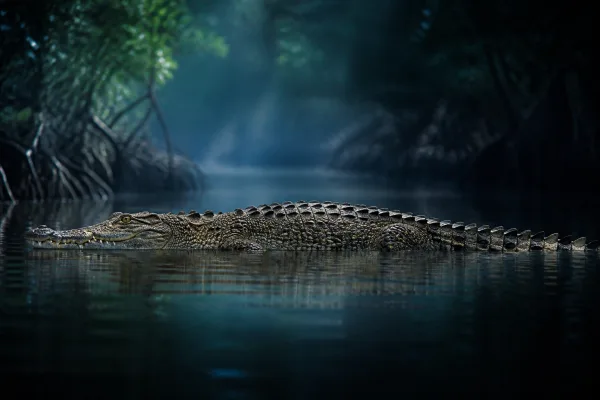
Adults are rarely preyed upon; larger sharks and, in some estuaries, crocodilians can take juveniles. Predation by other bull sharks on smaller ones is documented, which is one reason pups remain in fresh and brackish water.
Bull sharks link two systems that most large predators keep separate. By feeding in rivers and estuaries as well as on the coast, they move energy and nutrients between them. In shallow bays they are often the largest predator present, and their removal has been followed in some regions by increases in rays and mid-sized fish.
Conservation and threats
Vulnerable Assessed 2020 · population decreasing
Reassessed from Near Threatened to Vulnerable as evidence of regional declines accumulated. The species is exposed at every life stage because its nurseries sit in the most heavily developed coastal waters. The requiem shark family was added to CITES Appendix II in 2022, effective in late 2023.
Bull sharks are fished for meat and fins across much of their range and caught incidentally in gillnets, longlines and trawls. Because pups depend on estuaries, dredging, damming, mangrove clearance and freshwater diversion remove nursery habitat directly. Beach protection nets and drumlines take additional animals, and coastal runoff exposes juveniles to contaminants during their slowest-growing years.
Main pressures
- Targeted fishing
- Bycatch in other fisheries
- Habitat loss
- Coastal development
- Chemical pollution
Notable details
- A bull shark was recorded in the Mississippi River near Alton, Illinois, in 1937, roughly 1,700 miles from the Gulf of Mexico.
- The sharks in Lake Nicaragua were long thought to be a landlocked species of their own; tagging showed they are ordinary bull sharks that travel up the San Juan River, working through its rapids in stages.
- Rather than being sealed off from fresh water like most sharks, bull sharks adjust urea retention and rectal gland output, which lets them cross the salinity gradient of an estuary in a single tide.
- Chemical signatures laid down in the vertebrae record the salinity a shark lived in, so researchers can reconstruct whether an individual grew up in a river, an estuary or the open coast.
Sources
-
The IUCN Red List of Threatened Species
International Union for Conservation of Nature
Global conservation assessments, population trends and threat classifications for every species profiled here.
-
Species Directory
NOAA Fisheries
Management-grade biology, distribution and stock information for species in United States waters.
-
Florida Program for Shark Research
Florida Museum of Natural History
Shark biology, size records and documented interaction data.
-
FishBase
FishBase Consortium
Compiled length, weight, growth and depth records for fish species, drawn from the primary literature.
-
Smithsonian Ocean
Smithsonian National Museum of Natural History
Peer-reviewed public science writing on marine life, ecosystems and ocean change.
Figures on this page were last checked against these sources on .