
What the numbers mean
The leatherback sea turtle and the emperor penguin belong to different classes of vertebrate, breed at opposite ends of the planet, and eat almost nothing in common. They nonetheless solved two of the same problems. Both dive deeper than any other member of their group, and both hold their bodies substantially warmer than the water around them. Neither inherited those abilities from the other, which is precisely what makes the pairing worth examining.
The methods differ completely. The turtle relies on being enormous, insulated and almost constantly in motion, an arrangement biologists call gigantothermy. The penguin is a bird and generates heat metabolically as birds do, insulated by dense feathers and fat and, through the Antarctic winter, by thousands of other penguins. Both animals also breed on the one substrate in their environment that is changing fastest: tropical sand in one case, Antarctic fast ice in the other.
Two ways to stay warm in cold water
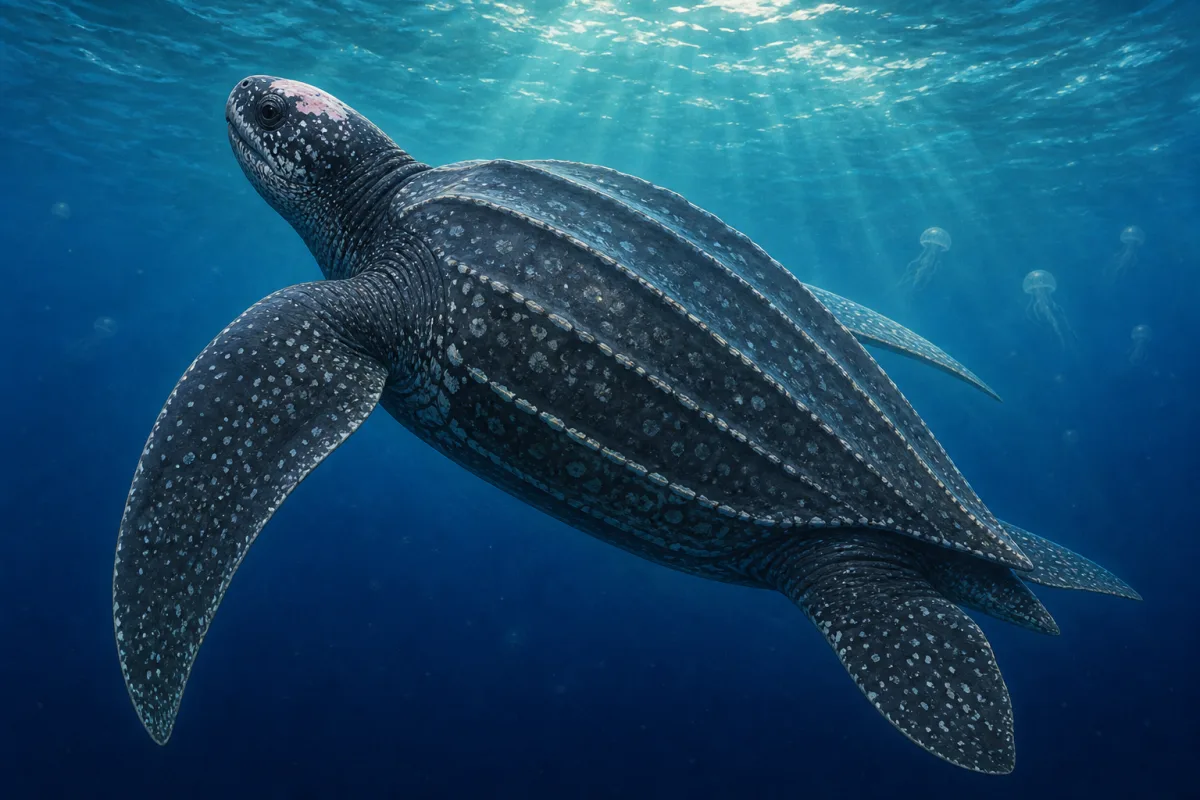
For the leatherback, size itself is the thermal strategy. A large body loses heat slowly, and combined with an insulating fat layer, counter-current heat exchangers in the flippers and near-constant swimming, it lets the turtle hold a core temperature roughly 32 degrees Fahrenheit above the surrounding sea. Nesting females typically measure 4.5 to 6 feet along the curve of the carapace and weigh 660 to 1,100 pounds. That mass is the reason a tropical-nesting reptile can forage off Newfoundland, Norway and New Zealand.
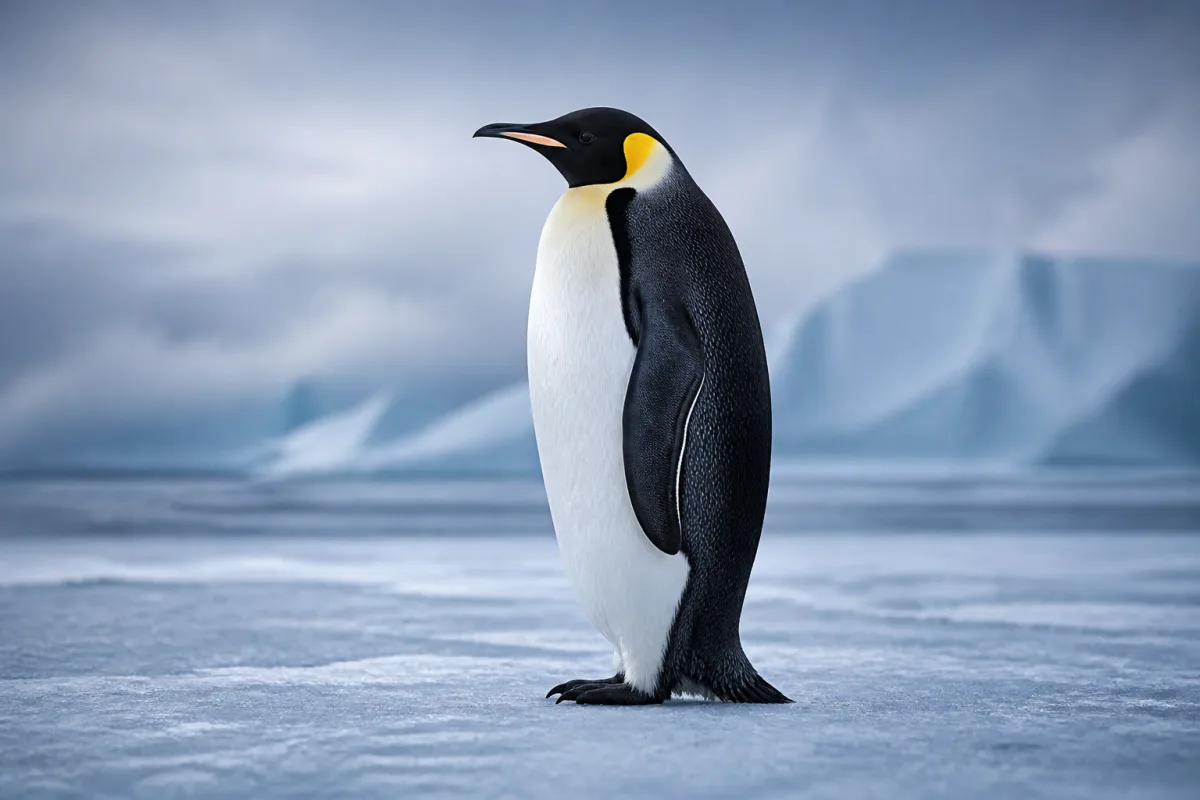
The penguin generates its warmth rather than conserving it, and at 50 to 90 pounds it is far too small to rely on bulk. Dense plumage and a fat layer do most of the insulating work, and during the winter incubation the birds add a social solution: males form dense huddles in which individuals shuffle steadily through the group, so each takes a turn on the cold windward edge before working back into the warm interior. Temperatures inside a huddle run far above the surrounding air.
The two arrangements have different failure modes. The turtle's warmth is a byproduct of being large and moving, so it cannot be increased on demand, and it comes with the constraint that a leatherback must keep growing to enormous size before the strategy works at all. The penguin's warmth has to be paid for continuously in food, which is why body mass swings so enormously across the breeding cycle, with males arriving near 90 pounds and leaving the incubation fast at close to half that.
Record dives in two separate lineages
The emperor penguin is the most accomplished diver of any bird by a wide margin. Tracked individuals have reached about 1,850 feet and stayed submerged for nearly half an hour, and no other bird approaches either figure. The performance rests on dense bones that reduce buoyancy, a sharply slowed heart rate, large oxygen stores bound to myoglobin in the swimming muscles, and a tolerance for blood oxygen levels that would incapacitate most mammals. Typical foraging dives are far more modest, reaching a few hundred feet and lasting five or six minutes.
The leatherback holds the equivalent record among reptiles. Most foraging dives stay above about 820 feet, but the deepest recorded dive, near 4,200 feet, is the greatest confirmed for any reptile and comes from a small number of tracked animals. The turtle has an advantage the penguin does not: a much larger body and a lower metabolic rate, so its oxygen store lasts considerably longer relative to demand, even though both animals are breathing air at the surface before they descend.
Their dive profiles converge in an unexpected way. Both animals go deepest in daylight and shallowest at night, because both are following prey that migrates vertically with the light. Leatherback dives track gelatinous prey down by day and back toward the surface after dark. Penguin dive depth tracks light levels closely enough that birds go deepest around the middle of the day. Two unrelated air-breathers ended up on the same daily schedule because the animals they eat are on it.
Low-value food in bulk, or high-value food at a distance
The leatherback's diet is the strangest thing about it. An animal that can weigh half a ton lives almost entirely on jellyfish, salps, pyrosomes and other gelatinous drifters, prey that is more than 95 percent water and yields very little energy per bite. It compensates with volume: a study using animal-borne cameras off Nova Scotia estimated intake at several hundred pounds of jellyfish a day during good foraging conditions. Backward-pointing keratin spines line the throat and esophagus, holding slippery prey in place while seawater is forced back out through the mouth.
The penguin eats at the opposite end of the energy scale. Antarctic silverfish are the staple across much of the range, supplemented by other notothenioid fish, small squid and krill, all of it far richer per mouthful than a jellyfish. Emperors hunt by pursuit, chasing individual prey through clear water and relying on eyesight rather than sound, frequently approaching from below so prey is silhouetted against the brighter surface or the pale underside of the ice. Prey is swallowed whole underwater.
The constraint each faces is different in kind. The turtle's problem is throughput, since it must process an enormous volume of low-value material to stay in positive energy balance, and body mass falls steadily across a nesting season when it is not feeding. The penguin's problem is distance. Foraging trips start at cracks and polynyas that may be many miles from the colony, and an incubating male goes about 65 days without eating anything at all.
One egg on the feet, eighty in the sand
The leatherback invests in numbers and walks away. Females return to tropical beaches every two to four years and lay several clutches in a season, spaced roughly nine or ten days apart, each holding about 80 fertile eggs plus a number of smaller yolkless ones whose function is still debated. Incubation runs 60 to 65 days, and sand temperature during the middle third determines the sex of the hatchlings, with warmer nests producing females. Nesting is almost entirely nocturnal, and there is no care after the eggs are covered.
The penguin invests everything in one. A single egg is laid in May or June onto the female's feet and passed to the male, who balances it on his own feet beneath a fold of skin called the brood pouch so it never touches the ice. He incubates for about 65 days without feeding while the female returns to the sea. Chicks hatch in midwinter, are brooded on the feet for several weeks, then gather in creches and fledge in December or January as the fast ice breaks up.
The mortality curves that result look nothing alike. A leatherback hatchling faces its most dangerous hours immediately: ghost crabs, monitor lizards, dogs, raccoons, coatis and vultures take eggs and hatchlings on the beach, and reef fish and frigatebirds take them in the surf. A penguin chick is guarded for months but represents a whole season's reproductive output, so losing it costs the pair a year. Both strategies work, and both depend absolutely on the physical condition of a substrate.
Both listed for the ground they breed on
The leatherback is assessed as Vulnerable globally, a category that conceals a wide regional split. The East Pacific and West Pacific subpopulations are assessed separately as Critically Endangered after nesting declines of more than 90 percent, while the far larger Northwest Atlantic subpopulation was assessed at a much lower category. The species is listed as endangered throughout its range under the United States Endangered Species Act, with critical habitat designated off the U.S. West Coast and at Sandy Point in the U.S. Virgin Islands.
The emperor penguin was uplisted from Least Concern to Near Threatened in 2020, not because current numbers are small but because projected losses of fast ice threaten breeding habitat across the range; the global population is on the order of a quarter of a million breeding pairs. The U.S. Fish and Wildlife Service listed the species as threatened under the Endangered Species Act in 2022, citing sea ice loss as the primary risk. Total breeding failures have been recorded at Halley Bay in the Weddell Sea and at several colonies in the Bellingshausen Sea.
The two listings rest on the same logic. In both cases the animal itself is still reasonably numerous and the problem is the substrate. Emperor colonies need fast ice that holds from roughly April until December, and chicks that enter the water before growing waterproof plumage do not survive. Leatherback nests need sand within a temperature range that determines the sex of the hatchlings, on beaches that are not eroding, and warming sand skews sex ratios while rising seas remove the beaches outright.
Their other threats are more conventional and more immediate. Incidental capture in longline, gillnet and trawl fisheries is the largest source of adult leatherback mortality, entanglement in the vertical buoy lines of pot and trap gear kills turtles along the U.S. East Coast, and floating plastic bags and sheeting closely resemble jellyfish, with ingested plastic found in a substantial share of examined animals. For the penguin, warming shifts the distribution of silverfish and krill, and the expanding krill fishery overlaps with foraging areas near some colonies.