Overview
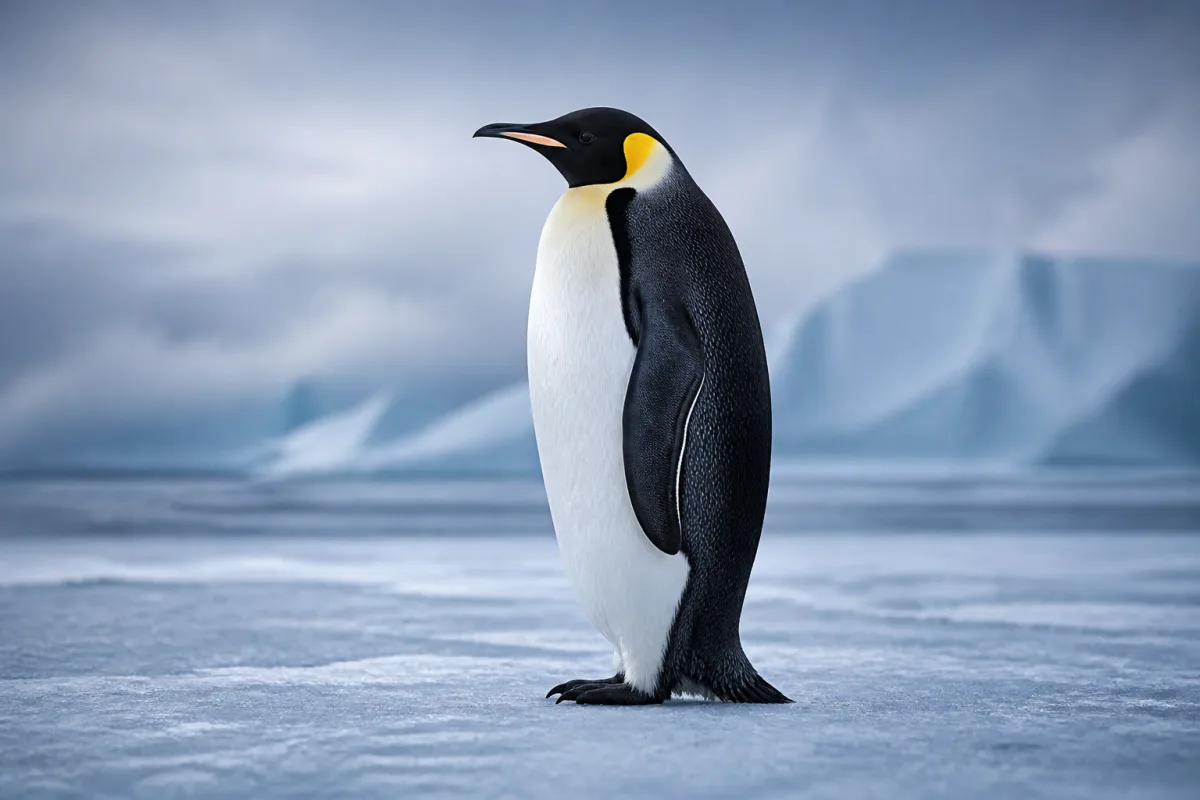
The emperor penguin is the largest penguin alive, standing close to four feet tall and weighing 50 to 90 pounds at the start of the breeding season. It is also the only bird that breeds through the Antarctic winter, and it does so on fast ice, the frozen sheet welded to the edge of the continent. Most emperors never set foot on land. Their entire life cycle, from courtship to the fledging of chicks, plays out on floating ice and in the water beneath it.
Underwater, the emperor is the most accomplished diver of any bird. Tracked individuals have reached about 1,850 feet and stayed submerged for nearly half an hour, figures no other bird approaches. The performance rests on dense bones that reduce buoyancy, a sharply slowed heart rate, large oxygen stores bound to myoglobin in the swimming muscles, and a tolerance for blood oxygen levels that would incapacitate most mammals. Typical foraging dives are far more modest, reaching a few hundred feet and lasting five or six minutes.
Because the colonies sit on sea ice that must hold from roughly April until December, the species is unusually exposed to changes in the timing of freeze and breakup. When fast ice fails early, chicks that have not yet grown waterproof feathers are lost, and complete breeding failures have been documented at several colonies. That evidence underlies the move to Near Threatened on the Red List and the 2022 decision by the U.S. Fish and Wildlife Service to list the species as threatened under the Endangered Species Act.
Where it lives
Circumpolar around Antarctica. Satellite surveys have identified more than sixty breeding colonies, nearly all of them on fast ice attached to the coastline or anchored behind grounded icebergs, with only a handful on rock. Outside the breeding season birds disperse widely through the pack ice zone and the open Southern Ocean, and occasional vagrants reach South Georgia, the Falkland Islands, New Zealand and southern South America.
Habitat
- Sea ice & polar shelves
- Coastal waters
- Continental shelf
- Open ocean
What it eats
Antarctic silverfish are the staple across much of the range, supplemented by other notothenioid fish, small squid and Antarctic krill. Proportions shift with location and season: colonies beside productive shelf water take mostly fish, while krill and squid make up a larger share in some regions and at particular points in the year.
- Bony fish
- Squid & octopus
- Zooplankton & krill
How it hunts
Emperors hunt by pursuit, chasing individual prey through clear water and relying on eyesight rather than sound. Their eyes work well in dim light, and birds frequently approach from below so that prey is silhouetted against the brighter surface or the pale underside of the ice. Foraging trips start at cracks and polynyas, sometimes many miles from the colony, and consist of long series of dives separated by short recoveries at the surface. Prey is swallowed whole underwater.
Behavior
Social structure: Breeding colonies
Colonies hold from a few hundred to more than twenty thousand pairs. Through the winter incubation the males form dense huddles in which birds shuffle steadily through the group, so each takes a turn on the cold windward edge before working back into the warm interior. The behavior is a shared thermoregulatory strategy, and temperatures inside a huddle run far above the surrounding air.
Active period: Daytime
Foraging is concentrated in daylight, and dive depth tracks light levels closely enough that birds go deepest around the middle of the day. During the winter, when the sun does not rise, incubating males are largely inactive and conserve energy in the huddle.
Reproduction
Eggs laid on land.
A single egg is laid in May or June onto the female's feet and passed to the male, who balances it on his own feet beneath a fold of skin called the brood pouch, so it never touches the ice. He incubates for about 65 days without feeding while the female returns to the sea. Chicks hatch in midwinter, are brooded on the feet for several weeks, then gather in creches and fledge in December or January as the fast ice breaks up.
Predators and ecological role
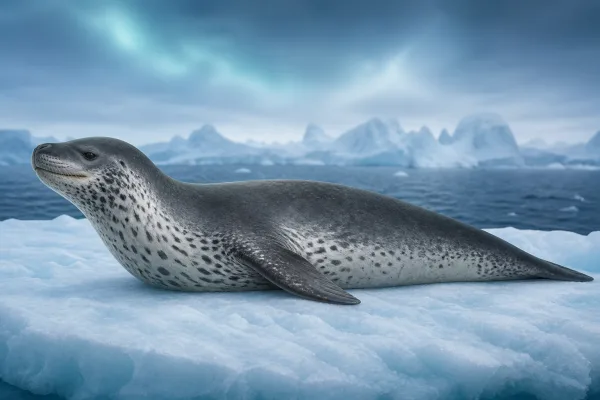
At sea, leopard seals and orcas take adults, and leopard seals often patrol the ice edge where birds enter and leave the water. On the ice, southern giant petrels and south polar skuas take eggs and chicks, and giant petrels account for a large share of chick mortality at some colonies. Adults standing on the ice are otherwise safe, because Antarctica has no land predators.
Emperors sit in the middle to upper part of the Antarctic shelf food web, converting silverfish, krill and squid into the energy that supports leopard seals and, through guano, into nutrients that fertilize the ice-edge community. Their need for fast ice of a particular thickness and duration also makes colony counts a practical indicator of ice conditions along much of the Antarctic coast.
Conservation and threats
Near Threatened Assessed 2020 · population decreasing
Uplisted from Least Concern to Near Threatened because projected losses of fast ice threaten breeding habitat across the range, rather than because current numbers are small; the global population is on the order of a quarter of a million breeding pairs. The U.S. Fish and Wildlife Service listed the species as threatened under the Endangered Species Act in 2022, citing sea ice loss as the primary risk.
Early breakup of fast ice is the central concern, because chicks that enter the water before growing waterproof plumage do not survive; total breeding failures have been recorded at Halley Bay in the Weddell Sea and at several colonies in the Bellingshausen Sea. Warming also shifts the distribution of Antarctic silverfish and krill, and the expanding krill fishery overlaps with foraging areas near some colonies. Aircraft, vessels and station traffic add disturbance at the most accessible sites.
Main pressures
- Sea ice loss
- Climate change
- Ocean warming
- Depletion of prey
- Human disturbance
Notable details
- Emperor penguins hold the diving records for birds, reaching about 1,850 feet and staying submerged for close to 28 minutes.
- Males incubate a single egg on their feet for roughly two months of winter darkness without eating, losing a large share of their body mass before the female returns.
- Most known colonies were located from orbit, because penguin guano stains the sea ice a rust-brown color that is visible in satellite images.
- During the longest dives, blood oxygen falls to levels that would cause most mammals to lose consciousness, and the birds draw on oxygen stored in their muscles.
Sources
-
British Antarctic Survey
Natural Environment Research Council
Antarctic field research on seals, penguins and Southern Ocean food webs.
-
BirdLife International Data Zone
BirdLife International
Population estimates and Red List documentation for seabirds.
-
The IUCN Red List of Threatened Species
International Union for Conservation of Nature
Global conservation assessments, population trends and threat classifications for every species profiled here.
-
U.S. Fish & Wildlife Service
USFWS
Listing decisions and recovery planning for protected marine and coastal species.
-
Animal Diversity Web
University of Michigan Museum of Zoology
Referenced accounts of anatomy, reproduction, behavior and life history.
Figures on this page were last checked against these sources on .