Overview
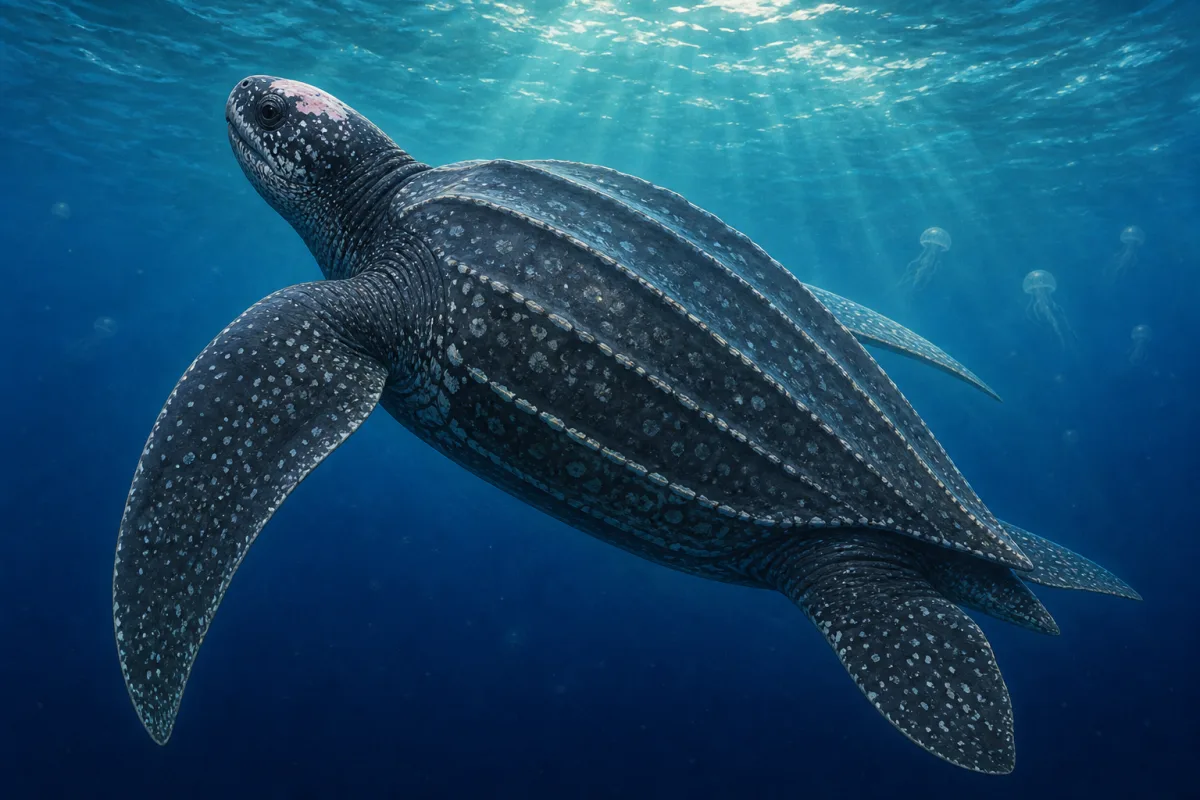
The leatherback is the largest turtle alive and the only sea turtle without a hard shell. In place of bony plates it carries a mosaic of small osteoderms set in thick, oil-saturated skin, ridged lengthwise into seven low keels that run from neck to tail. Nesting females typically measure 4.5 to 6 feet along the curve of the carapace and weigh 660 to 1,100 pounds. The largest documented individual, stranded on a Welsh beach in 1988, was considerably larger than any regularly measured animal.
Its diet is the strangest thing about it. An animal that can weigh half a ton lives almost entirely on jellyfish, salps and other gelatinous drifters, prey that is more than 95 percent water and yields very little energy per bite. The turtle compensates with volume, and feeding studies off Nova Scotia estimated daily intake at a large fraction of its own body mass. Backward-facing spines lining the throat and esophagus keep slippery prey from washing back out as seawater is expelled.
Size itself is a thermal strategy. A large body loses heat slowly, and combined with an insulating fat layer, counter-current heat exchangers in the flippers and near-constant swimming, it lets the leatherback hold a core temperature well above the surrounding water. Biologists call the arrangement gigantothermy. It is the reason a tropical-nesting reptile can forage off Newfoundland, Norway and New Zealand, dive deeper than any other reptile, and cross entire ocean basins between the beaches where it hatched and the cold seas where it feeds.
Where it lives
The most widely distributed reptile on Earth. Leatherbacks nest on tropical and subtropical beaches in the Atlantic, Pacific and Indian Oceans, including Florida, Puerto Rico, the U.S. Virgin Islands, Trinidad, Costa Rica, Gabon, Indonesia and Papua. Foraging adults range far into cold water and have been recorded off Newfoundland, Iceland, Norway, the Gulf of Alaska, Chile and New Zealand.
Habitat
- Open ocean
- Coastal waters
- Continental shelf
- Deep sea
What it eats
Almost exclusively gelatinous zooplankton: scyphozoan jellyfish such as lion's mane and moon jellies, along with salps, pyrosomes and siphonophores. Because this prey is mostly water, an adult must process an enormous volume to stay in positive energy balance. A study using animal-borne cameras off Nova Scotia estimated intake at several hundred pounds of jellyfish a day during good foraging conditions.
- Jellyfish & salps
How it hunts
Leatherbacks hunt visually in the upper water column, concentrating along thermal fronts and eddies where gelatinous prey collects. They follow that prey downward as it descends by day and back toward the surface at night, which is why dive profiles change so predictably with the light. The jaws close with sharp cusps that grip rather than cut, and backward-pointing keratin papillae line the throat and esophagus, holding prey in place while water is forced back out through the mouth.
Behavior
Social structure: Mostly solitary
Adults live alone at sea and form no lasting associations. The closest thing to social behavior is aggregation: many females may come ashore along the same stretch of beach within a few nights, and males gather in coastal water near nesting beaches during the breeding season.
Active period: Day & night
Diving continues around the clock. Daytime dives tend to be deeper and follow prey into the twilight zone, while nighttime foraging happens nearer the surface. Nesting, by contrast, is almost entirely nocturnal.
Reproduction
Eggs laid on land.
Females return to tropical beaches every two to four years and lay several clutches in a season, spaced roughly nine or ten days apart. A clutch holds about 80 fertile eggs plus a number of smaller yolkless ones whose function is still debated. Incubation runs 60 to 65 days, and sand temperature during the middle third determines the sex of the hatchlings, with warmer nests producing females.
Predators and ecological role
Adults are large enough that few predators trouble them, though orcas and large sharks occasionally take them. The dangerous stage is the first hours of life: ghost crabs, monitor lizards, dogs, raccoons, coatis and vultures take eggs and hatchlings on the beach, and reef fish and frigatebirds take them in the surf and just beyond it.
By consuming enormous quantities of gelatinous zooplankton, leatherbacks are among the few predators capable of exerting real pressure on jellyfish populations, and their decline is one hypothesis offered for regional increases in jellyfish abundance. Nesting also moves nutrients from the open ocean onto land, where unhatched eggs and shell fragments fertilize beach and dune vegetation.
Conservation and threats
Vulnerable Assessed 2013 · population decreasing
The global category conceals a wide regional split. The East Pacific and West Pacific subpopulations are assessed separately as Critically Endangered following nesting declines of more than 90 percent, while the far larger Northwest Atlantic subpopulation was assessed at a much lower category. The species is listed as endangered throughout its range under the United States Endangered Species Act, with critical habitat designated off the U.S. West Coast and at Sandy Point in the U.S. Virgin Islands.
Incidental capture in longline, gillnet and trawl fisheries is the largest source of adult mortality, and entanglement in the vertical buoy lines of pot and trap gear kills turtles along the U.S. East Coast. Floating plastic bags and sheeting closely resemble jellyfish, and ingested plastic has been found in a substantial share of examined leatherbacks. On land, egg collection, beach armoring, vehicle traffic and artificial lighting reduce hatchling output, while warming sand skews sex ratios and rising seas erode nesting beaches.
Main pressures
- Bycatch in other fisheries
- Entanglement in gear
- Plastic debris
- Egg & nest harvest
- Coastal development
- Climate change
Notable details
- The leatherback is the only sea turtle without a bony shell; its back is a mosaic of small bones set in leathery, oil-filled skin and ridged into seven lengthwise keels.
- Backward-pointing spines made of keratin line the throat and esophagus, holding soft prey in place while seawater is pushed back out through the mouth.
- Core body temperature can run roughly 32 degrees Fahrenheit above the surrounding sea, an ability called gigantothermy that allows a tropical reptile to feed in subarctic water.
- One female tracked by satellite traveled 12,774 miles from Indonesia to the U.S. West Coast over 647 days, among the longest migrations recorded for any vertebrate.
Sources
-
Species Directory
NOAA Fisheries
Management-grade biology, distribution and stock information for species in United States waters.
-
U.S. Fish & Wildlife Service
USFWS
Listing decisions and recovery planning for protected marine and coastal species.
-
The IUCN Red List of Threatened Species
International Union for Conservation of Nature
Global conservation assessments, population trends and threat classifications for every species profiled here.
-
Smithsonian Ocean
Smithsonian National Museum of Natural History
Peer-reviewed public science writing on marine life, ecosystems and ocean change.
-
Animal Diversity Web
University of Michigan Museum of Zoology
Referenced accounts of anatomy, reproduction, behavior and life history.
Figures on this page were last checked against these sources on .