
What the numbers mean
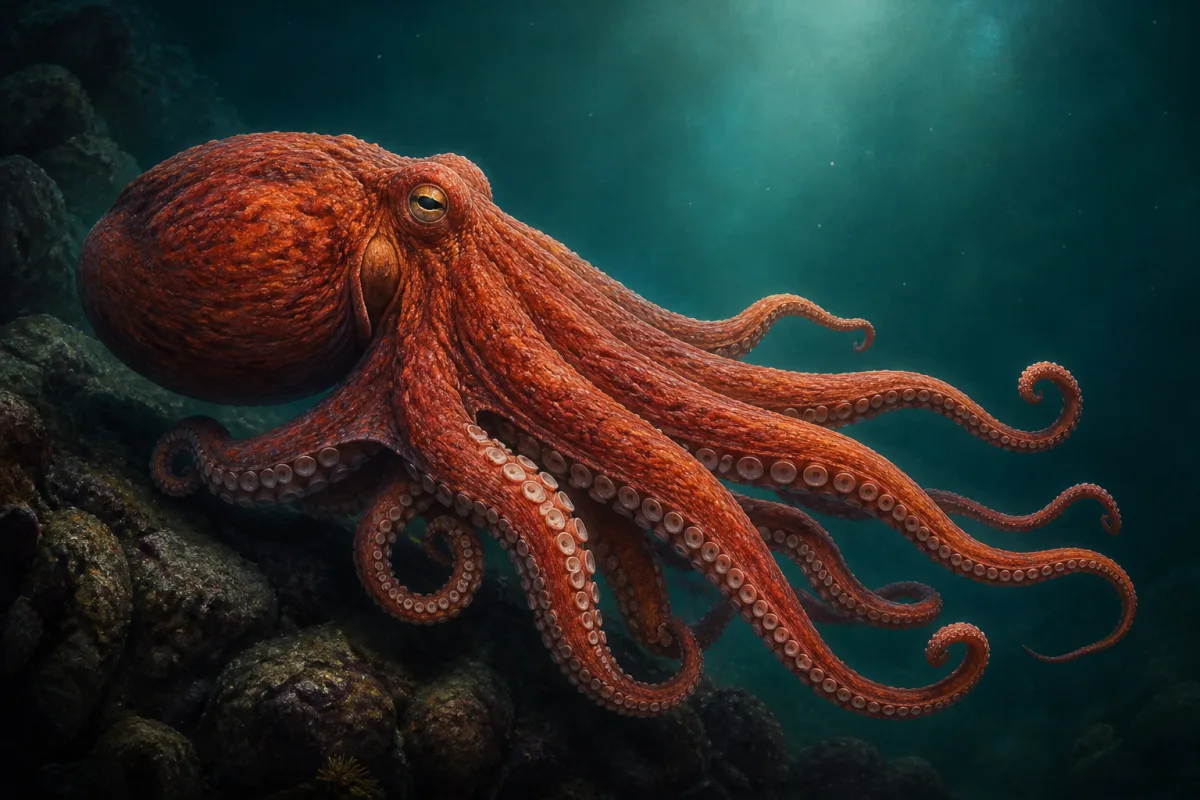
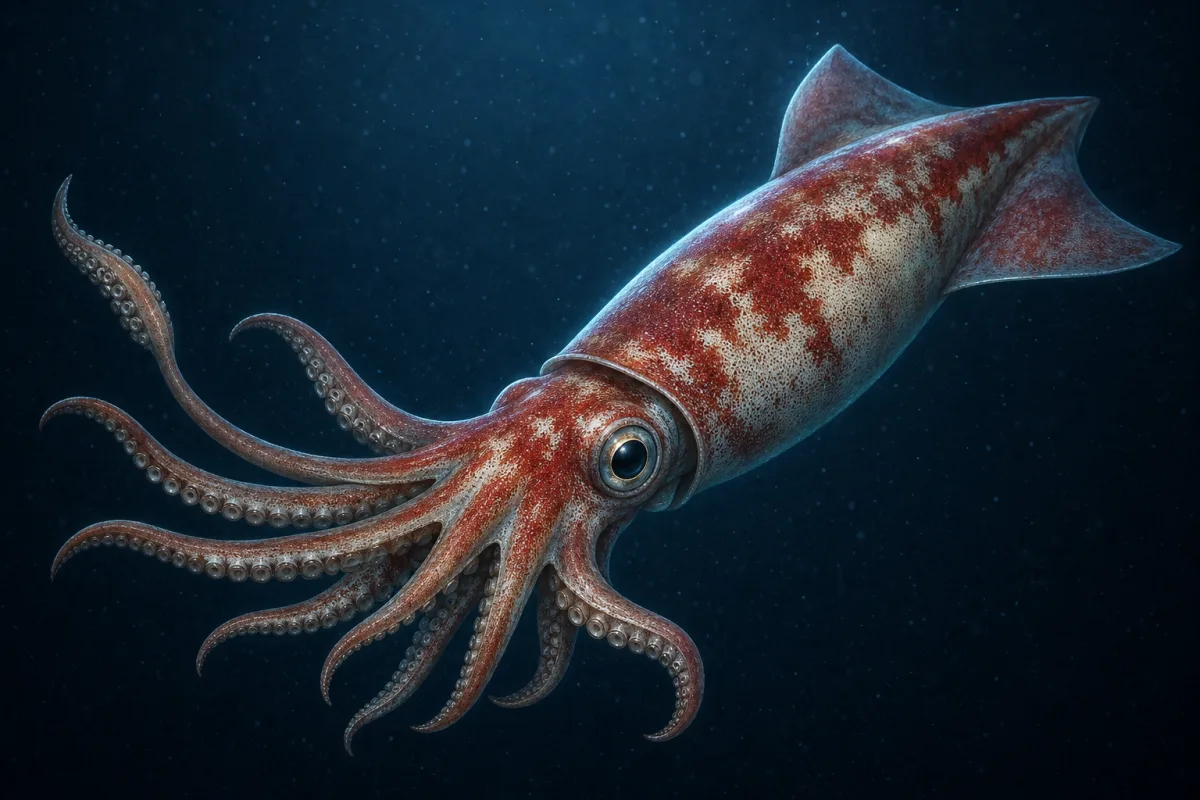
The giant Pacific octopus and the Humboldt squid are the two largest cephalopods most people along the Pacific coast of North America are likely to hear about, and they live almost completely different lives. One is a solitary animal of cold rocky bottoms that hunts by touch and spends its final months guarding eggs in a den. The other is a fast-growing open-ocean hunter that gathers in groups of a thousand, crosses steep oxygen gradients daily, and supports the largest invertebrate fishery on Earth.
What they share is a schedule. Both grow with extraordinary speed, both spawn once and then die, and both complete an entire life in a handful of years or less. That timetable shapes everything else about them, including how difficult they are to count, and it is the reason a single poor year in the ocean can remove most of a generation before anyone has registered that anything changed.
Measuring animals with no fixed shape
Both species come with measurement problems, and they are not the same problem. The giant Pacific octopus is usually reported by arm span, which stretches with handling: adults commonly span 10 to 15 feet and weigh 20 to 110 pounds, while the mantle stays under about 2 feet. The heaviest carefully weighed individual, measured by researchers in British Columbia, reached 156 pounds. Older accounts of 600-pound animals with 32-foot spans still circulate but were never verified, and an animal that can stretch or bunch its arms at will makes span figures inherently soft.
The Humboldt squid has a firmer body but a moving target of a different kind. Mantle length reaches about 4 feet, total length runs to roughly 6 feet, and the heaviest individuals approach 110 pounds, though most animals landed by fisheries are far smaller. The complication here is time rather than tissue: growth is so fast that in warm water the species can mature in under a year, so body size in any given season depends on conditions that year rather than on any fixed adult dimension.
The practical result is that neither animal has a stable maximum in the way a whale or a shark does. For the octopus, published figures depend on how the arms were handled. For the squid, they depend on which year and which region the sample came from, since size varies widely between years, between the sexes and between El Niño and La Niña conditions. In both cases the mantle is the more dependable measurement, which is why specialists reach for it even though it yields numbers that sound far less impressive than a 15-foot arm span.
Eight arms and ten, used differently
The octopus is a soft-bodied problem solver, and its nervous system is arranged accordingly. Roughly two-thirds of its 500 million neurons sit in the arms rather than the brain, so each arm does a great deal of its own searching and gripping while the animal attends to something else. Captive individuals open latched containers, and work at the Seattle Aquarium found they responded differently to individual keepers. Prey is located largely by touch and by chemical sensing in the suckers, which suits an animal that works its arms into crevices it cannot see into.
The squid is built for seizing prey in open water. Two feeding tentacles with toothed suckers on the clubs shoot out to grab, the eight shorter arms hold, and a heavy beak cuts the animal apart. There is no equivalent of the octopus's exploratory touch, because there is nothing to explore: in midwater at night the problem is catching a fish that is already moving, not finding one hidden under a rock.
Both change color, for different audiences. The octopus shifts chromatophores, iridophores and leucophores in under a second while bands of muscle raise papillae that mimic rock, barnacle and algae texture, which is a camouflage system aimed at everything that might eat it. The squid's flickering waves of red and white, recorded by deep-sea cameras while animals feed near one another, appear to be aimed at other squid, in a crowd where collisions and cannibalism are real costs.
A rocky bottom and a moving water column
The octopus hunts at night in short trips out from a rock den, spreading its arms and interbrachial web over a crevice or boulder to trap whatever is underneath and drawing prey to the beak at the center. Crabs and clams dominate the diet, along with snails, shrimp, scallops, small fish and other octopuses. Hard-shelled animals are handled two ways: small crabs are pulled apart, while clams and larger crabs may be drilled through with the rasping radula so paralyzing saliva can be injected into the shell.
The squid's day is vertical. Electronic tags show animals spending daylight between about 650 and 2,300 feet inside the oxygen minimum zone that lies along the eastern Pacific, then rising toward the surface at night to feed. They handle the low-oxygen layer not by swimming out of it but by throttling their metabolism down until the next ascent, which puts them somewhere most large predators cannot follow. Lanternfish taken in the midwater at night make up much of the diet, along with anchoveta, sardine, hake, krill and smaller squid.
Cannibalism marks the difference between the two feeding lives. Larger octopuses will eat smaller ones, but encounters are occasional. Among Humboldt squid, other Humboldt squid are among the most frequent prey items of all, showing up in a large share of stomachs, partly because animals caught on jigs are attacked by others in the same group. Feeding in a crowd is efficient and carries a cost the octopus never pays.
Alone in a den, or in a crowd of a thousand
Adult giant Pacific octopuses live alone in dens and defend them against other octopuses, moving every few weeks as local prey runs down. Encounters are brief and usually involve mating or the displacement of a smaller animal. There is no evidence of cooperative behavior, though dens are sometimes reused by successive occupants, and the shells discarded outside one, known as a midden, are often the first clue the animal is there at all.
Humboldt squid form groups of a few dozen to more than a thousand, though these are best understood as feeding aggregations rather than stable schools, forming and breaking apart continually. Individuals within a group are typically of similar size, which may reduce cannibalism, and tagging shows they do not stay together across long migrations. Those migrations are substantial: tagged squid have sustained travel near 24 miles a day for weeks at a time.
The two also sit differently in the food web. The octopus is taken by harbor seals, sea otters, Steller sea lions and Pacific sleeper sharks, all animals that work the same coastal bottom. The squid feeds sperm whales, short-finned pilot whales, swordfish, sharks, tuna, California sea lions and seabirds, and in several of those diets it is the dominant item, which makes it a central link between small fish and large predators across the eastern Pacific.
One reproduction each, two different endings
The octopus ends its life on a long vigil. A female mates once, stores the sperm packets for weeks or months, then attaches tens of thousands of rice-grain eggs in braided strands to the roof of a den, with reported clutches running from about 50,000 to well over 100,000. She cleans and ventilates them for six months or more in cold water without eating, and dies around the time they hatch. Males die within months of mating. Hatchlings emerge about the size of a grain of rice and drift as plankton for weeks before settling.
The squid ends its life by dispersing. Females are extraordinarily fecund, with reported oocyte counts in the millions, and release eggs in several batches over a short period before dying. A rare egg mass collected in the Gulf of California in 2006 was a neutrally buoyant sphere of jelly several feet across, holding hundreds of thousands of eggs suspended in midwater with no parent attached. Paralarvae hatch at a few millimeters and grow quickly.
The contrast is between care and volume. An octopus mother converts her remaining body into six months of guarding a fixed clutch; a squid converts hers into eggs released into the open sea. Both are semelparous and both die, but the octopus's strategy is tied to a place, which is one reason its life runs three to five years while the squid's closes in one or two. Neither approach produces many survivors. Of the tens of thousands of hatchlings an octopus releases, only a tiny fraction reach maturity, and the squid's paralarvae enter a water column full of animals that eat them.
Counting animals that turn over every year
The octopus is assessed as Least Concern, with no evidence of global decline. It is taken commercially in Japan, Korea and parts of Alaska and appears as bycatch in crab and groundfish gear, and both pressures are lightly monitored across much of the range. Because the animal lives only a few years, local abundance swings with ocean conditions, which makes trends genuinely difficult to read: a low year and a decline look much the same in the data.
The Humboldt squid is listed as Data Deficient despite being one of the most heavily fished animals in the world. Jigging fleets in Peru and Chile land close to a million tons a year, more than any other invertebrate fishery, and landings fluctuate widely. Since the species is short-lived and highly responsive to ocean conditions, a drop in catch may reflect climate rather than depletion. There is no global population estimate, and yields in recent years have declined.
Both species illustrate a general difficulty with short-lived animals. Range and abundance can shift dramatically within a few seasons: the strong El Niño of 1997 and 1998 brought Humboldt squid into Monterey Bay for the first time, and within a few years individuals were reaching Oregon, Washington and southeastern Alaska, where researchers documented increased predation on Pacific hake. A population that replaces itself annually depends entirely on each year's recruitment, and monitoring designed for long-lived species does not capture that well.