Overview
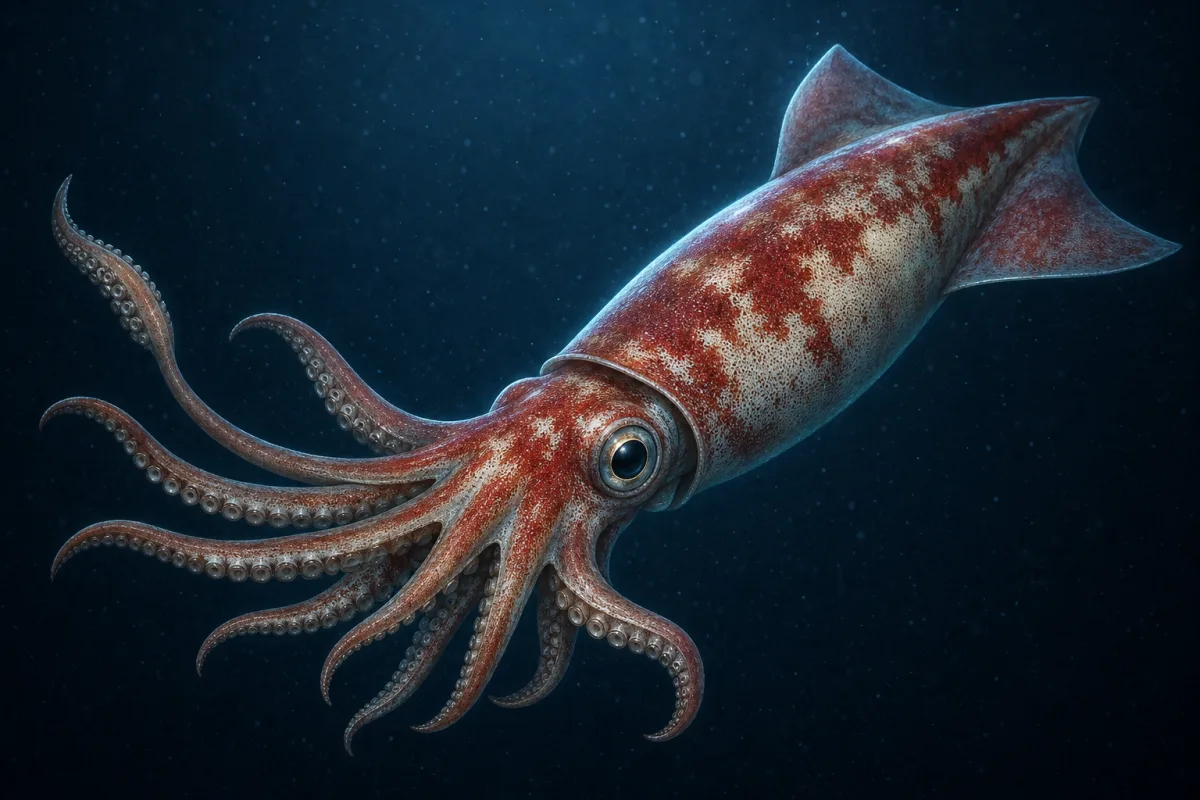
The Humboldt squid is the largest member of its family and the most abundant big squid in the eastern Pacific. Mantle length reaches about 4 feet, total length runs to roughly 6 feet, and the heaviest individuals approach 110 pounds, though most animals landed by fisheries are far smaller. Growth is extremely fast. In warm water the species can mature in under a year, and the entire life cycle usually closes within one to two years, which makes body size in any given season a moving target.
Its daily routine crosses steep gradients in temperature and oxygen. Electronic tags show squid spending daylight between about 650 and 2,300 feet, inside the oxygen minimum zone that lies along the eastern Pacific, then rising toward the surface at night to feed. They handle the low-oxygen layer by throttling back their metabolism rather than by swimming out of it. Tags have also recorded dives approaching 4,000 feet and sustained travel near 24 miles a day for weeks at a time.
Range and abundance shift with ocean conditions. The species is centered on the Humboldt and California currents from Chile to Mexico, but the strong El Niño of 1997 and 1998 brought it into Monterey Bay for the first time, and by the mid-2000s individuals were reaching Oregon, Washington and southeastern Alaska. Jigging fleets in Peru and Chile land close to a million tons a year, and those catches rise and fall sharply with the same climate cycles.
Where it lives
The eastern Pacific from Tierra del Fuego north to California, centered on the productive upwelling of the Humboldt and California current systems and on the Gulf of California. Warm-water years extend the range north to Oregon, Washington, British Columbia and southeastern Alaska, and spawning is concentrated off Peru, in the Gulf of California and near the Costa Rica Dome.
Habitat
- Open ocean
- Continental shelf
- Deep sea
- Coastal waters
What it eats
Lanternfish taken in the midwater at night make up much of the diet, along with anchoveta, sardine, hake, krill and smaller squid. Cannibalism is common and shows up in a large share of stomachs, partly because squid caught on jigs are attacked by others in the same group. Diet composition shifts markedly between El Niño and La Niña years as prey availability changes.
- Bony fish
- Squid & octopus
- Crustaceans
- Zooplankton & krill
How it hunts
Hunting is done in loose groups that can number over a thousand animals, working the upper few hundred feet of water after dark. Prey is seized with two feeding tentacles whose clubs bear toothed suckers, held by the eight shorter arms, and cut apart by a heavy beak. Deep-sea cameras have recorded flickering waves of red and white passing across the skin while squid feed near one another, patterns that may serve as signaling in a crowd where collisions and cannibalism are real costs.
Behavior
Social structure: Schools
Groups of a few dozen to more than a thousand form and break apart continually, and they are best understood as feeding aggregations rather than stable schools. Individuals within a group are typically of similar size, which may reduce cannibalism, and tagging shows they do not stay together across long migrations.
Active period: Nighttime
Feeding peaks at night in the upper water column, followed by a descent at dawn into the oxygen minimum zone, where metabolic rate drops sharply until the next ascent.
Reproduction
Spawns once, then dies.
Females are extraordinarily fecund, with reported oocyte counts in the millions, and release eggs in several batches over a short period before dying. A rare egg mass collected in the Gulf of California in 2006 was a neutrally buoyant sphere of jelly, several feet across, holding hundreds of thousands of eggs suspended in midwater. Paralarvae hatch at a few millimeters and grow quickly.
Predators and ecological role
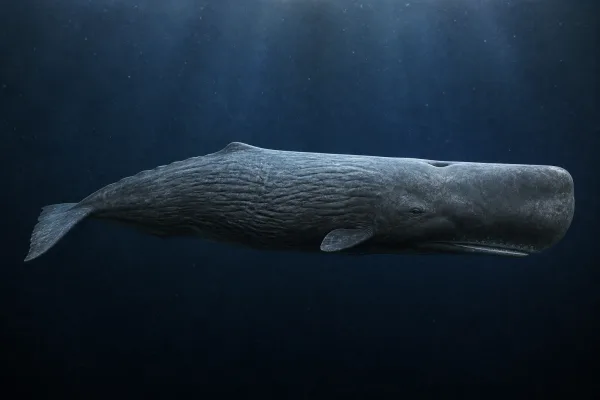
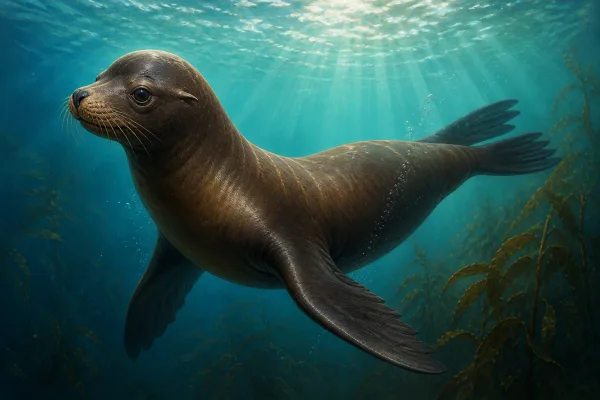
Sperm whales, short-finned pilot whales, swordfish, sharks, tuna, California sea lions and seabirds all take Humboldt squid, and in some of those diets it is the dominant item. Other Humboldt squid are among the most frequent predators of all, especially where fishing gear concentrates injured animals.
The species is a central mid-trophic link in the eastern Pacific, converting small fish and krill into food for whales, billfish, sharks and sea lions. Its range expansions have measurable consequences: when the squid moved north into the California Current, researchers documented increased predation on Pacific hake, a stock of considerable commercial importance.
Conservation and threats
Data Deficient Assessed 2014 · population unknown
Listed as Data Deficient. The fishery is enormous and landings fluctuate widely, but the species is short-lived and highly responsive to ocean conditions, so a drop in catch may reflect climate rather than depletion. There is no global population estimate, and yields in recent years have declined.
The Peruvian and Chilean jigging fleets, along with a smaller Mexican fishery, remove more biomass of this animal than of any other invertebrate. Because a single generation lasts about a year, the population depends heavily on each year's recruitment, which is tied closely to upwelling strength, the extent of the oxygen minimum zone and the abundance of small forage fish.
Main pressures
- Targeted fishing
- Climate change
- Ocean warming
- Depletion of prey
Notable details
- Jigging fleets in Peru and Chile land close to a million tons of Humboldt squid a year, more than any other invertebrate fishery in the world.
- The squid completes its whole life in one to two years, spawning once and then dying, so a population can turn over entirely within about two seasons.
- During the 1997 to 1998 El Niño the species reached Monterey Bay for the first time, and within a few years individuals were turning up in southeastern Alaska.
- It spends daylight hours inside a low-oxygen layer that most large predators avoid, suppressing its metabolism until it rises again after dark.
Sources
-
SeaLifeBase
SeaLifeBase Project
Companion database to FishBase covering non-fish marine organisms, including cephalopods.
-
Monterey Bay Aquarium Research Institute
MBARI
Deep-sea observations, including remotely operated vehicle records of squid and midwater predators.
-
Species Directory
NOAA Fisheries
Management-grade biology, distribution and stock information for species in United States waters.
-
Monterey Bay Aquarium
Monterey Bay Aquarium
Husbandry-informed accounts of feeding, growth and behavior for species held in public aquariums.
-
The IUCN Red List of Threatened Species
International Union for Conservation of Nature
Global conservation assessments, population trends and threat classifications for every species profiled here.
Figures on this page were last checked against these sources on .