Overview
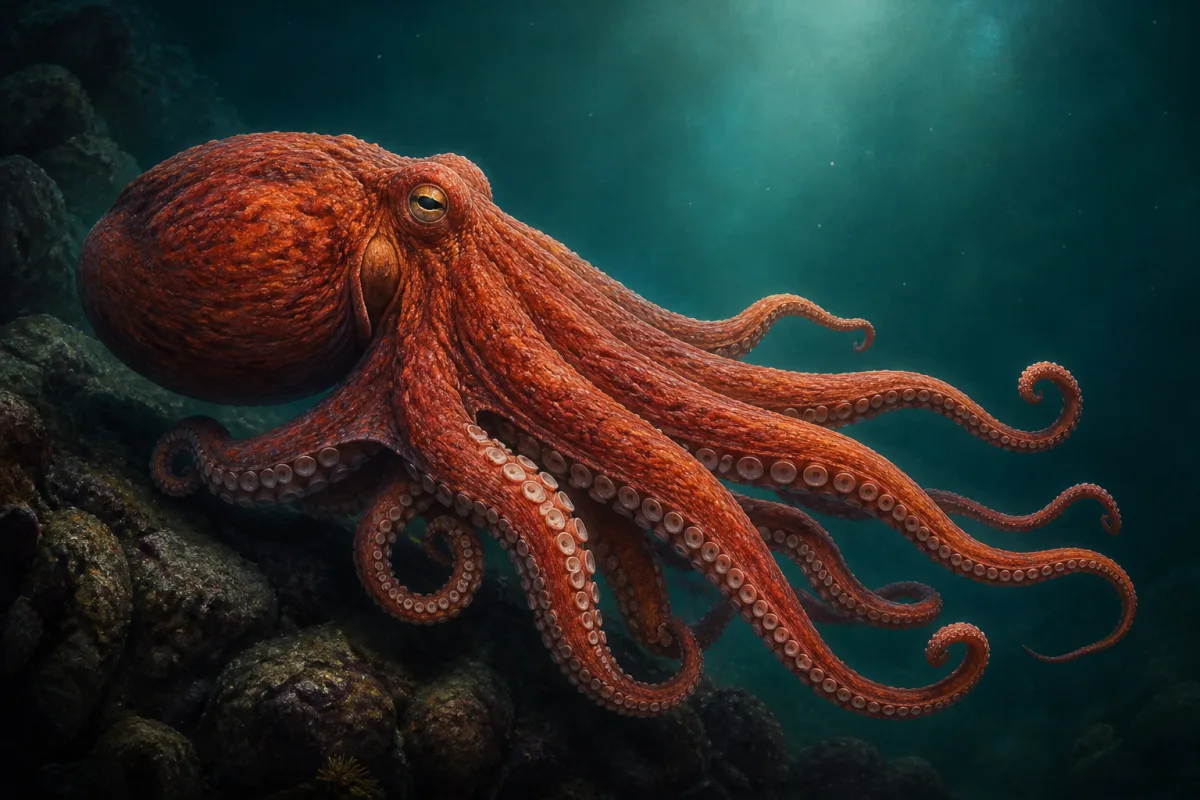
The giant Pacific octopus is the largest octopus described, and a good example of how hard cephalopods are to measure. Adults usually span 10 to 15 feet from arm tip to arm tip and weigh 20 to 110 pounds, with a mantle under 2 feet long. The heaviest carefully weighed individual reached 156 pounds. Older accounts of 600-pound animals with 32-foot spans still circulate, but none was verified, and because an octopus can stretch or bunch its arms at will, span figures deserve caution.
Much of the animal's biology is built around soft-bodied problem solving. Roughly two-thirds of its neurons sit in the arms rather than the brain, so each arm does a great deal of its own searching and gripping. Chromatophores, iridophores and leucophores in the skin shift color in under a second, while bands of muscle raise papillae that mimic rock, barnacle and algae texture. Captive animals open latched containers, and work at the Seattle Aquarium found that they responded differently to individual keepers.
The species lives fast and once. Hatchlings emerge about the size of a grain of rice and add close to one percent of their body weight a day, reaching adult size in roughly three years. Reproduction ends life: a female lays tens of thousands of eggs in a rock den, grooms and aerates them for six months or more without feeding, and dies soon after they hatch. Males die within months of mating. Of the hatchlings released, only a tiny fraction reach maturity.
Where it lives
The temperate North Pacific rim, from Baja California north through the coasts of California, Oregon, Washington, British Columbia and Alaska, west along the Aleutian Islands, and south again through the Kuril Islands, Kamchatka, Japan and the Korean Peninsula. It is absent from tropical and Arctic waters.
Habitat
- Coastal waters
- Kelp forests & rocky reefs
- Continental shelf
- Sandy flats & seagrass beds
What it eats
Crabs and clams dominate the diet, along with snails, shrimp, scallops, small fish and other octopuses. Prey is located largely by touch and by chemical sensing in the suckers, so a hunting octopus works its arms into crevices it cannot see into. Shells discarded outside a den, known as a midden, are often the first clue that the animal is there.
- Crustaceans
- Clams & other molluscs
- Bony fish
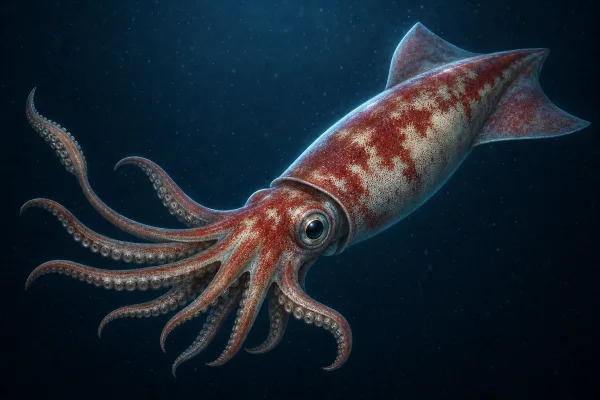
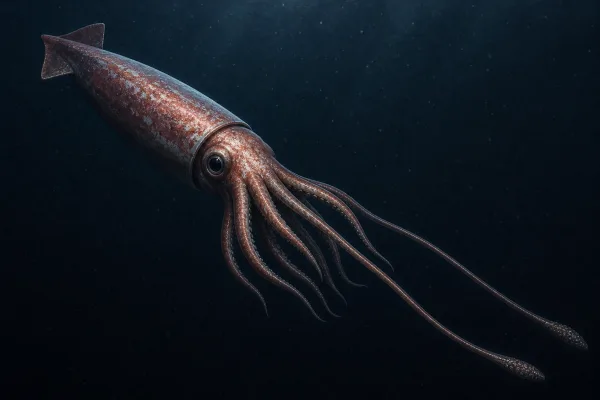
- Squid & octopus
- Seafloor invertebrates
How it hunts
Hunting happens mostly at night, in short trips out from a rock den. The octopus spreads its arms and interbrachial web over a crevice or boulder to trap whatever is underneath, then draws prey to the beak at the center of the arms. Hard-shelled animals are dealt with in two ways: small crabs are simply pulled apart, while clams and larger crabs may be drilled through with the rasping radula so that paralyzing saliva can be injected into the shell.
Behavior
Social structure: Mostly solitary
Adults live alone in dens and defend them against other octopuses, moving every few weeks as local prey runs down. Encounters are brief and usually involve mating or displacement of a smaller animal. There is no evidence of cooperative behavior, though dens are sometimes reused by successive occupants.
Active period: Nighttime
Foraging is concentrated in darkness, with the animal resting in a den during daylight. In deep or turbid water, activity is spread more evenly across the day.
Reproduction
Spawns once, then dies.
A female mates once, stores the sperm packets for weeks or months, then attaches tens of thousands of rice-grain eggs in braided strands to the roof of a den. Reported clutches run from about 50,000 to well over 100,000. She cleans and ventilates them for six months or more in cold water without eating, and dies around the time they hatch. The young drift as plankton for weeks before settling.
Predators and ecological role
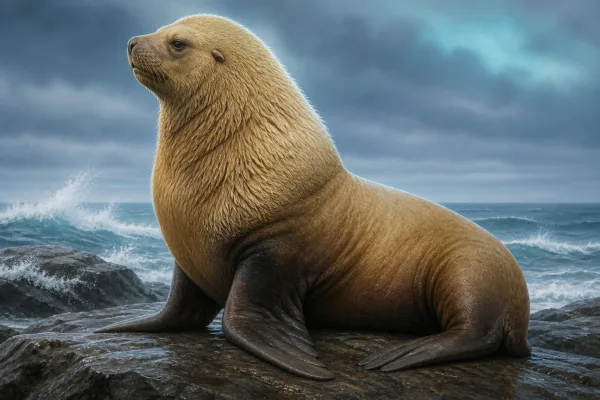
Harbor seals, sea otters, Steller sea lions and Pacific sleeper sharks take adults, and larger octopuses will eat smaller ones. The planktonic young are eaten by an enormous range of fish and invertebrates, which is why so few of each clutch survive.
As a major predator of crabs, clams and snails on rocky bottoms, the species helps set the size and distribution of those populations. Its middens concentrate shell material and provide shelter for small invertebrates, and the huge number of planktonic young it releases feeds midwater food webs well away from the reef where they hatched.
Conservation and threats
Least Concern Assessed 2014 · population unknown
Assessed as Least Concern, with no evidence of global decline. It is taken commercially in Japan, Korea and parts of Alaska and appears as bycatch in crab and groundfish gear. Because the animal lives only a few years, local abundance swings with ocean conditions, which makes trends difficult to read.
Directed fisheries and incidental capture in pots and trawls are the main direct pressures, and both are lightly monitored across much of the range. Coastal pollution and warming bottom water matter more for a short-lived animal than for a long-lived one, because a single poor year can remove most of a generation before it spawns.
Main pressures
- Targeted fishing
- Bycatch in other fisheries
- Chemical pollution
- Ocean warming
Notable details
- About two-thirds of the animal's roughly 500 million neurons sit in the arms, which keep searching and gripping while the brain attends to something else.
- Its blood is blue because oxygen is carried by copper-based hemocyanin, circulated by one systemic heart and two smaller hearts serving the gills.
- A brooding female stops eating for the six months or more she spends tending her eggs, then dies shortly after they hatch.
- Divers and researchers have photographed giant Pacific octopuses catching and eating spiny dogfish, a small shark.
Sources
-
SeaLifeBase
SeaLifeBase Project
Companion database to FishBase covering non-fish marine organisms, including cephalopods.
-
Monterey Bay Aquarium
Monterey Bay Aquarium
Husbandry-informed accounts of feeding, growth and behavior for species held in public aquariums.
-
Animal Diversity Web
University of Michigan Museum of Zoology
Referenced accounts of anatomy, reproduction, behavior and life history.
-
The IUCN Red List of Threatened Species
International Union for Conservation of Nature
Global conservation assessments, population trends and threat classifications for every species profiled here.
Figures on this page were last checked against these sources on .