
What the numbers mean
The great white shark and the saltwater crocodile are often mentioned in the same breath because both are large, both hunt in water, and both carry reputations well out of proportion to their actual biology. Placing them side by side is useful for a different reason. They are among the clearest examples in the ocean of two opposite solutions to the same problem: how to be a big predator without running out of energy.
One is a fish that keeps its muscles warmer than the sea and crosses ocean basins between feeding grounds. The other is a reptile that lets its body track the water temperature, spends much of the day motionless, and can go weeks without eating. Their maximum lengths are nearly identical, at roughly 20 feet, yet a large white shark weighs about twice what a large crocodile does. Almost nothing else about the way they make a living lines up.
Nearly the same length, very different mass
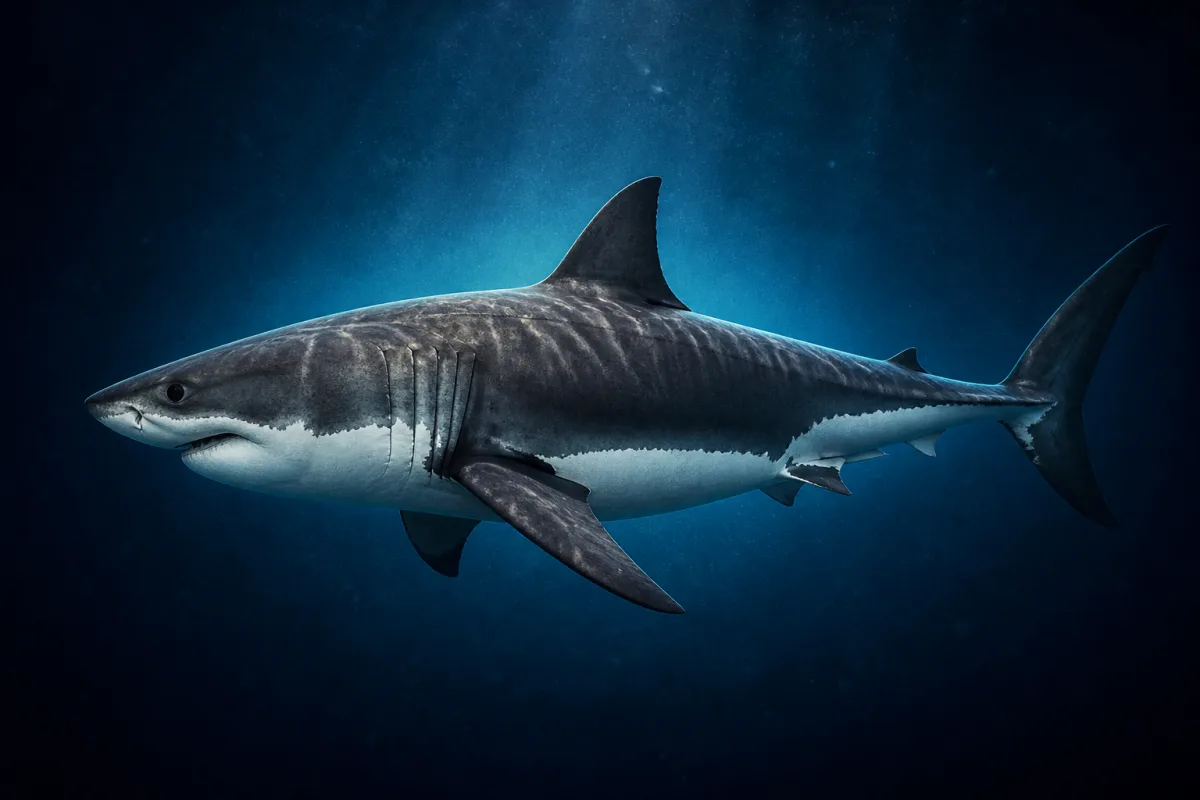
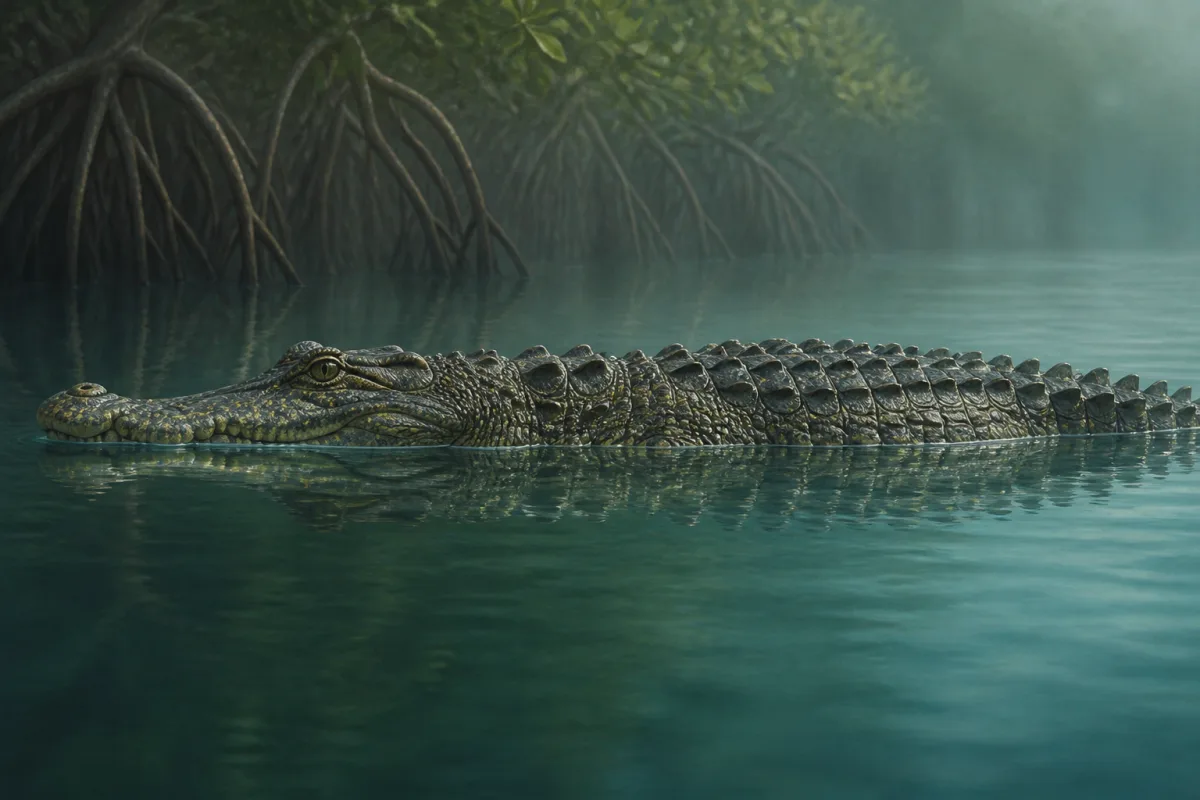
The two animals converge on a similar upper length and diverge sharply on weight. The biggest reliably measured white sharks approach 20 feet, and a heavy female can pass 4,000 pounds. The largest carefully measured saltwater crocodile, a male captured in the Philippines in 2011, was 20 feet 3 inches long and weighed about 2,370 pounds on a truck weighbridge. A shark's cross-section is deep and rounded, while a crocodile is comparatively flat and elongated, and that geometry accounts for most of the difference.
Both species also show large differences between the sexes, but in opposite directions. Female white sharks average considerably larger than males, which is common among sharks and tied to the demands of carrying developing young. In saltwater crocodiles the pattern reverses: adult males commonly reach 14 to 16 feet while females rarely exceed 10 and weigh a small fraction as much. A generic figure for either species therefore describes one sex better than the other.
Both are also magnets for exaggeration, and for similar reasons. Length is easy to overestimate at sea or from a boat, and preserved material distorts: shark specimens shrink or stretch during handling, and crocodile skins lengthen during preparation. Museum skulls suggest saltwater crocodiles can approach 23 feet, and reports of larger sharks are common, but specialists treat both as unresolved rather than established. The defensible ceiling for each species remains close to 20 feet.
Warm muscle against a patient metabolism
The white shark is a regional endotherm. A counter-current heat exchanger in the bloodstream traps the heat produced by the swimming muscles instead of losing it at the gills, keeping muscle, stomach, brain and eyes several degrees above the surrounding water. Warm muscle contracts faster and recovers sooner, which buys sustained cruising power in cold seas. That is why the species thrives off California, South Africa, southern Australia and New England rather than in the tropics, and why it can hold a steady pace for weeks at a time.
The crocodile takes the opposite approach and pays almost nothing for it. Its body temperature follows the water and the sun, regulated by moving between bank and shallows rather than by burning fuel. Daylight hours go to basking, hunting is concentrated after dark, and a large adult can go a long time between meals. Salt glands on the tongue excrete concentrated sodium, and the animal limits water loss well enough to spend weeks at sea, which is what separates it from every other crocodilian.
The consequence is a completely different daily budget. A white shark must keep moving, and the energy that warmth costs has to be recovered from high-value prey such as seals and whale carcasses. A crocodile can afford to do nothing at all. Tracking work in Queensland showed how it uses that patience at sea: long journeys are timed to the tides, with animals setting out within an hour of a favorable current and hauling out when the flow reverses. One tagged male covered 370 miles in 25 days without swimming hard.
Hunting at two different edges
Each animal ambushes, but from a different boundary. The white shark works the vertical one, patrolling deep water beneath a seal colony with a dark back against the seafloor and a pale belly against the light, then striking upward in a single high-speed rush that sometimes carries it clear of the surface. Against prey capable of injuring it, the shark uses a bite-and-wait approach, releasing the animal after an initial wound and returning once it weakens, which reduces the risk of injury from teeth, claws or flukes.
The crocodile works the horizontal boundary between land and water. It approaches submerged with only eyes and nostrils showing, holds position near a bank, trail or tidal channel where prey comes to drink, and lunges from close range. Pressure receptors in the scales around the jaws register surface disturbance in water too muddy to see through. Researchers measuring bite force across crocodilians recorded their highest value from a 15-foot saltwater crocodile, a reflection of jaws built for holding rather than chewing.
Diet follows the habitat. The shark's changes with age: juveniles under about 10 feet take fish, rays and smaller sharks, and adults add seals, sea lions and small cetaceans while readily scavenging whale carcasses. The crocodile's diet tracks body size just as closely but draws on the shoreline, running from insects and shrimp in hatchlings to mud crabs and fish in juveniles and, in large adults, to turtles, wading birds, snakes, wild pigs and livestock. The shark never touches land; the crocodile depends on the animals that do.
Few large young, or many small ones
White shark reproduction is unusual even among sharks. Embryos develop inside the mother without a placenta and feed on unfertilized eggs she supplies, a strategy called oophagy. Gestation is thought to last more than a year and produces 2 to 10 pups roughly 4 feet long, already capable of hunting. No pregnant female has ever been studied in detail, so most of this is inferred from a handful of specimens, and the location of pupping grounds is still an open question in most of the range.
The crocodile invests in numbers and then in care. During the wet season a female builds a mound of vegetation and mud above the tide line, lays roughly 40 to 60 eggs and guards them for about 90 days. Nest temperature determines the sex of the hatchlings. She opens the mound in response to calls from inside and carries the young to water. Flooding of nests is the largest single cause of failure, and few hatchlings reach adulthood, with larger crocodiles among the main causes of death.
The two strategies produce similar outcomes by different routes. A shark pup starts life large enough to avoid most predators but is one of very few; a crocodile hatchling is one of dozens but spends its first two years as prey. Where they differ sharply is in the mother's role. A crocodile defends a fixed nest and can be helped by protecting a stretch of shoreline. A shark's young are dispersed at birth into open water, which leaves managers with far less to work with.
Why their conservation outcomes diverge
The white shark is assessed as Vulnerable with a decreasing trend. Accidental capture in gillnets and longlines is the main pressure, compounded by demand for jaws, teeth and fins and by beach protection programs that still kill sharks in some regions. The deeper problem is arithmetic: females do not mature until around 26 years, litters are small, and a population that loses adults faster than it produces them cannot recover quickly. The species is protected in United States, Australian, South African and New Zealand waters and listed on CITES Appendix II.
The saltwater crocodile is assessed as Least Concern with a stable trend, on the strength of populations in Australia, Papua New Guinea and Indonesia that together exceed 400,000 non-hatchlings. That is a recovery, not a species that was never in trouble. Unregulated skin hunting cut the northern Australian population by roughly 95 percent by 1971. After protection, and after regulated ranching gave landholders a financial reason to keep nesting habitat intact, numbers passed 100,000 in that region alone.
The contrast is less about the animals than about where they live. A crocodile population occupies mapped river systems inside national borders, its nests can be counted and protected, and the people who share the habitat can be given a stake in it. A white shark spends much of its life in international water and is caught by fleets no single country controls. Regional protections do help, because tagged sharks return to the same coastal sites year after year, but the crocodile's habitat is defensible in a way the shark's is not.