Overview
The saltwater crocodile is the largest living reptile, and the difference between the sexes is unusually wide. Adult males commonly reach 14 to 16 feet and several hundred pounds, with exceptional individuals passing 1,000; females rarely exceed 10 feet and weigh a small fraction as much. The largest carefully measured animal, a male captured in the Philippines in 2011, was 20 feet 3 inches long and weighed about 2,370 pounds on a truck weighbridge. Larger claims exist but lack documentation.
Museum skulls suggest the species can reach close to 23 feet, and reports of animals beyond that circulate widely. Those reports come from visual estimates made from boats or from dried skins whose original measurements were never recorded, and specialists treat them as unresolved rather than established. Size estimation on the water is notoriously unreliable, and skins stretch during preparation, so the defensible upper limit for a modern verified measurement remains close to 20 feet.
What separates this crocodile from its relatives is a genuine tolerance for seawater. Salt glands on the tongue excrete concentrated sodium, and the animal limits water loss enough to spend weeks at sea without fresh water or food. Tracking work in Queensland showed that long journeys are timed to the tides: crocodiles set out within an hour of a favorable current and haul out when the flow reverses. One tagged male covered 370 miles in 25 days that way.
Where it lives
Coasts and river systems from eastern India, Bangladesh and Sri Lanka through Southeast Asia and the Indonesian archipelago to New Guinea, northern Australia, the Solomon Islands, Palau and Vanuatu. Australia, Papua New Guinea and the Indonesian province of Papua hold the strongest populations, while much of Southeast Asia retains only remnants. Wandering individuals reach Fiji and southern Japan.
Habitat
- Estuaries & river mouths
- Mangroves & lagoons
- Coastal waters
- Open ocean
What it eats
Diet tracks body size closely. Hatchlings take insects, shrimp and small crabs; juveniles move to mud crabs and fish; adults add turtles, wading birds, snakes, wild pigs, macaques and livestock that come to the water's edge to drink. Large individuals scavenge readily, and carcasses in a river system draw crocodiles from a considerable distance.
- Bony fish
- Crustaceans
- Land mammals
- Seabirds
- Sea turtles
How it hunts
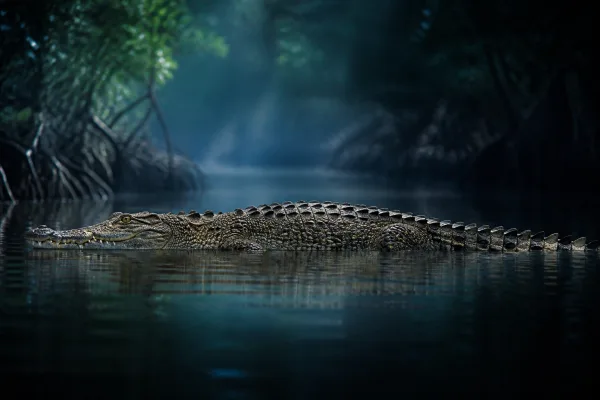
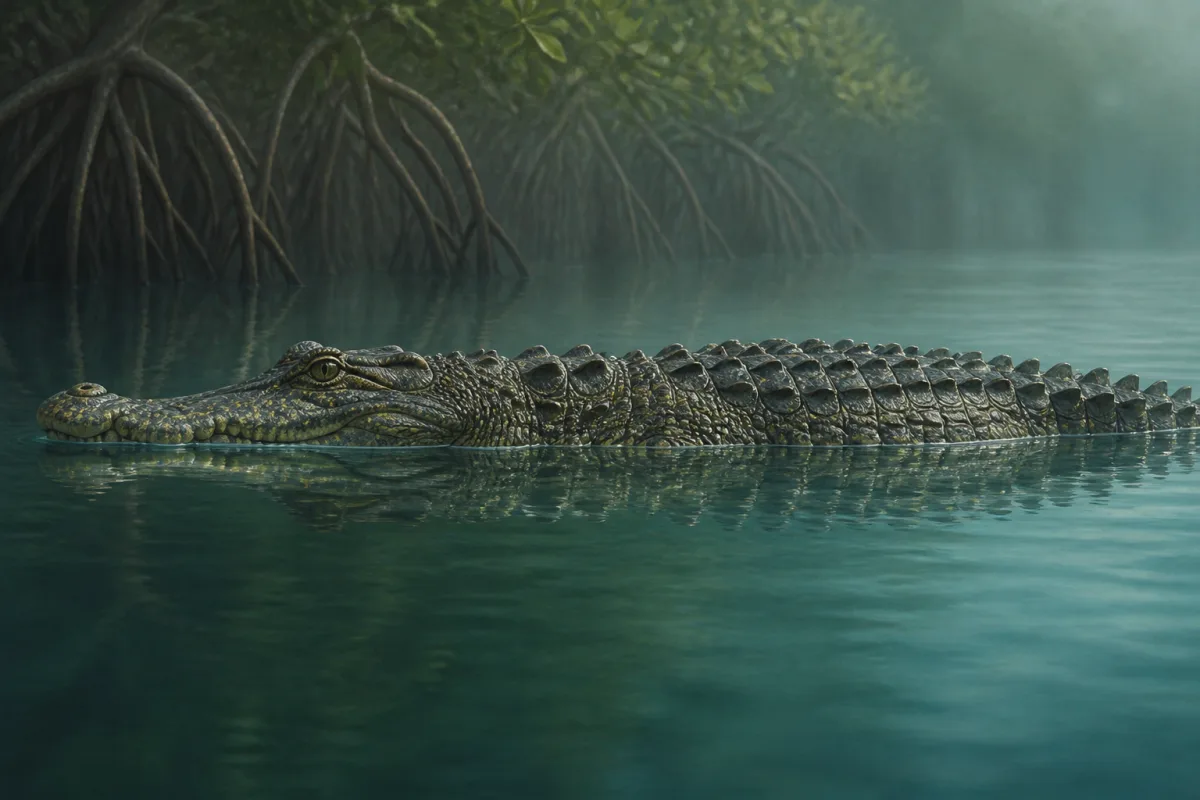
The species is an ambush predator that works the boundary between land and water. It approaches submerged with only eyes and nostrils above the surface, holds position near a bank, trail or tidal channel where prey passes, and lunges from close range. Pressure receptors in the scales around the jaws detect surface disturbance in muddy water. Researchers measuring bite force in crocodilians recorded the highest value from any living animal in a 15-foot saltwater crocodile, a reflection of jaw muscles built for holding rather than chewing.
Behavior
Social structure: Mostly solitary
Adults are territorial and largely intolerant of one another. Dominant males hold the best reaches of tidal rivers and displace smaller animals, which is a principal reason subordinate crocodiles end up in coastal and open-ocean water. Basking groups form where space is limited, and hatchlings stay together near the nest for their first weeks.
Active period: Nighttime
Hunting is concentrated at night, particularly in the hours around dusk and dawn. Daylight is spent basking on banks or holding station in the water to regulate body temperature.
Reproduction
Eggs laid on land.
During the wet season a female builds a mound of vegetation and mud above the tide line and lays roughly 40 to 60 eggs, which incubate for about 90 days. Nest temperature determines the sex of the hatchlings. She guards the mound, opens it in response to calls from inside, and carries the young to water. Flooding of nests is the largest single cause of failure, and few hatchlings reach adulthood.
Predators and ecological role
Adults have no natural predators. Eggs and hatchlings are taken by monitor lizards, feral pigs, wading birds, turtles and predatory fish, and larger crocodiles kill smaller ones, which makes the first two years by far the most dangerous stage of life.
As the apex predator of Indo-Pacific estuaries, the species influences the numbers and behavior of fish, crabs, turtles and waterbirds, and its presence keeps prey away from certain stretches of shoreline. Crocodiles also move nutrients between land and water in both directions, and their recovery in northern Australia restored a top predator that had been functionally absent from many rivers for decades.
Conservation and threats
Least Concern Assessed 2019 · population stable
Least Concern globally, on the strength of large populations in Australia, Papua New Guinea and Indonesia that together exceed 400,000 non-hatchlings. Several range states retain only small or depleted populations, and the species is probably gone from the wild in Thailand, Cambodia and Vietnam. CITES lists Australian, Papua New Guinean and Indonesian populations on Appendix II and all others on Appendix I.
Unregulated skin hunting through the middle of the twentieth century drove the historic decline, and illegal killing continues where enforcement is weak. Conversion of mangrove and estuarine habitat for aquaculture, agriculture and coastal development now matters more in most of the range. Regulated ranching in Australia and Papua New Guinea has given landholders a reason to protect nesting habitat, which is one of the clearer conservation successes in the group.
Main pressures
- Habitat loss
- Coastal development
- Illegal trade
- Hunting & persecution
Notable details
- Salt glands on the tongue excrete excess sodium, which is why this species can cross open ocean between islands while most crocodilians cannot.
- Tracking in northern Australia showed crocodiles beginning long journeys within an hour of the tide turning, and one male covered 370 miles in 25 days.
- Skin hunting cut the northern Australian population by roughly 95 percent by 1971; after protection it recovered to more than 100,000 animals.
- The temperature inside the nest mound determines whether hatchlings are male or female, with males produced in a narrow band near 88 to 90 degrees Fahrenheit.
Sources
-
The IUCN Red List of Threatened Species
International Union for Conservation of Nature
Global conservation assessments, population trends and threat classifications for every species profiled here.
-
Australian Museum
Australian Museum
Species accounts for Indo-Pacific fish, reptiles and invertebrates.
-
Animal Diversity Web
University of Michigan Museum of Zoology
Referenced accounts of anatomy, reproduction, behavior and life history.
-
Convention on International Trade in Endangered Species of Wild Fauna and Flora
CITES Secretariat
Appendix listings governing international trade in the species profiled here.
-
Smithsonian Ocean
Smithsonian National Museum of Natural History
Peer-reviewed public science writing on marine life, ecosystems and ocean change.
Figures on this page were last checked against these sources on .