
What the numbers mean
The Greenland shark and the shortfin mako sit at opposite ends of nearly every axis on which a shark can be measured. One cruises at about three-quarters of a mile per hour in water close to freezing and may live for centuries. The other holds its muscles warmer than the surrounding sea, has been recorded near 30 miles per hour, and rarely passes 32 years. These are not three separate differences. They are one difference, seen from three angles.
Temperature is the thread that connects them. Chemical reactions run faster when it is warmer, and growth, digestion, muscle power and the rate at which tissue accumulates damage all follow that curve. The mako spends energy raising its own temperature and converts it into speed; the Greenland shark accepts the temperature of Arctic water and grows about a third of an inch a year. Both are large sharks, and both are in trouble for reasons that follow directly from those settings.
Two bodies for two temperatures
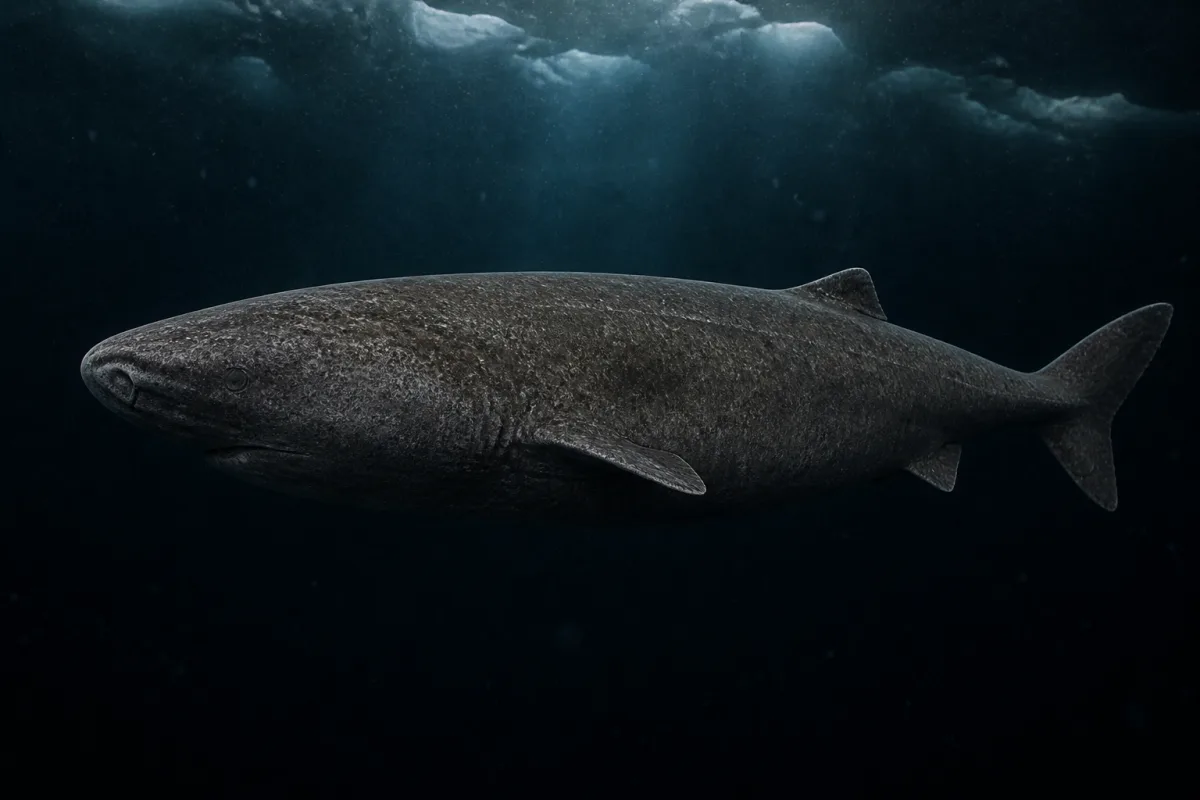
The Greenland shark is understated in every respect: a small rounded snout, tiny low dorsal fins with no spines, a broad rounded body in brown, gray or slate, and skin covered in coarse denticles. The flesh is soft and oil-rich rather than dense with muscle. Adults commonly measure 8 to 15 feet, and the largest well-documented individuals reach about 21 feet and can approach 2,200 pounds, which makes this the larger of the two species by a considerable margin.
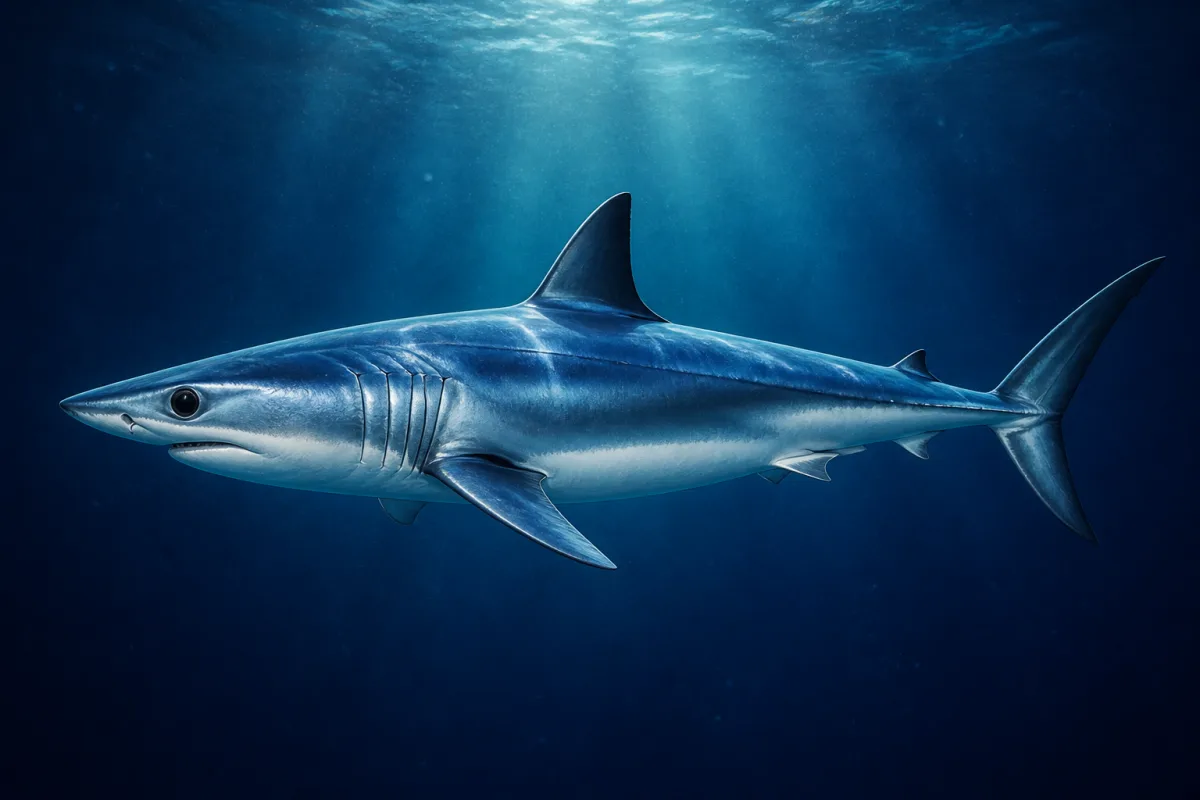
The mako is the opposite kind of animal to look at. Its body is stiff and nearly cylindrical, with narrow keels at the tail base and a crescent-shaped caudal fin whose lobes are almost equal, an arrangement that turns muscle effort into forward thrust with very little waste. The snout is sharply pointed and the back a deep metallic blue that fades quickly after death. Adults commonly run 6 to 9 feet, with the largest reliably recorded individuals near 13 feet and roughly 1,250 pounds.
The mako's key feature is internal. Networks of small parallel blood vessels called retia mirabilia trap the heat produced by its swimming muscles instead of losing it at the gills, keeping muscle, viscera and eyes several degrees above the water. Warm muscle contracts faster and recovers sooner. The Greenland shark has nothing comparable, and at the temperatures it occupies there would be little point: the heat would be lost as fast as it was made.
What the speed measurements show
The Greenland shark's pace has been measured directly, which is unusual for a deep-water animal. Accelerometer tags deployed in Greenland recorded a mean cruising speed of about three-quarters of a mile per hour, with the fastest bursts still falling under 2 miles per hour and tail beats slow enough to count by eye. These are among the slowest swimming speeds recorded for any fish of this size, and the figure is a measurement rather than an impression.
The mako's number is also instrumented, and also smaller than its reputation. Tagged animals have been recorded near 30 miles per hour in short bursts. Figures around 45 miles per hour circulate widely but rest on brief, poorly documented observations, and in either case ordinary cruising is a small fraction of the maximum. The honest comparison, then, is roughly 30 miles per hour against under 2, both from tags on living sharks.
The gap is larger than any single adaptation explains. It is a compound of muscle temperature, body stiffness, tail shape and the viscosity of near-freezing water, and it corresponds to two completely different ways of obtaining food. A shark that can accelerate chases prey. A shark that cannot has to find another approach entirely, and how the Greenland shark manages that is one of the genuinely open questions in shark biology.
Two thermal worlds
The Greenland shark lives at temperatures near freezing, from the surface under Arctic ice down to at least 7,000 feet. Its range covers Greenland, Iceland, Svalbard, the Barents Sea, northern Norway, the Canadian Arctic and the Gulf of St. Lawrence, and individuals of this species or a close relative have been recorded in deep water much farther south, including the Gulf of Mexico. Where it goes south, it goes deep, holding to the same cold rather than following a latitude.
The mako lives where surface temperatures stay above about 61 degrees Fahrenheit, across every ocean basin roughly between 50 degrees north and 50 degrees south. Its warm body extends that envelope downward rather than poleward: it spends most of its time in the upper 300 feet and makes regular deeper excursions into colder water where prey concentrates, then returns. Satellite-tagged individuals have covered more than 8,000 miles in a year within that thermal band.
The Greenland shark's biochemistry is built for its conditions in ways that show up in odd places. Its flesh carries urea and trimethylamine N-oxide at concentrations that stabilize proteins under deep-sea pressure and make the meat toxic when fresh, which is why the traditional Icelandic preparation involves long fermentation and drying. Most individuals also carry a parasitic copepod anchored to the surface of the eye, damaging the cornea; the sharks appear largely unaffected, since vision is of limited use in dark, deep water.
Two ways of catching a meal
The mako hunts by pursuit, because open water offers no cover. Warm muscle and a stiff, high-aspect tail let it close on fast prey and change direction sharply at speed, and it often approaches from below and behind, where a target's field of view is poorest. Its teeth are long, narrow and smooth-edged, curving inward and visible even when the mouth is shut, and they grip slippery fish rather than cutting them. Schooling fish dominate the diet, with bluefish making up the majority of identifiable prey in studies off the northeastern United States.
How the Greenland shark obtains its food is not fully resolved. Fish dominate its stomach contents, including Greenland halibut, Arctic skate, redfish, capelin, lumpfish and wolffish, and the species is strongly drawn to carcasses and to fishery discards. Suction assists in both scavenging and capture: the shark can draw prey and pieces of carcass into its mouth, and the lower teeth form a continuous cutting edge that works against large carcasses.
The unresolved part concerns seals. Seal remains turn up in a meaningful share of stomachs, and some of that material is too fresh to be explained by scavenging. One hypothesis is that the sharks take seals while they sleep in the water, where a slow, quiet approach would be an advantage rather than a handicap. Direct observations are almost nonexistent, so the question stands open, and it deserves to be reported as an open question rather than a settled account.
Age, and how both of these numbers were obtained
Both species had their lifespans revised by radiocarbon dating, using the atmospheric carbon-14 spike from mid-century nuclear testing as a time marker. For the mako, bomb radiocarbon showed that earlier counts of vertebral growth bands had been underestimating age, roughly doubling accepted figures to a maximum near 32 years and pushing female maturity to about 18. That revision changed how the species is managed, because a shark that matures at 18 cannot sustain the catch levels that one maturing at nine could.
The Greenland shark result came from a different tissue and produced a far stranger number. A shark's eye lens forms before birth and its proteins are never replaced, so the carbon it contains records the year the animal was born. Dating lenses from 28 females, published in 2016, gave the largest individual a central estimate of about 392 years, with a 95 percent confidence range running from 272 to 512. Those are not observed ages, the method depends on assumptions about carbon uptake, and the uncertainty is a genuine part of the result.
Growth ties the numbers together. The Greenland shark adds roughly a third of an inch a year, and females are not thought to mature until they are around 13 feet long, which by the radiocarbon age curve corresponds to an age near 150 years, later than any other known vertebrate. Almost nothing else about its reproduction has been observed: a single well-documented pregnant female carried about ten pups roughly 15 inches long, and gestation length, mating behavior and pupping grounds are all unknown.
Two Red List categories, one shared arithmetic
The mako moved from Vulnerable to Endangered in the global shark reassessment published in 2019. The dominant pressure is capture on pelagic longlines set for tuna and swordfish, where makos are taken both incidentally and as retained catch for their meat and fins. North Atlantic assessments concluded the population was overfished and would need decades of near-zero catch to rebuild, prompting a retention ban that took effect in 2022, and the species was added to CITES Appendix II in 2019.
The Greenland shark was uplisted from Near Threatened to Vulnerable in 2019 after review of its exceptionally slow life history. Historic liver-oil fisheries in Greenland, Iceland and Norway removed tens of thousands of sharks a year in the early twentieth century. That fishery ended by mid-century, but the population has had only a fraction of one generation to recover since, which is a sentence with no equivalent for any other exploited fish. Today the main pressure is incidental capture in halibut and shrimp trawl and longline fisheries, where survival after release is poorly known.
The shared arithmetic is simple and unforgiving. Both species are removed mostly by accident, by fleets fishing for something else, and both replace losses far more slowly than the gear operates. Both also accumulate mercury and persistent organic pollutants because of their long lives at high trophic levels. The difference is one of scale: a mako population might rebuild across decades, while a shark that may not breed until 150 years old cannot absorb sustained losses on any timescale a fishery would recognize.