Overview
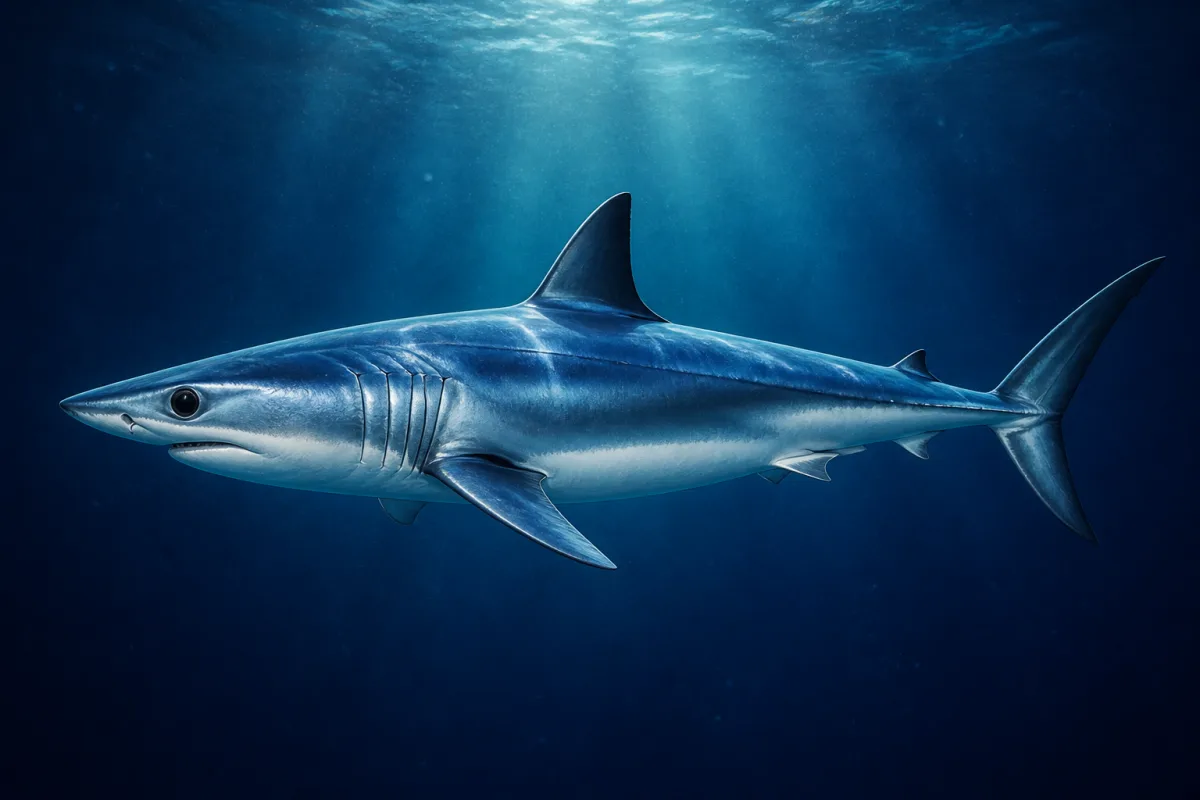
The shortfin mako is a mackerel shark built along the same lines as a tuna: a stiff, nearly cylindrical body, a sharply pointed snout, narrow keels at the tail base and a crescent-shaped caudal fin with lobes of almost equal length. The back is a deep metallic blue that fades quickly after death, and the belly is white. Adults commonly measure 6 to 9 feet, and the largest reliably recorded individuals reach about 13 feet.
Like its relatives the great white and the porbeagle, the mako is a regional endotherm. Networks of small parallel blood vessels called retia mirabilia trap the heat produced by the swimming muscles instead of losing it at the gills, keeping the muscle, viscera and eyes several degrees warmer than the surrounding water. Warm muscle contracts faster and recovers sooner, which supports both long-distance cruising and the short accelerations used to catch fast schooling fish.
Makos live in the open ocean, generally where surface temperatures stay above about 61 degrees Fahrenheit. They range across every ocean basin and cross them regularly; tagged individuals have moved thousands of miles between the U.S. East Coast and the mid-Atlantic, and between New Zealand and the tropical Pacific. Those long movements carry them repeatedly through high-seas longline fisheries, which is the central problem for the species today.
Where it lives
Temperate and tropical open ocean worldwide, roughly between 50 degrees north and 50 degrees south. In United States waters it is common off the mid-Atlantic and New England in summer and off southern California, and it occurs throughout the Gulf of Mexico, the central Pacific, the Indian Ocean and the Mediterranean.
Habitat
- Open ocean
- Continental shelf
- Seamounts & offshore banks
What it eats
Schooling fish dominate the diet: bluefish, mackerel, herring, sardines and, in larger sharks, tuna and swordfish. Squid are important in some regions. Adults occasionally take smaller sharks, sea turtles and, rarely, small cetaceans. Stomach studies off the northeastern United States found bluefish making up the majority of identifiable prey.
- Bony fish
- Squid & octopus
- Sharks & rays
- Marine mammals
How it hunts
Makos hunt in open water without cover, so pursuit replaces ambush. Warm muscle and a stiff, high-aspect tail let them close on fast prey and change direction sharply at speed. They often approach from below and behind, where a target's field of view is poorest. The teeth are long, narrow and smooth-edged, curving inward and visible even when the mouth is shut, and they grip slippery fish rather than cutting through them. Larger makos switch toward swordfish and tuna, prey that is itself fast and warm-bodied.
Behavior
Social structure: Mostly solitary
Encountered alone in almost all circumstances. Loose concentrations form where prey is dense or along temperature fronts, and there is broad separation by size and sex across the range, but no evidence of lasting associations between individuals.
Active period: Day & night
Active around the clock, following a daily vertical rhythm in which the shark stays near the surface at night and works deeper, cooler water during the day.
Reproduction
Live birth, egg-eating embryos.
Embryos develop without a placenta and feed on unfertilized eggs produced by the mother, a strategy called oophagy that yields few but large young. Gestation is thought to last 15 to 18 months, producing 4 to 25 pups about 2 feet long. Females appear to rest for a year or more between litters, so the effective cycle is roughly three years, and they do not begin breeding until around 18 years old.
Predators and ecological role
Adults have few predators; larger sharks and orcas are the plausible ones, and documented cases are scarce. Juveniles are vulnerable to larger pelagic sharks, including adult shortfin makos.
As a fast-swimming predator of schooling fish and squid, the mako helps regulate abundant mid-level species across huge stretches of open ocean where few other predators of its size operate. Its warm-bodied physiology allows it to hunt actively in cooler water than most large pelagic fish, extending predation into regions and depths that would otherwise be a refuge.
Conservation and threats
Endangered Assessed 2018 · population decreasing
Moved from Vulnerable to Endangered in the global shark reassessment published in 2019. Late maturity, a multi-year breeding cycle and heavy overlap with high-seas longline fleets make recovery slow. The species was added to CITES Appendix II in 2019, and North Atlantic fishing nations adopted a retention ban that took effect in 2022.
The dominant pressure is capture on pelagic longlines set for tuna and swordfish, where makos are taken both incidentally and as a retained catch for their meat and fins. Recreational fisheries add to the total in the North Atlantic and off California. North Atlantic stock assessments concluded that the population was overfished and would need decades of near-zero catch to rebuild, which prompted the retention ban.
Main pressures
- Bycatch in other fisheries
- Targeted fishing
- Fin trade
- Depletion of prey
Notable details
- A counter-current heat exchanger in the bloodstream keeps the swimming muscle warmer than the surrounding sea, a feature shared by only a handful of shark species.
- Bomb radiocarbon dating, which uses the atmospheric carbon-14 spike from mid-century nuclear testing as a time marker, showed that makos live about twice as long as researchers previously believed.
- The long, narrow teeth curve inward and protrude from the jaws even when the mouth is closed, giving the head a distinctive profile.
- Satellite-tagged makos have crossed entire ocean basins, with some individuals covering more than 8,000 miles in a year.
Sources
-
The IUCN Red List of Threatened Species
International Union for Conservation of Nature
Global conservation assessments, population trends and threat classifications for every species profiled here.
-
Species Directory
NOAA Fisheries
Management-grade biology, distribution and stock information for species in United States waters.
-
Florida Program for Shark Research
Florida Museum of Natural History
Shark biology, size records and documented interaction data.
-
FishBase
FishBase Consortium
Compiled length, weight, growth and depth records for fish species, drawn from the primary literature.
-
Convention on International Trade in Endangered Species of Wild Fauna and Flora
CITES Secretariat
Appendix listings governing international trade in the species profiled here.
Figures on this page were last checked against these sources on .