Overview
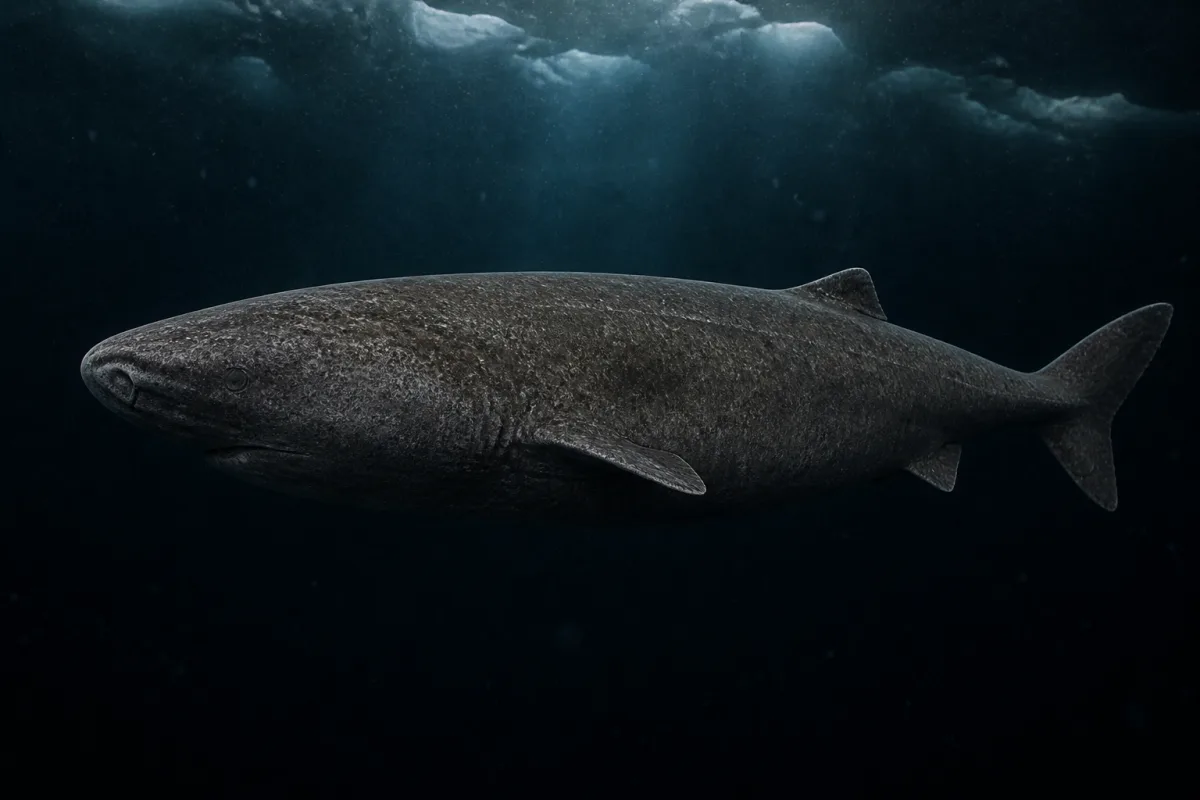
The Greenland shark is a bulky, soft-bodied sleeper shark of cold northern water. Everything about it is understated: a small rounded snout, tiny low dorsal fins with no spines, a broad rounded body in brown, gray or slate, and skin covered in coarse denticles. Adults commonly measure 8 to 15 feet, and the largest well-documented individuals reach about 21 feet. Reports of longer animals appear in the older literature but were not measured under conditions that allow them to be confirmed.
It lives at temperatures near freezing, from the surface under Arctic ice down to at least 7,000 feet. Cold slows everything. Instrumented sharks cruise at about three-quarters of a mile per hour, with tail beats so slow that the fastest recorded bursts still fall under 2 miles per hour. Growth is correspondingly slow, on the order of a third of an inch per year, and females are not thought to mature until they are around 13 feet long.
That slow pace is the basis of the species' most remarkable finding. Because a shark's eye lens is formed before birth and its proteins are never replaced, the carbon it contains records the year the animal was born. Radiocarbon dating of lenses from 28 females published in 2016 produced ages far beyond anything previously measured in a vertebrate, and the numbers carry wide uncertainty that any honest account has to carry with them.
Where it lives
The North Atlantic and Arctic, including Greenland, Iceland, Svalbard, the Barents Sea, northern Norway, the Canadian Arctic, the Gulf of St. Lawrence and, less commonly, the Gulf of Maine. Individuals of this species or a close relative have been recorded in deep water much farther south, including the Gulf of Mexico and the western Caribbean, which suggests the range is wider than long assumed.
Habitat
- Sea ice & polar shelves
- Deep sea
- Continental shelf
- Coastal waters
What it eats
Fish dominate: Greenland halibut, Arctic skate, redfish, capelin, lumpfish and wolffish. Seal remains turn up in a meaningful share of stomachs, along with pieces of whale, and occasionally the remains of land animals such as reindeer that entered the water. Squid, crabs, sea stars and other seafloor invertebrates fill out the rest.
- Bony fish
- Carrion & whale falls
- Marine mammals
- Squid & octopus
- Seafloor invertebrates
How it hunts
How a shark this slow obtains fresh seal is genuinely unresolved. Scavenging explains part of it, and Greenland sharks are strongly drawn to carcasses and to fishery discards. But some stomach contents are too fresh for that, and one hypothesis is that sharks take seals while they sleep in the water, where a slow, quiet approach is an advantage rather than a handicap. Direct observations are almost nonexistent, so the question stands open. Suction feeding assists in both cases: the shark can draw prey and pieces of carcass into its mouth, and the lower teeth form a continuous cutting edge that works against large carcasses.
Behavior
Social structure: Mostly solitary
Ordinarily alone. Numbers gather at concentrated food such as a whale carcass or the discard trail behind a fishing vessel, and baited cameras in Arctic fjords sometimes record several individuals in view, but there is no sign of structured social behavior.
Active period: Day & night
Active in a habitat where daylight is either continuous or absent for months, so activity follows season and depth rather than time of day, with shallow water used mainly in the coldest part of the year.
Reproduction
Live birth, yolk-fed young.
Embryos are nourished by yolk with no placental connection. Almost nothing has been observed directly. A single well-documented pregnant female carried about ten pups roughly 15 inches long, and estimates place female maturity near 13 feet, which by the radiocarbon age curve corresponds to an age around 150 years. Gestation length, mating behavior and pupping grounds are all unknown.
Predators and ecological role
No predator of adult Greenland sharks has been documented. Their size, the cold and the depths they occupy leave few candidates, and even scarring of unclear origin is uncommon.
The Greenland shark is the largest predator and the principal large scavenger through much of the Arctic seafloor, breaking down carcasses that would otherwise decay very slowly in near-freezing water. Because individuals persist for centuries, a single shark integrates conditions across a span of Arctic history longer than most scientific records, which makes the species a useful if slow-reading indicator of long-term change.
Conservation and threats
Vulnerable Assessed 2019 · population decreasing
Uplisted from Near Threatened after review of its exceptionally slow life history. A species that may not breed until roughly 150 years old cannot absorb sustained losses. Historic liver-oil fisheries in Greenland, Iceland and Norway removed tens of thousands of sharks a year in the early twentieth century, and the population has had only a fraction of one generation to recover since.
The main pressure today is incidental capture in Greenland halibut and shrimp trawl and longline fisheries, where survival after release is poorly known. The historic liver-oil fishery ended by the mid-twentieth century but its effects remain within a single generation of this species. Arctic warming is altering the cold habitat the shark depends on, and its long life leads to accumulation of mercury and persistent organic pollutants at high concentrations.
Main pressures
- Bycatch in other fisheries
- Targeted fishing
- Climate change
- Chemical pollution
Notable details
- Radiocarbon dating of eye-lens tissue, which forms before birth and is never replaced, gave the largest female in a 2016 study a central age estimate of about 392 years, with the statistical range running from 272 to 512.
- If those estimates are close to correct, females do not begin reproducing until roughly 150 years of age, later than any other known vertebrate.
- Most Greenland sharks carry a parasitic copepod anchored to the surface of the eye, which damages the cornea; the sharks appear largely unaffected, since vision is of limited use in dark, deep water.
- The flesh contains urea and trimethylamine N-oxide at concentrations that make it toxic when fresh, compounds that stabilize the shark's proteins under deep-sea pressure and are removed by the long fermentation and drying used in Iceland.
Sources
-
The IUCN Red List of Threatened Species
International Union for Conservation of Nature
Global conservation assessments, population trends and threat classifications for every species profiled here.
-
FishBase
FishBase Consortium
Compiled length, weight, growth and depth records for fish species, drawn from the primary literature.
-
Smithsonian Ocean
Smithsonian National Museum of Natural History
Peer-reviewed public science writing on marine life, ecosystems and ocean change.
-
Animal Diversity Web
University of Michigan Museum of Zoology
Referenced accounts of anatomy, reproduction, behavior and life history.
-
Florida Program for Shark Research
Florida Museum of Natural History
Shark biology, size records and documented interaction data.
Figures on this page were last checked against these sources on .