
What the numbers mean
The polar bear and the walrus share the Arctic, share a dependence on sea ice, and are both listed as Vulnerable for the same underlying reason. They use that ice for opposite purposes. The bear hunts from it, treating a frozen surface as the platform from which it reaches seals. The walrus rests on it, treating a floe as somewhere to sleep between dives to the clam beds below. Neither can substitute anything else for it.
They also intersect directly, though in narrower circumstances than is often assumed. Polar bears take walrus calves, mostly at crowded haulouts or by scavenging animals killed in stampedes, and a healthy adult walrus is not a routine target: one defending itself can seriously injure or kill a bear. Understanding when that interaction occurs, and why the circumstances producing it are changing, turns out to be a question about ice rather than about either animal.
Two bodies built for the same cold
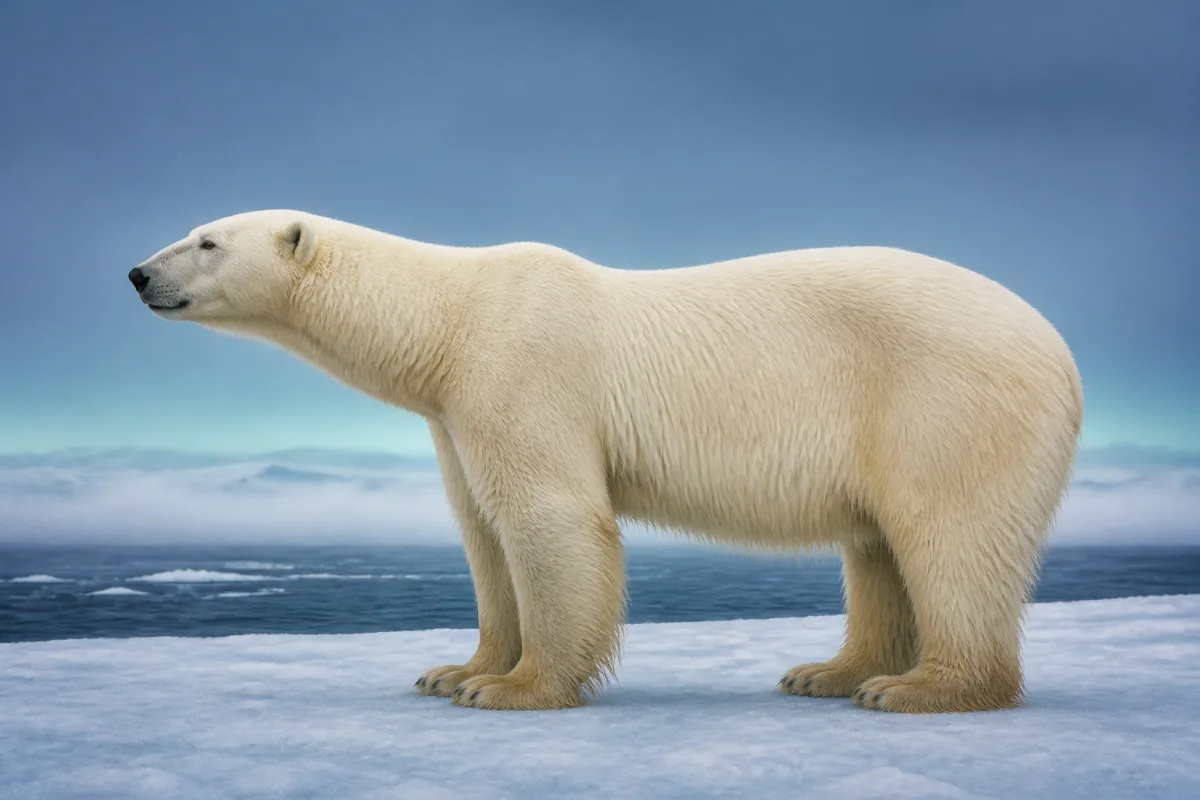
The polar bear is the largest living bear and the only one that United States law treats as a marine mammal, a designation it earns honestly, since almost everything it eats comes from the sea. Adult males commonly reach 8 to 10 feet in body length and weigh 700 to 1,300 pounds, roughly twice the size of adult females. Insulation is the foundation of its biology: dense underfur beneath long, hollow guard hairs traps air, and a fat layer up to four inches thick sits below black skin that absorbs what little solar warmth the Arctic offers.
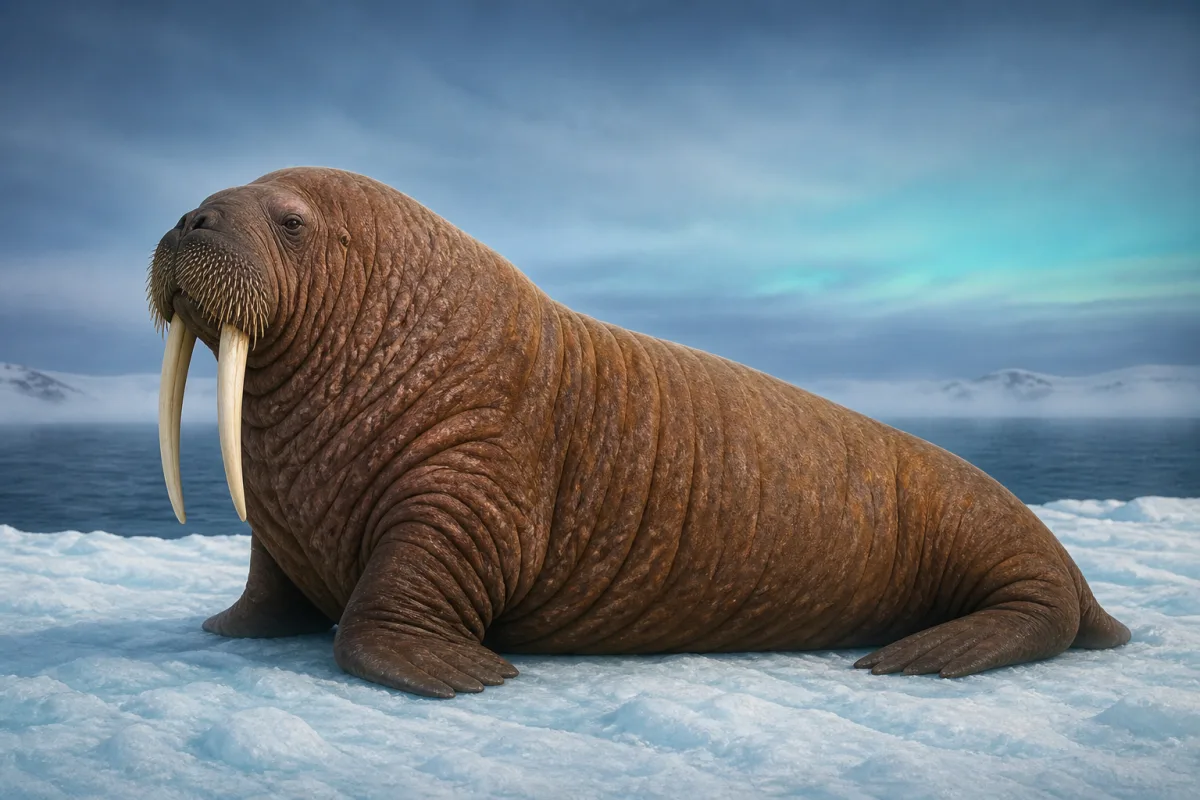
The walrus is the only surviving member of its family, sitting apart from both the true seals and the sea lions. A large Pacific bull runs to about 12 feet and can exceed 3,700 pounds, with thick, deeply creased hide, a broad muzzle carrying several hundred stiff whiskers, and tusks that in an old male may reach three feet. Females are smaller but also tusked, which is unusual among mammals, and the skin of a mature bull is studded with raised nodules known as bosses that females do not develop.
Set against each other, the walrus is much the heavier animal, with the largest bulls weighing roughly twice what the largest bears do. Both figures describe exceptional individuals rather than typical ones, and in both species mass swings by a third or more across the year as blubber is laid down and then drawn on. A walrus weighed in autumn and the same animal weighed after winter are not really the same measurement, and the same is true of a bear before and after the ice-free season.
Hunting from the ice, feeding beneath it
Still-hunting is the polar bear's signature method and it is mostly an exercise in patience. A bear locates a breathing hole by scent, lies down beside it and waits, sometimes for hours, then strikes as a seal surfaces. In spring it also stalks seals hauled out on the ice, approaching low and slowly across open snow, and breaks through the roofs of subnivean birth lairs where ringed seal pups are hidden beneath roughly three feet of packed snow. Success rates per attempt are low, which is why reliable ice during the spring pupping season matters more than any other part of the year.
The walrus feeds by excavation rather than pursuit. It swims down to a patch of soft sediment, orients head-down, and works across it using 400 to 700 stiff whiskers to identify buried prey by touch in near-total darkness and in silt clouds of its own making. Sediment is loosened with jets of water from the mouth and sweeps of the foreflippers, and the soft body of a clam is drawn out by suction from a piston-like tongue, leaving the shell intact. A single animal can take several thousand clams in one foraging bout. The tusks, despite persistent belief otherwise, play no part in digging.
The shared requirement is more specific than ice alone. A bear needs ice over continental shelf water where ringed seals concentrate, which is why bears are found along ice edges and over shelves rather than in the deep central Arctic basin. A walrus needs ice positioned over shallow bottom it can reach, since the bivalves it depends on live on shelf sediment generally less than 250 feet down. Ice drifting over deep water is useless to both, and that distinction matters more than total ice extent.
In the water and out of it
The polar bear is a surface swimmer rather than a diver. Recorded dives are brief and rarely exceed 20 feet, so its remarkable aquatic feats are horizontal: one satellite-tracked female in the Beaufort Sea swam continuously for nine days, covering about 426 miles of open water before she reached ice. On land it can sprint at roughly 25 miles per hour but cannot sustain it, because the insulation that keeps it alive in winter causes it to overheat quickly, which is one reason bears move slowly and rest often.
The walrus is the more capable diver but not by much, and it is limited by where its food lives rather than by its own ability. Feeding dives usually run between about 30 and 165 feet and last five to ten minutes, with deeper dives recorded but uncommon. In water it can manage a brief burst near 22 miles per hour, though ordinary swimming is closer to 4 and the animal is built for endurance and digging. Inflatable pouches in its throat let it float upright with its head above water while it sleeps.
The two occupy opposite sides of the same boundary. The bear is a land mammal that swims out of necessity, and the walrus is a marine mammal that must haul out to rest. Both therefore live at the interface between ice and water, and both are constrained by the same fact: the platform they need has to be within reach of the food they need, and those two requirements are coming apart.
Alone, and in thousands
Polar bears travel alone apart from females with dependent cubs and brief pairings during the spring mating season. Tolerance rises where food is concentrated: bears feed together at whale carcasses, which can draw dozens of animals to one site, and animals waiting out the ice-free season ashore in places such as western Hudson Bay rest in loose groups without defending territory. These are gatherings of circumstance rather than any social structure.
Walruses are gregarious to an extreme degree. They rest in dense heaps on ice floes or beaches, packed body against body in groups ranging from dozens to many thousands, and animals in a herd move and dive together. Herds are largely segregated by sex outside the breeding season. Mating takes place in the water during winter, with males competing through loud, complex underwater displays of clicks, knocks and bell-like sounds produced in part by those same inflatable pharyngeal pouches.
Massing is itself a defense. Orcas and polar bears are the only meaningful predators of walruses, and both concentrate on calves and on animals separated from the herd; a herd responds by bunching and driving its calves to the center. A healthy adult is rarely attacked, and bears more often take calves at crowded haulouts or scavenge animals killed in stampedes than confront a grown walrus. The bear's solitude means its own difficulties are individual rather than collective: body condition, and how long it must go without food.
Two of the slowest reproductive rates in the Arctic
Polar bears mate on the sea ice in April and May, after which the fertilized egg pauses its development until autumn, a delay called embryonic diapause. Pregnant females dig snow dens and give birth in midwinter to one or two cubs weighing about a pound. The family stays sealed in the den until March or April, and cubs normally remain with their mother for roughly two and a half years. Most wild bears that reach adulthood live 15 to 18 years and few pass 25, so a female's reproductive career is short.
The walrus has among the slowest reproductive rates of any pinniped. A single calf weighing 100 to 150 pounds is born in spring after a gestation of fifteen to sixteen months, which also includes a delay before the fertilized egg implants. The calf stays with its mother for two to three years, riding on her back in the water when small and being defended vigorously, so a female produces a calf only every second or third year at best. Females first breed at six to ten years, and animals reaching adulthood commonly live into their thirties.
The convergence is striking: two unrelated Arctic mammals, both using delayed implantation, both producing a single young at long intervals, both investing years in each one. Delayed implantation serves the same purpose in each case, separating the timing of mating from the timing of birth so that a cub or calf arrives when conditions favor it rather than whenever a mate happened to be encountered. The practical implication is the same for both. Neither population can respond quickly to a good run of years, and neither can absorb a sustained increase in mortality, which is why projections rather than current counts drive how both species are assessed.
Two Vulnerable listings, two unknown trends
The polar bear is listed as Vulnerable on the basis of projected declines in sea ice habitat rather than documented losses everywhere, and the Red List records the global trend as unknown, because several of the nineteen subpopulations recognized by the IUCN Polar Bear Specialist Group have never been surveyed adequately and others show contrasting trajectories. Satellite records kept by the National Snow and Ice Data Center show Arctic summer ice extent falling steadily since 1979, and long-term work by the U.S. Geological Survey has linked longer ice-free seasons to lower body condition and reduced cub survival in the southern Beaufort Sea.
The walrus is also listed as Vulnerable on projected sea ice loss rather than a documented decline, and its trend is likewise recorded as unknown, but for a different reason. The Pacific population is genuinely difficult to count: animals are spread across pack ice in two nations' waters, and successive survey methods are not comparable, so no reliable time series exists. The Atlantic subspecies is divided into small populations with individually better-known but varied trajectories, several still depleted from historical commercial hunting.
Their legal positions in the United States diverge. The polar bear has been listed as threatened under the Endangered Species Act since 2008, the first species listed primarily because of climate change. The Pacific walrus was found in 2017 not to warrant listing, a decision that drew criticism, and harvest by Alaska Native and other Arctic Indigenous communities is legal and managed. Both species carry deep subsistence and cultural importance for Arctic coastal communities.
The mechanism behind both listings is the same, and it operates through geography rather than temperature. As summer ice retreats off the Chukchi shelf into the deep Arctic basin, the combination of a resting platform over productive shallow water simply disappears. Walruses are forced ashore into land haulouts holding tens of thousands of animals, where any disturbance from aircraft, vessels or a predator can trigger a stampede that crushes calves, and where the surrounding seafloor is depleted by concentrated feeding. Bears face the other half of the same problem, a longer fast between hunting seasons and longer swims between floes.