Overview
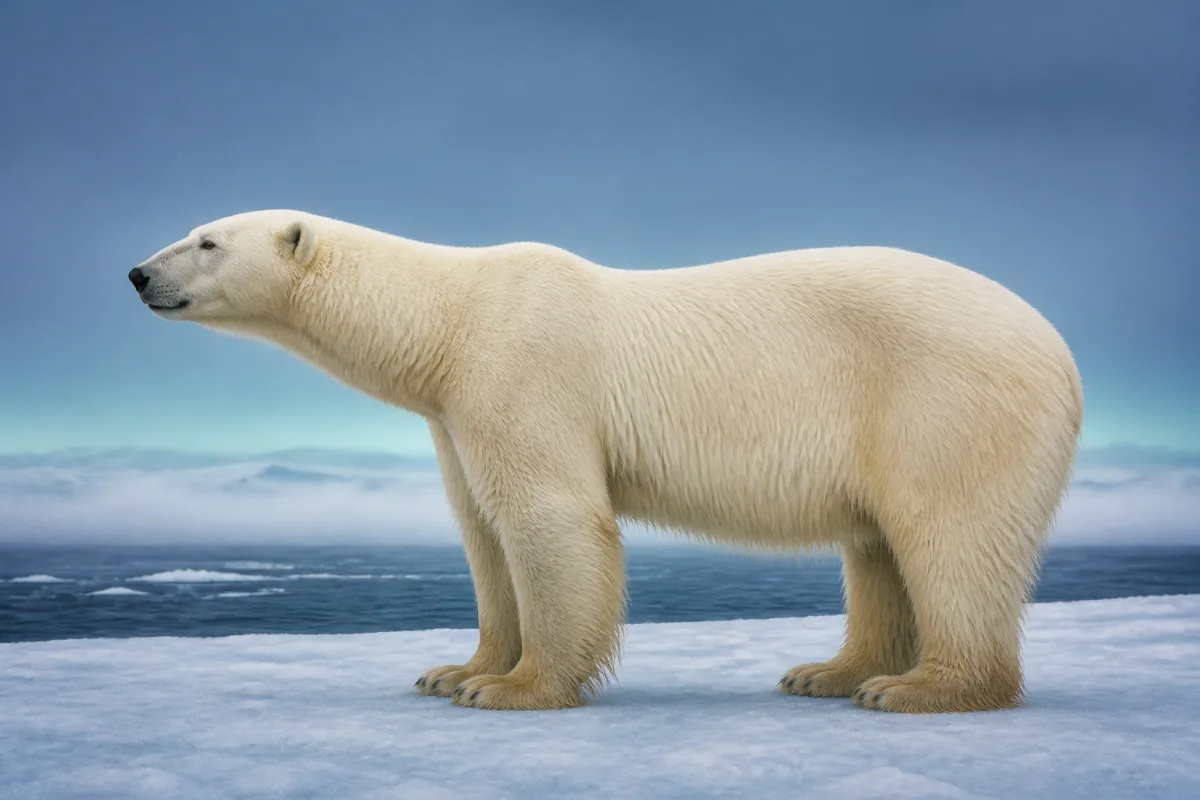
The polar bear is the largest living bear and the only one that United States law treats as a marine mammal. It earns that designation honestly: almost everything it eats comes from the sea, and it hunts from a platform of frozen seawater rather than from land. Adult males commonly reach 8 to 10 feet in body length and weigh 700 to 1,300 pounds, roughly twice the size of adult females. The difference between the sexes is among the largest of any bear.
Insulation is the foundation of its biology. A dense underfur beneath long, hollow guard hairs traps air, and a layer of fat up to four inches thick sits below black skin that absorbs what little solar warmth the Arctic offers. The system works so well that bears overheat when they run far on land, which is one reason they move slowly and rest often. Most hunting is patient rather than fast: a bear waits beside a breathing hole in the sea ice, sometimes for hours, for a ringed seal to surface.
Sea ice is therefore not scenery but infrastructure, and its decline is the central question in polar bear research. Satellite records kept by the National Snow and Ice Data Center show Arctic summer ice extent falling steadily since 1979, and long-term work by the U.S. Geological Survey has linked longer ice-free seasons to lower body condition and reduced cub survival in the southern Beaufort Sea. Not every subpopulation is affected equally, and several remain too poorly surveyed to describe with confidence, which is why the global trend is still reported as unknown.
Where it lives
Circumpolar across the Arctic, wherever sea ice forms over productive continental shelf waters. The range states are the United States, Canada, Greenland, Norway and Russia, with the largest numbers in the Canadian Arctic Archipelago and the smallest in marginal seas such as western Hudson Bay. Bears concentrate along ice edges and over shelves rather than in the deep central Arctic basin, where prey is sparse.
Habitat
- Sea ice & polar shelves
- Coastal waters
- Continental shelf
What it eats
Ringed seals supply most of the calories, with bearded seals second and harp, hooded and ribbon seals taken where they occur. Bears also take walrus calves and beluga trapped at breathing holes, and they feed heavily on stranded whale carcasses, which can draw dozens of animals to one site. Eider and murre eggs, kelp and berries are eaten ashore but do not substitute for seal fat.
- Marine mammals
- Carrion & whale falls
- Seabirds
How it hunts
Still-hunting is the signature method. A bear locates a breathing hole by scent, lies down beside it and waits, sometimes for hours, then strikes as a seal surfaces. In spring it also stalks seals hauled out on the ice, approaching low and slowly across open snow, and it breaks through the roofs of subnivean birth lairs where ringed seal pups are hidden. Success rates per attempt are low, which is why reliable access to ice during the spring pupping season matters more than any other part of the year.
Behavior
Social structure: Mostly solitary
Adults travel alone apart from females with dependent cubs and brief pairings during the spring mating season. Tolerance rises where food is concentrated: bears feed together at whale carcasses, and animals waiting out the ice-free season ashore in places such as western Hudson Bay rest in loose groups without defending territory.
Active period: Day & night
Active at any hour, which suits a region where the sun does not set for months in summer and does not rise for months in winter. Activity peaks in spring, when seal pups are available, and drops sharply during the ice-free season, when many bears fast ashore and conserve energy.
Reproduction
Live birth, milk-fed young.
Mating takes place on the sea ice in April and May, after which the fertilized egg pauses its development until autumn, a delay called embryonic diapause. Pregnant females dig snow dens and give birth in midwinter to one or two cubs weighing about a pound. The family stays sealed in the den until March or April, and cubs normally remain with their mother for roughly two and a half years.
Predators and ecological role
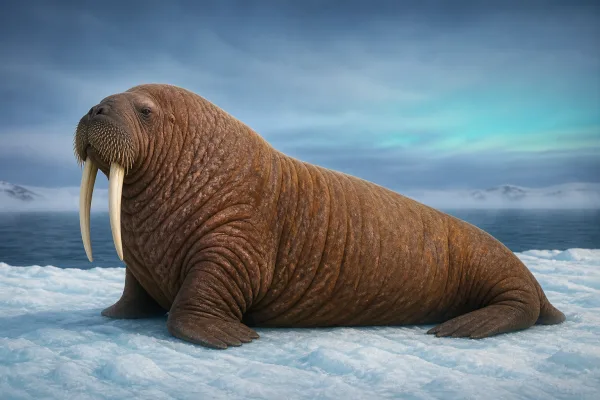
Adults have no natural predators. Cubs are occasionally killed by adult male polar bears and, rarely, by wolves, and a walrus defending itself can seriously injure or kill a bear that approaches it.
As the apex predator of the sea ice, the polar bear shapes where and how ringed seals rest and pup across the Arctic. Its leftovers matter as much as its kills: arctic foxes, glaucous gulls and ravens depend on carcasses that bears open and abandon, so the energy in a single seal is spread widely through the scavenger community.
Conservation and threats
Vulnerable Assessed 2015 · population unknown
Listed as Vulnerable on the basis of projected declines in sea ice habitat rather than documented losses everywhere. The Red List records the global trend as unknown, because several of the nineteen subpopulations recognized by the IUCN Polar Bear Specialist Group have never been surveyed adequately and others show contrasting trajectories. In the United States the species has been listed as threatened under the Endangered Species Act since 2008.
The loss of summer sea ice is the dominant pressure, lengthening the fast between hunting seasons and forcing longer swims between floes. Persistent organic pollutants and mercury concentrate in seal blubber and then in the bears that eat it. Subsistence harvest has been regulated across the range under an international agreement signed in 1973, but conflict killings rise as bears spend more time near settlements, and industrial activity and tourism add disturbance near denning areas.
Main pressures
- Sea ice loss
- Climate change
- Chemical pollution
- Hunting & persecution
- Human disturbance
Notable details
- A satellite-tracked female in the Beaufort Sea swam continuously for nine days, covering about 426 miles of open water before she reached ice.
- Polar bear skin is black and the guard hairs are hollow and colorless rather than white; the coat looks pale because it scatters light.
- In 2008 the polar bear became the first species listed as threatened under the Endangered Species Act primarily because of climate change.
- Scent is the primary hunting sense, and bears locate seal birth lairs concealed beneath roughly three feet of packed snow without seeing them.
Sources
-
U.S. Geological Survey
USGS
Long-term research programs, including polar bear population and sea ice studies.
-
National Snow and Ice Data Center
NSIDC
Sea ice extent and trend data underlying polar habitat descriptions.
-
The IUCN Red List of Threatened Species
International Union for Conservation of Nature
Global conservation assessments, population trends and threat classifications for every species profiled here.
-
U.S. Fish & Wildlife Service
USFWS
Listing decisions and recovery planning for protected marine and coastal species.
-
Smithsonian Ocean
Smithsonian National Museum of Natural History
Peer-reviewed public science writing on marine life, ecosystems and ocean change.
Figures on this page were last checked against these sources on .