Overview
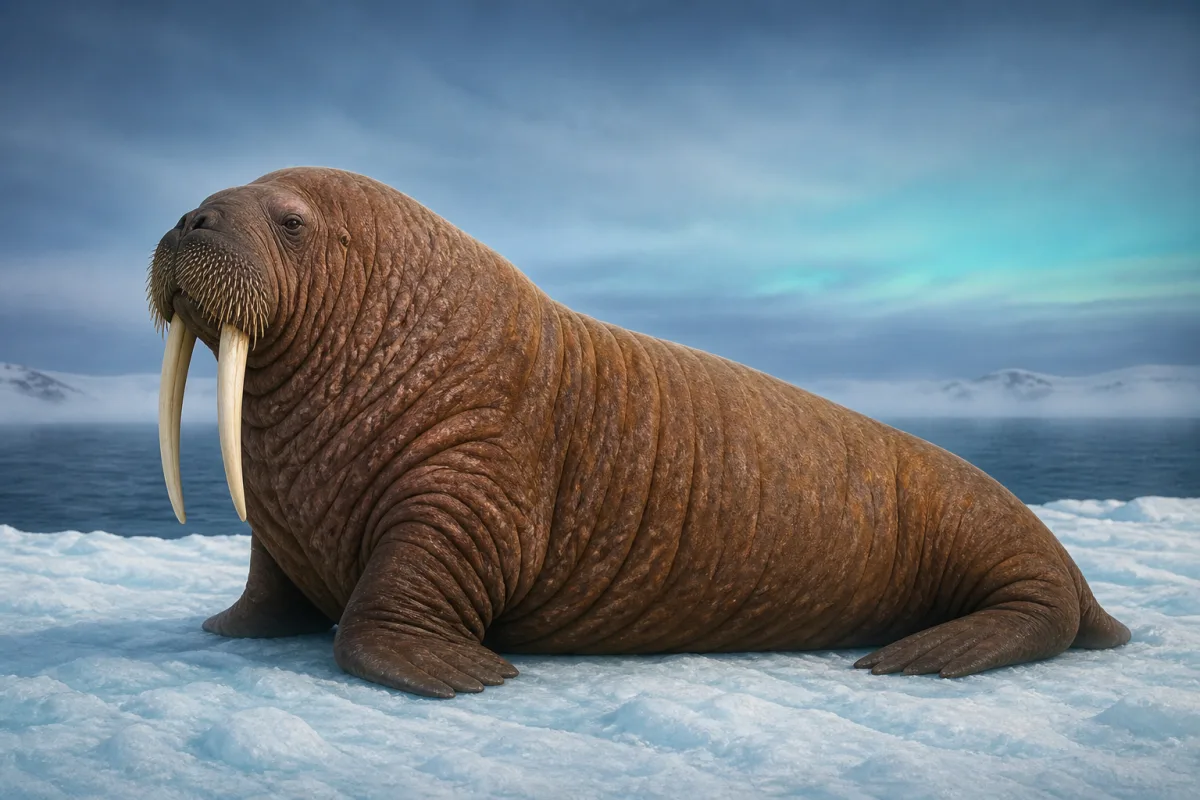
The walrus is the only surviving member of its family, sitting apart from both the true seals and the sea lions, and it is unmistakable. A large Pacific bull runs to about 12 feet and can exceed 3,700 pounds, with thick, deeply creased hide, a broad muzzle carrying several hundred stiff whiskers, and a pair of tusks that in an old male may reach three feet. Females are smaller and lighter but also tusked, which is unusual among mammals. The skin of a mature bull is studded with the raised nodules known as bosses, a secondary sexual feature absent in females.
Almost everything about the animal follows from what it eats. A walrus is a benthic specialist, feeding on clams and other invertebrates dug out of soft sediment in relatively shallow Arctic shelf water, usually less than 250 feet down. It works in near-total darkness, in silt clouds of its own making, and vision is close to useless there. Instead it relies on the vibrissae: roughly 400 to 700 of them, each thick, short and richly supplied with nerves, giving a tactile resolution fine enough to distinguish shapes and textures on the seafloor by touch alone.
Once a clam is located the tusks play no part in extracting it. The walrus seals its lips around the exposed edge of the shell and retracts a piston-like tongue against the roof of the mouth, generating suction strong enough to pull the soft body out and leave the shell behind. The same suction is used to excavate, along with jets of water squirted from the mouth and sweeps of the foreflippers, and a feeding animal leaves long furrows in the sediment. A single walrus can take several thousand clams in one foraging bout.
Where it lives
Circumpolar in the Arctic and adjacent seas, in two widely separated subspecies. The Pacific walrus occupies the Bering and Chukchi Seas between Alaska and the Russian Far East and makes a long seasonal migration with the ice edge, wintering in the Bering Sea and moving north through the Bering Strait in summer. The Atlantic walrus is broken into smaller, more isolated populations around eastern Canada, Greenland, Svalbard, Franz Josef Land and the Barents and Kara Seas. A separate population inhabits the Laptev Sea. Nearly all of the range lies over shallow continental shelf, because that is where the clams are.
Habitat
- Sea ice & polar shelves
- Continental shelf
- Coastal waters
- Sandy flats & seagrass beds
What it eats
Overwhelmingly benthic invertebrates, with bivalve molluscs such as clams and cockles making up the bulk of it, alongside marine worms, snails, shrimp, crabs, sea cucumbers and soft coral. Fish are taken occasionally and are a minor component. A small number of individuals, usually large males, learn to prey on ringed and bearded seals and on seabirds, and these animals become noticeably different from the rest in behavior and appearance; the habit is rare enough to be treated as individual specialization rather than a species trait.
- Clams & other molluscs
- Seafloor invertebrates
- Crustaceans
- Bony fish
- Marine mammals
How it hunts
Feeding is excavation rather than pursuit. The walrus swims down to a patch of soft sediment, orients head-down, and works across it using the vibrissae to identify buried prey by touch. It loosens the sediment with jets of water from the mouth and with sweeps of its foreflippers, then applies suction to draw the soft body of a bivalve out of its shell, discarding the shell intact. Foraging bouts last several minutes per dive and are repeated for hours, and the furrows left behind are visible in seafloor surveys. The tusks, despite persistent belief to the contrary, are not used for digging; they serve for hauling the body onto ice, for display and for fighting.
Behavior
Social structure: Breeding colonies
Gregarious to an extreme degree. Walruses rest in dense heaps on ice floes or beaches, packed body against body in groups that range from dozens to many thousands, and animals in a herd move and dive together. Herds are largely segregated by sex outside the breeding season. Mating takes place in the water during winter, with males competing through loud, complex underwater displays of clicks, knocks and bell-like sounds produced in part by inflatable pharyngeal pouches, which also let the animal float head-up while it rests at the surface.
Active period: Day & night
Feeding bouts alternate with long periods hauled out, cycling through the day and night rather than following a light schedule; through much of the range there is continuous daylight in summer and continuous darkness in winter in any case. An animal typically feeds for one to two days and then rests ashore or on ice for a comparable stretch.
Reproduction
Live birth, milk-fed young.
Among the slowest reproductive rates of any pinniped. A single calf weighing 100 to 150 pounds is born in spring after a gestation of fifteen to sixteen months, including a delay before the fertilized egg implants. The calf stays with its mother for two to three years, riding on her back in the water when small and being defended vigorously, and a female therefore produces a calf only every second or third year at best. Females first breed at six to ten years and males rather later, since success depends on reaching full size.
Predators and ecological role
Orcas and polar bears are the only meaningful predators, and both concentrate on calves and on animals separated from the herd. A healthy adult walrus is dangerous to attack, and polar bears more often take calves at crowded haulouts or scavenge animals killed in stampedes than confront a grown animal. Herds respond to threats by massing and by driving calves to the center of the group.
The walrus is the principal large consumer of shelf-bottom invertebrates across the Arctic, and its feeding physically reworks the seafloor. Digging turns over sediment, releases buried nutrients into the water column and exposes prey for other animals, which makes the species an agent of disturbance in the ecological sense rather than only a consumer. Its dependence on shallow shelf water reachable from sea ice ties it more tightly to ice conditions than most Arctic predators, so its distribution is a direct readout of where usable ice sits over productive bottom. It also carries deep cultural and subsistence importance for Arctic coastal communities.
Conservation and threats
Vulnerable Assessed 2016 · population unknown
Listed as Vulnerable on the basis of projected sea ice loss rather than a documented decline in current numbers. The trend is recorded as unknown because the Pacific population is genuinely difficult to count: animals are spread across pack ice over two nations' waters, and successive survey methods are not comparable, so no reliable time series exists. The Atlantic subspecies is divided into small populations with individually better-known but varied trajectories, several still depleted from historical commercial hunting. In the United States the Pacific walrus was found in 2017 not to warrant listing under the Endangered Species Act, a decision that drew criticism; harvest by Alaska Native and other Arctic Indigenous communities is legal and managed.
Sea ice loss is the central problem, and it acts through geography rather than through temperature. A walrus needs ice as a resting platform positioned over shallow water it can feed in; as summer ice retreats off the Chukchi shelf into the deep Arctic basin, that combination disappears, and the animals are forced ashore. The resulting land haulouts hold tens of thousands of animals in one place, where any disturbance from aircraft, vessels or a predator can trigger a stampede that crushes calves, and where the surrounding seafloor is depleted by concentrated feeding. Expanding shipping through newly open Arctic routes brings noise and strike risk, oil and gas activity adds spill risk in the Chukchi and Barents Seas, and contaminants accumulate in a long-lived, fat-rich animal.
Main pressures
- Sea ice loss
- Climate change
- Human disturbance
- Hunting & persecution
- Chemical pollution
- Underwater noise
Notable details
- The 400 to 700 whiskers on a walrus's muzzle are sensitive enough for the animal to identify buried clams by touch in complete darkness, and each is served by a dense supply of nerves.
- Clams are extracted by suction from a piston-like tongue, not with the tusks, and the shells are left behind intact; one animal may take several thousand in a single feeding bout.
- Both sexes grow tusks, which are elongated upper canines used for hauling the body onto ice, for display and for fighting. The scientific name Odobenus rosmarus means roughly tooth-walking sea horse.
- Inflatable pouches in the throat let a walrus float upright with its head above water while it sleeps, and are also used to produce the bell-like sounds of a male's underwater display.
Sources
-
The IUCN Red List of Threatened Species
International Union for Conservation of Nature
Global conservation assessments, population trends and threat classifications for every species profiled here.
-
Species Directory
NOAA Fisheries
Management-grade biology, distribution and stock information for species in United States waters.
-
U.S. Geological Survey
USGS
Long-term research programs, including polar bear population and sea ice studies.
-
National Snow and Ice Data Center
NSIDC
Sea ice extent and trend data underlying polar habitat descriptions.
-
Smithsonian Ocean
Smithsonian National Museum of Natural History
Peer-reviewed public science writing on marine life, ecosystems and ocean change.
-
Animal Diversity Web
University of Michigan Museum of Zoology
Referenced accounts of anatomy, reproduction, behavior and life history.
Figures on this page were last checked against these sources on .