
What the numbers mean
The sperm whale and the giant squid are bound together in the public imagination by images no one has ever captured. There is no film of the two animals meeting, no photograph, no direct observation of a hunt. What exists instead is a large body of indirect evidence: squid beaks by the thousand in whale stomachs, circular scars on whale skin, and a handful of recent deep-sea encounters with living squid. The relationship is real, and nearly everything about how it works is inferred.
Comparing them is less a matter of matching numbers than of following a food chain that operates a mile below the surface. A large sperm whale weighs on the order of 150 times what a large giant squid does. The squid is not a counterpart; it is one item in a diet made up mostly of much smaller cephalopods. What makes the pairing worth examining is that each animal has been a primary source of evidence about the other for more than a century.
The size gap, and what the numbers actually describe
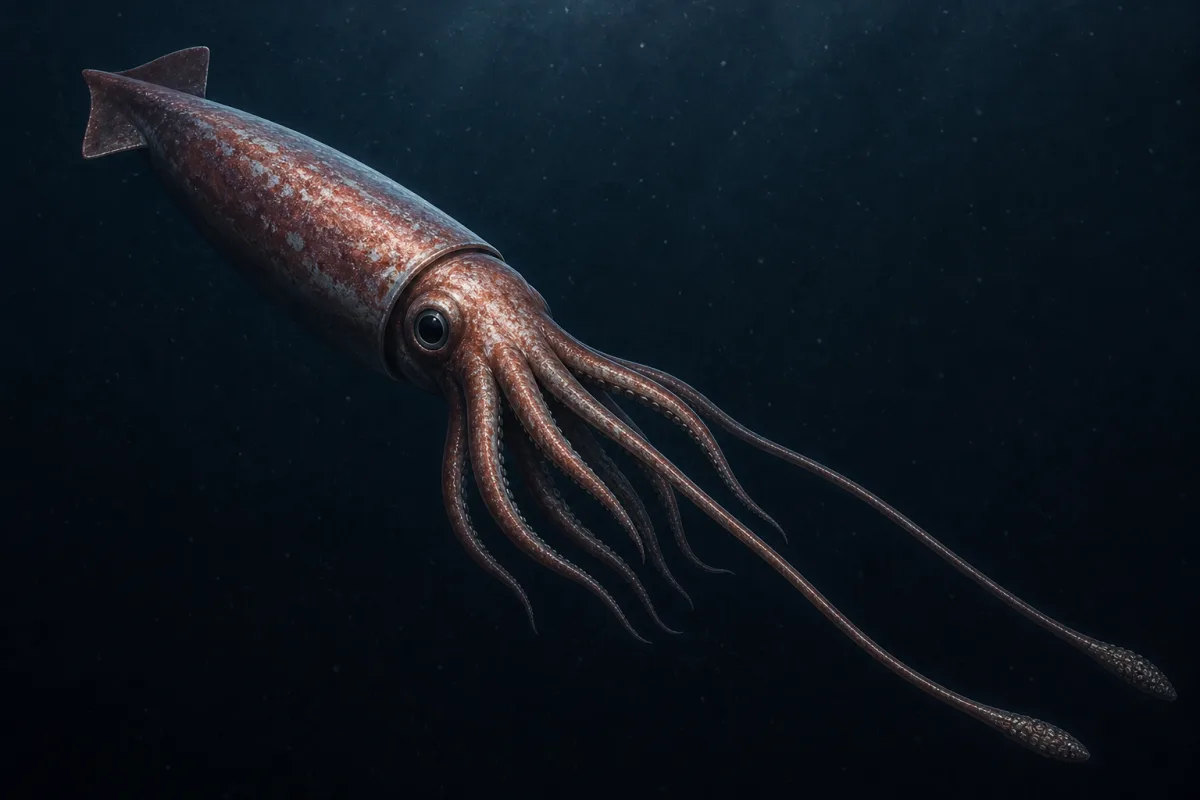
Length flatters the squid and mass does not. Giant squid have the longest body of any invertebrate, with maximum total length running to roughly 43 feet in females measured relaxed after death, but the mantle, the muscular body proper, is not known to exceed about 7 feet. Most of that headline length is elastic feeding tentacle. The heaviest reliable weights are near 600 pounds. A large sperm whale reaches roughly 52 feet and can approach 45 tons, so the two are not remotely in the same weight class.
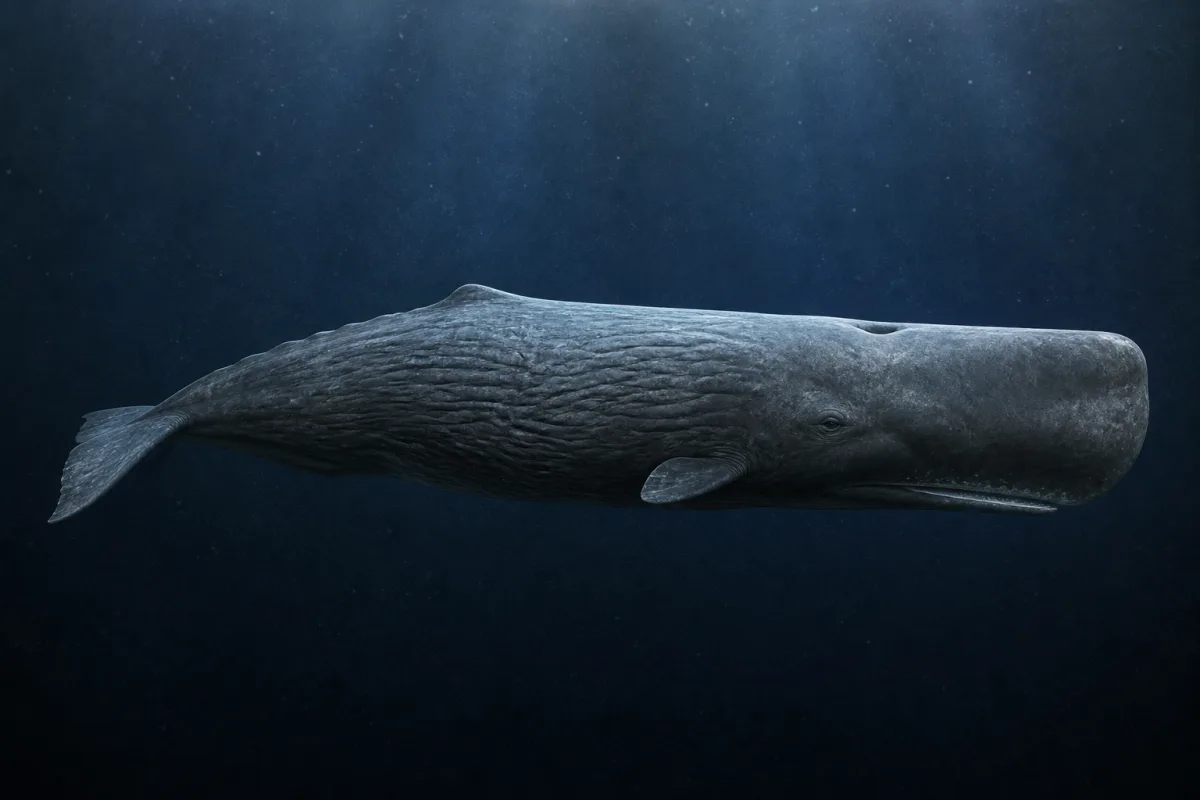
The whale's proportions are strange in their own way. Its blunt, boxy head accounts for about a third of the body and houses the spermaceti organ, a reservoir of waxy oil that shapes and focuses sound, while functional teeth are set only in the narrow lower jaw. Sexual size difference is extreme: females mature near 36 feet while large males approach 52. Whaling-era reports of 65-foot animals circulate widely but are not reliably documented, a problem the two species share.
Both animals, in other words, come with measurement caveats attached. Squid figures depend on whether tentacles were stretched and on whether the specimen was fresh, frozen or long dead, and they derive from a sample of carcasses, strandings and trawl bycatch weighted toward damaged animals. Whale masses are almost never taken directly and are usually estimated from length. Any comparison of the two should be read as approximate at both ends.
Two solutions to the same darkness
Both animals make their living where sunlight does not reach, and each solved that problem differently. The sperm whale hunts by sound, producing clicks in its nose that have been measured above 230 decibels, the loudest known biological sound source in the ocean. Descending whales emit slow, regular pulses that scan the water ahead and switch to rapid buzzes in the final seconds before capture. Because the clicks are directional and regular, researchers can count whales acoustically and estimate an individual's length from the spacing within a single click.
The giant squid answers with vision. Its eyes are roughly 10 inches across, the largest of any animal except the colossal squid, and a leading hypothesis holds that they are built to detect the faint bioluminescence stirred up by a large body moving through the water. If that is right, the same organ the squid uses to find prey may also give it warning of an approaching whale. The idea is plausible and widely cited, but it has not been tested on a living animal.
The depths at which the two overlap are well matched. Sperm whales take most of their squid between about 1,300 and 4,000 feet on dives that typically last around 45 minutes, and well-supported tag records reach roughly 6,500 feet. Giant squid records cluster between about 1,000 and 3,300 feet, over continental slopes, islands and offshore banks. That band of the water column is where the encounters must occur, and it is also where direct observation is hardest and rarest.
The evidence, and what it can and cannot show
The giant squid was known from sperm whales before it was known from the sea. Beaks accumulate in whale stomachs because they resist digestion, and they were among the first hard evidence that the animal existed at all; ambergris, the substance long used to fix scent in perfume, forms in the intestine around those same indigestible beaks. Circular scars on whale skin, left by suckers ringed with hard toothed rims, pointed the same way. The colossal squid was described in 1925 from two arm crowns found inside a sperm whale.
That evidence establishes the relationship and very little else. Stomach contents show what a whale ate, not how it caught it, and beaks persist long enough that they may accumulate over many meals. Sucker scars show that a squid's arms were in contact with a whale, but not whether the whale was hunting, whether the squid was already dying, or how the encounter ended. Scars also cannot easily be assigned to a species, since several large squid leave similar marks.
Live observation of giant squid is recent and still thin. A Japanese team photographed a hunting adult at about 3,000 feet in 2004 and filmed one at the surface in 2012, and researchers recorded the first footage in United States waters in the Gulf of Mexico in 2019. Those encounters mattered because they settled a long argument about whether the animal was an active predator or a passive drifter. They did not include a whale.
What the anatomy suggests about the encounter
The squid's feeding apparatus is now reasonably well understood. It holds the eight shorter arms spread and shoots the two long feeding tentacles out to seize prey, hauling it back toward a beak and a toothed radula that cut it into pieces small enough to pass through an esophagus that runs through the middle of the brain. Deep-water fish such as orange roughy and hoki appear in its stomach, along with other squid, including members of its own species. It is a predator of animals faster than itself.
The whale's apparatus points the other way. Prey is likely taken by suction rather than by biting, since the lower jaw is narrow and animals with broken or missing jaws have been found in good condition. A single whale may capture dozens of squid on one dive before surfacing for eight or nine minutes of recovery breathing. That figure is worth holding onto, because it indicates the scale at which the whale operates: it is processing many small animals, not pursuing one large one.
Squid make up the great majority of the sperm whale's diet by number, but most of them are medium-sized species weighing a few pounds. Giant squid are a minority item, and how often a whale takes one is not known. Nor is it known whether a giant squid ever escapes, whether the whale's clicks disorient it, or whether most of the animals eaten are already weakened. These are reasonable questions with no observational answers, and the honest position is that the encounter itself remains undescribed.
Opposite life histories, opposite conservation problems
The two animals run on completely different clocks. A sperm whale may live 50 to 70 years, matures late, and produces a single 13-foot calf every four to six years, nursing it for at least two. Ages are read from growth layers in the teeth, a method whose calibration remains debated. A giant squid probably lives only a few years, though published estimates range from about two to twelve and none is settled, and it is presumed to spawn once and die after releasing eggs numbered in the millions.
Those clocks explain the conservation categories. The sperm whale is assessed as Vulnerable: twentieth-century whaling removed an estimated three-quarters of a million animals, the heaviest losses fell on large males, and a species that replaces itself this slowly recovers over generations rather than decades. It has been listed as endangered in United States waters since 1970 and appears on CITES Appendix I. Today the leading direct causes of death are entanglement in fishing gear and collisions with large vessels.
The giant squid is listed as Least Concern, on the basis of a worldwide deep-water range and no targeted fishery, and genetic work on 43 individuals collected around the globe found unusually low diversity, consistent with a single population mixing across ocean basins. That category should be read carefully. There is no abundance estimate for the species anywhere, nothing is monitored, and a fast-breeding animal that nobody counts can change a great deal before anyone notices.