Overview
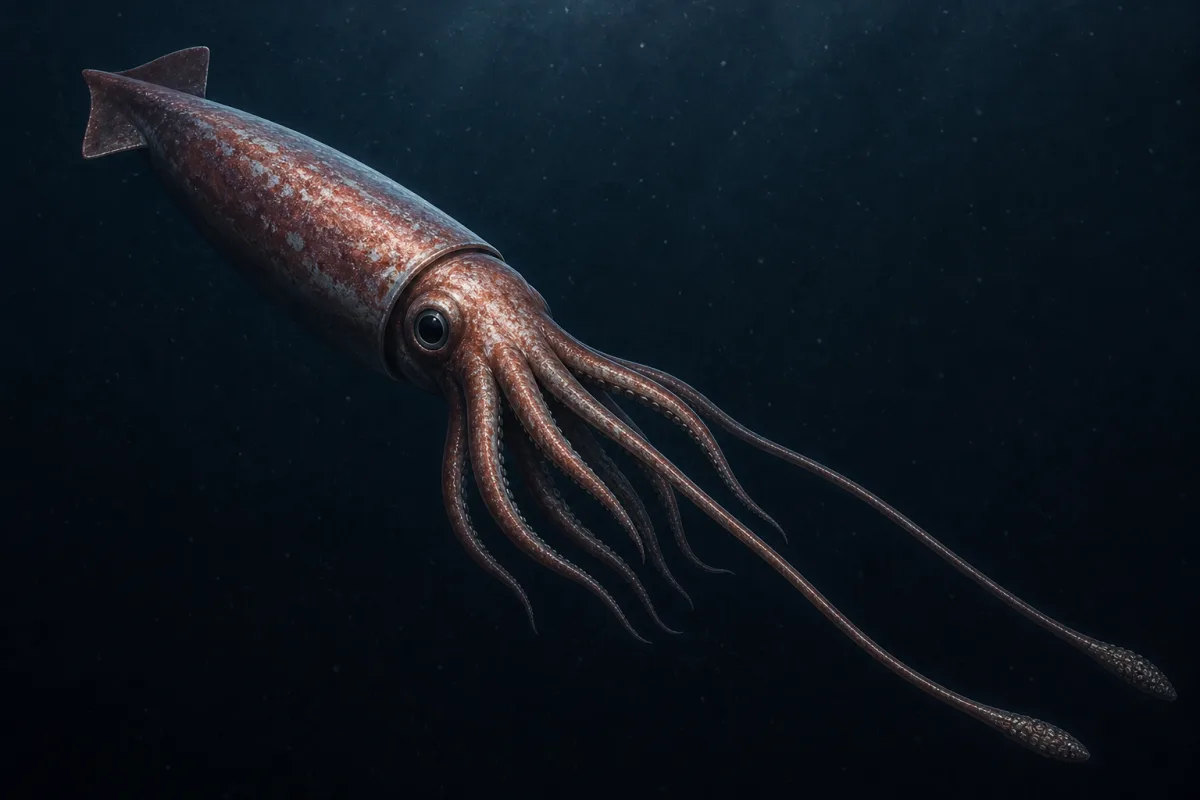
The giant squid has the longest body of any invertebrate, and also the most overstated dimensions. From more than 130 examined specimens, the mantle is not known to exceed about 7 feet, and the animal excluding its two feeding tentacles rarely passes 16 feet. Measured relaxed after death, maximum total length runs to roughly 43 feet in females and 33 feet in males. Reports of 60 feet or more, common in older literature, have never been scientifically documented.
That gap between mantle length and total length matters when comparing giants. The colossal squid of the Southern Ocean is much heavier and bulkier, at about 1,100 pounds against roughly 600 for the largest giant squid, yet shorter, because so much of this animal's length is elastic tentacle. Nearly all specimens come from carcasses at the surface, strandings, trawl bycatch and beaks in sperm whale stomachs, a sample weighted toward dying, damaged or partly digested animals.
Live observation is recent. A Japanese team photographed a hunting adult at about 3,000 feet in 2004 and filmed a live one in the deep sea in 2012, and researchers recorded the first footage in United States waters in the Gulf of Mexico in 2019. Those encounters showed an active predator that strikes with its two long tentacles rather than a drifting scavenger. Genetic work on 43 individuals worldwide found remarkably low diversity, consistent with a single species mixing across ocean basins.
Where it lives
All major oceans, generally in deep water over continental slopes, islands and offshore banks, and scarce in polar seas. Strandings and captures cluster where deep water meets land, notably off New Zealand, Japan, Spain, Norway, Newfoundland, South Africa and the Falkland Islands, which reflects observer effort as much as true abundance.
Habitat
- Deep sea
- Open ocean
- Continental shelf
What it eats
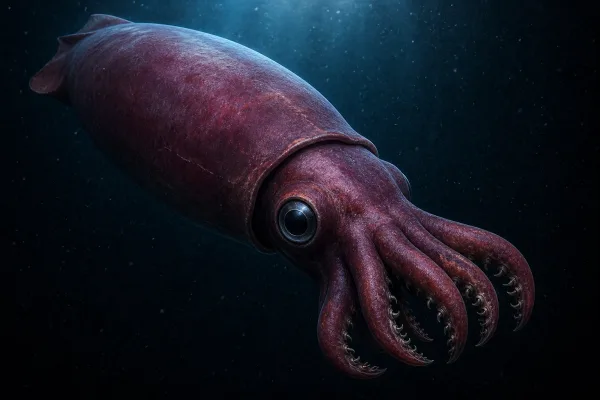
Stomach contents point to deep-water fish such as orange roughy and hoki, along with other squid, including members of its own species. Prey is drawn in by the two feeding tentacles, whose clubbed tips carry suckers ringed with chitinous teeth, then cut apart by a beak and a toothed radula before it reaches the esophagus, which passes through the middle of the brain.
- Bony fish
- Squid & octopus
How it hunts
The 2004 and 2012 footage settled a long argument about how the animal feeds. It holds the eight shorter arms spread and shoots the two feeding tentacles out to seize prey, then hauls it back toward the beak, a strike that works on animals moving faster than the squid itself. Its eyes, about 10 inches across, are thought to detect the faint bioluminescence stirred up by an approaching sperm whale, so the same organ that finds prey may also give warning.
Behavior
Social structure: Mostly solitary
Specimens are nearly always recovered alone, and the species is assumed to live alone through most of its life. Occasional multiple captures in a single haul suggest loose concentrations where deep-water prey is dense, but nothing is known about how or whether individuals interact.
Active period: Day & night
At the depths it occupies there is little day-night cycle, and the few live records span both. Some vertical movement toward shallower water at night is likely but poorly documented.
Reproduction
Spawns once, then dies.
Mature females carry very large numbers of small eggs, with estimates running into the millions. Males lack the arm used by most squid to pass a sperm packet and instead appear to implant packets directly into the female's arms, where they have been found embedded in the tissue. The species is presumed to spawn once and die, but no spawning, egg mass or hatchling has been observed in the wild.
Predators and ecological role
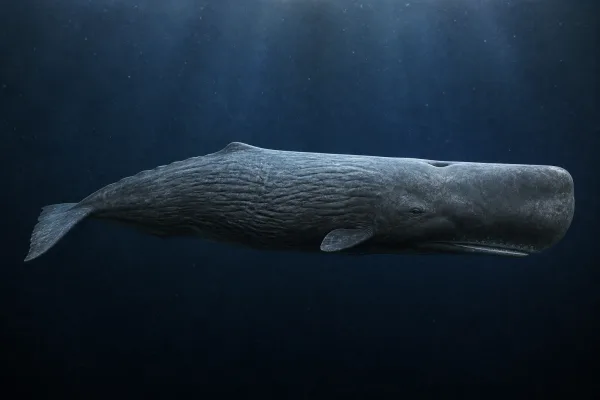
Sperm whales are the main predator, and the beaks in their stomachs, along with circular sucker scars on their skin, were the first hard evidence the species existed. Pilot whales, sleeper sharks and southern elephant seals also take them, and the small juveniles are eaten by a wide range of deep-water fish.
The species moves energy from deep midwater fish into animals that surface to breathe, and forms a substantial share of the diet of sperm whales across ocean basins. Its own eggs and paralarvae, produced in huge numbers and drifting on ocean currents, feed the midwater community that its adults later hunt.
Conservation and threats
Least Concern Assessed 2014 · population unknown
Least Concern on the basis of a worldwide deep-water range and no targeted fishery. Genetic data indicate a single global population, which reduces the risk that a local event would matter much, but there is no abundance estimate for the species anywhere.
Deep trawls take giant squid occasionally, particularly around New Zealand and the southwest Atlantic, and the numbers involved are small. Broader changes in the midwater ocean, including warming and reduced oxygen at depth, could affect its prey base, but no study has tested that for this species, and nothing is monitored.
Main pressures
- Bycatch in other fisheries
- Ocean warming
- Chemical pollution
Notable details
- Its eyes are roughly 10 inches across, the largest of any animal except the colossal squid, and are thought to detect the faint glow stirred up by an approaching sperm whale.
- The suckers on its two feeding tentacles are ringed with hard toothed rims, and their circular marks are found on the skin of sperm whales.
- A 2013 genetic study of 43 individuals collected worldwide found unusually low diversity, indicating one species that mixes across ocean basins.
- The animal's esophagus passes through the middle of its brain, so food must be cut into small pieces by the beak before it can be swallowed.
Sources
-
SeaLifeBase
SeaLifeBase Project
Companion database to FishBase covering non-fish marine organisms, including cephalopods.
-
Monterey Bay Aquarium Research Institute
MBARI
Deep-sea observations, including remotely operated vehicle records of squid and midwater predators.
-
Smithsonian Ocean
Smithsonian National Museum of Natural History
Peer-reviewed public science writing on marine life, ecosystems and ocean change.
-
World Register of Marine Species
WoRMS Editorial Board
Authority used for accepted scientific names, families and taxonomic placement.
-
The IUCN Red List of Threatened Species
International Union for Conservation of Nature
Global conservation assessments, population trends and threat classifications for every species profiled here.
Figures on this page were last checked against these sources on .