
What the numbers mean
The Atlantic bluefin tuna and the swordfish are caught on the same longlines, appear in the same markets, and are both routinely described as warm-blooded fish. The description is loose in a way worth unpacking, because the two species heat different parts of themselves for entirely different reasons. The tuna warms nearly everything it uses to swim and see. The swordfish warms almost nothing except its brain and its retinas.
That difference explains where each animal goes. The bluefin uses its warmth to cross latitude, feeding in northern water near 45 degrees Fahrenheit and returning to subtropical seas to spawn within a single year. The swordfish uses its warmth to cross depth, descending below the thermocline at dawn to hunt squid in cold darkness and rising to the surface again at night. Both are among the most valuable fish in the world, and both have been shaped as much by management as by biology.
Two kinds of internal heating
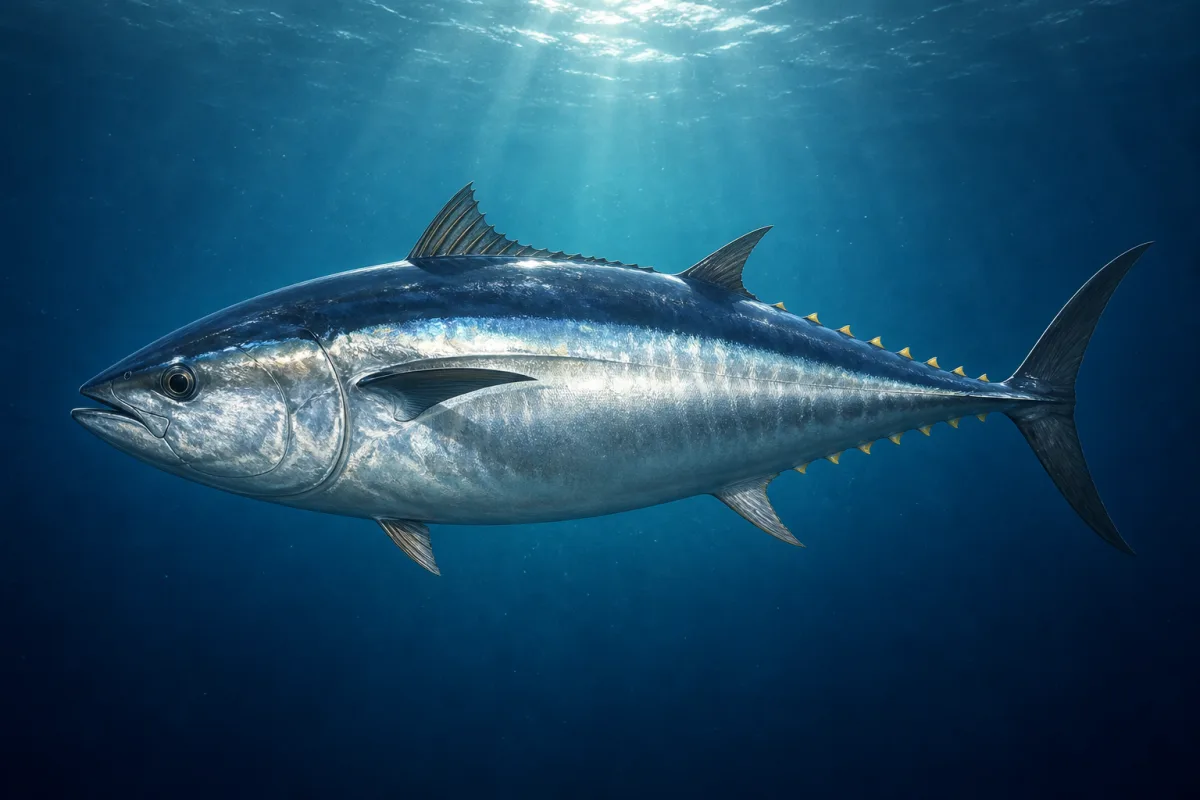
The bluefin is a regional endotherm. Dense networks of intertwined arteries and veins trap metabolic heat before it can be lost across the gills, keeping the swimming muscles, viscera, eyes and brain well above the temperature of the surrounding water. A fish feeding off Newfoundland in water near 45 degrees Fahrenheit can hold its core close to 70. Warm muscle delivers more power, warm viscera digest faster, and warm eyes and brain shorten reaction time, which together let one population exploit cold feeding grounds and warm spawning grounds in the same year.
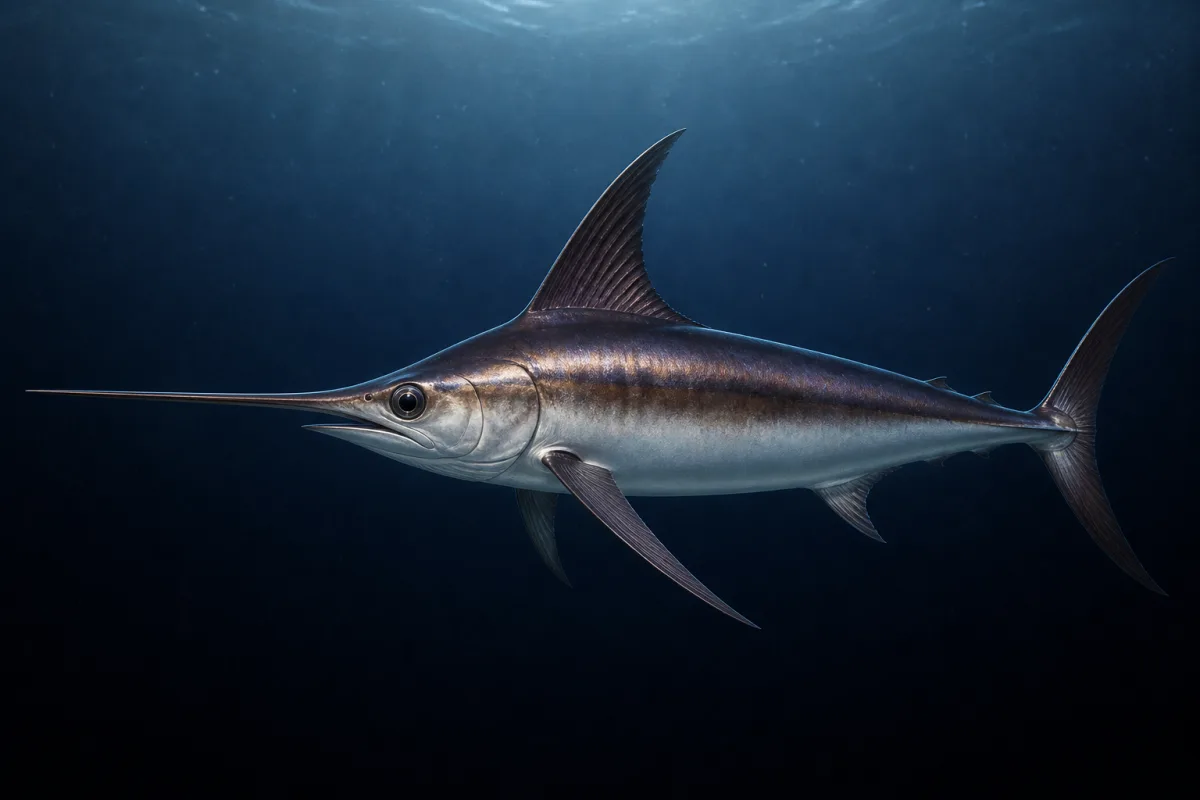
The swordfish heats a much smaller target far more intensely. A specialized heater organ beside the brain, built from modified eye muscle, keeps the brain and retinas up to about 25 degrees Fahrenheit warmer than the water. The reason is optical rather than muscular. Warm retinas respond to movement much faster than cold ones, and in dim, cold water where prey registers as a flicker of contrast rather than a shape, reaction time is the limiting factor. The rest of the fish runs at sea temperature.
The two solutions cost different amounts and buy different things. Heating an entire body is expensive and has to be paid for with heavy, sustained feeding, which is why a bluefin converts its northern surplus into the fat reserves that fund a transatlantic migration. Heating a brain is cheap by comparison and buys access to a place rather than a pace: it allows the swordfish to hunt effectively at depths where most large predatory fish would be too sluggish to catch anything.
A spindle and a blade
The bluefin is a thick spindle with a narrow, stiff, crescent tail that works less like a paddle than a propeller blade. Its pectoral and first dorsal fins fold flat into grooves in the body during a high-speed run, leaving an almost unbroken profile. Mature fish commonly run 6 to 8 feet, and the largest reliably recorded individuals approach 15 feet and roughly 1,500 pounds, though weight varies so much with feeding condition that two fish of the same length caught in different seasons can differ by a third.
The swordfish is longer-bodied and organized around its bill, a long, flattened, double-edged structure that gives the species its older name of broadbill. Adults have neither teeth nor scales, unlike the larvae, which hatch with both and lose them during development. Adults reach about 10 feet from bill tip to tail fork, with the largest verified individuals approaching 15 feet, and nearly all very large swordfish are female. The heaviest rod-caught individual, landed off Chile in 1953, weighed 1,182 pounds.
Their maximum sizes are close enough that the comparison hinges on how each is measured. Fishery records for both species usually report length from the lower jaw to the tail fork, which for a swordfish excludes the bill entirely, so figures that include it run substantially longer for the same fish. Anyone comparing published lengths for these two should check which convention was used before drawing a conclusion from the difference.
Dividing the water column
The bluefin is chiefly a fish of the upper ocean. Most of its time is spent in the top 300 feet, where its prey schools, though archival tags record repeated dives past 1,500 feet, usually brief and often at dawn. Its great journeys are horizontal. Conventional tags, electronic tags and the chemical signature locked into ear stones all show fish crossing the North Atlantic between feeding grounds off Newfoundland, Norway and Iceland and spawning areas thousands of miles away.
The swordfish makes its great journeys vertically, every day. Archival tags show a consistent pattern of descending below the thermocline at dawn, often past 1,500 feet, and rising to feed near the surface after dark, tracking the daily movement of the deep scattering layer. Most of its time is spent between the surface and about 2,600 feet, and tag records place the species deeper than 9,000 feet, making it one of the deepest-ranging of the large predatory fish.
The result is two animals that share a map but not a habitat. A swordfish spends its daylight hours in water a bluefin visits only in short excursions, and the two are most likely to overlap in the surface layer at night. Both, however, concentrate along the same features: steep temperature fronts, shelf edges and seamounts, which is one reason a single longline set can catch both. That partial overlap has practical consequences, because gear set for one species reliably encounters the other, and the two are assessed and regulated by the same international bodies for exactly that reason.
Hunting in company and hunting alone
Bluefin run down schooling prey in open water rather than ambushing it, and they often do it together. Groups spread into a broad curved rank that drives baitfish toward the surface before individual fish cut through the school. Schools are sorted by size and are fluid rather than fixed, forming and dispersing around prey. Herring, mackerel, sand lance, sardines, anchovies and squid dominate the diet in most regions, and small bluefin take crustaceans and larval fish before graduating to forage species.
Swordfish are normally encountered alone and are widely spaced even where they are abundant. A hunting fish moves into a concentration of squid or schooling fish and sweeps its bill through it in fast lateral strokes, then collects the injured animals. Squid recovered from swordfish stomachs are frequently cut in halves, and since adults have no teeth, prey must be swallowed whole or reduced to pieces first. The bill is stiff, streamlined and edged rather than pointed, which suits slashing far better than piercing.
Squid make up the largest share of the swordfish diet in most regions, which is precisely why it follows the deep scattering layer up and down each day. The bluefin's prey stays nearer the surface, so its feeding schedule peaks in daylight and at dusk when schooling fish are easiest to see. Two warm-bodied predators end up on opposite daily rhythms because their food does. The bluefin also feeds far more heavily than the swordfish needs to, because it has to convert a northern surplus into the fat reserves that fund a migration of thousands of miles to its spawning grounds.
Spawning grounds and the geography of management
Both species spawn by releasing eggs and sperm into warm surface water with no parental care, and both produce several million eggs per large female across a season. The difference is where. Swordfish spawn year-round in equatorial waters and seasonally at higher latitudes wherever surface temperatures exceed about 75 degrees Fahrenheit. Atlantic bluefin spawning is confined to two places: the Mediterranean Sea and the Gulf of Mexico, which is the single most consequential fact in the management of the species.
Fish from both bluefin origins mix on North Atlantic feeding grounds while returning to their natal region to spawn, and chemical signatures in their ear stones allow researchers to tell a Mediterranean-born fish from a Gulf of Mexico-born fish caught side by side. The two stocks are therefore assessed and managed separately. Deep quota cuts and tighter catch documentation after 2007 rebuilt the eastern stock substantially, which moved the species from Endangered to Least Concern in 2021, while the western stock remains far below its historical size.
The swordfish shows a similar regional split under a single global category. It is assessed as Least Concern because the species is widespread and several stocks are considered healthy, but the North Atlantic stock was overfished in the 1990s and rebuilt under international quotas, while the Mediterranean stock has been depleted for decades and is subject to separate recovery measures. Undersized fish have long been landed there in quantity. As a long-lived predator, the species also accumulates mercury, which underlies the consumption advisories issued for it in the United States.