Overview
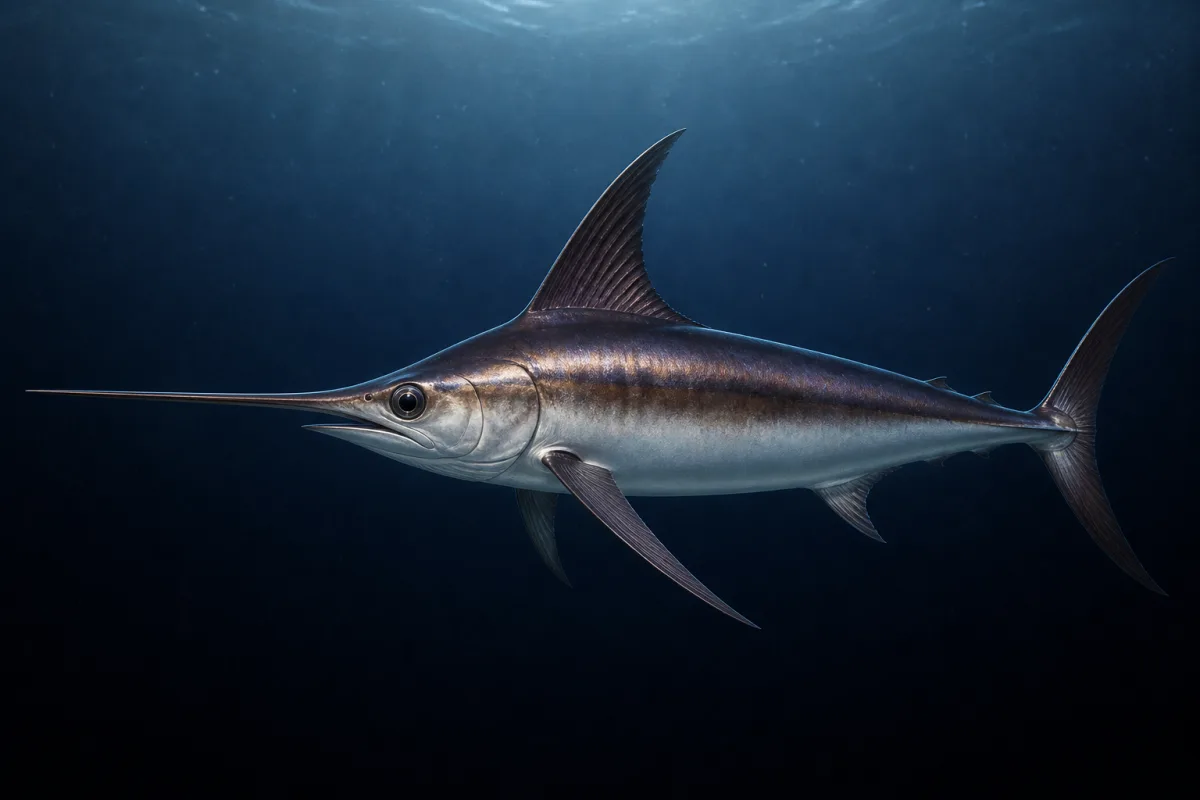
The swordfish is the only living member of its family and the most distinctive of the billfish, with a long, flattened, double-edged bill that gives it the older name broadbill. Adults reach about 10 feet from bill tip to tail fork, and the largest verified individuals approach 15 feet. Nearly all very large swordfish are female. Adults have neither teeth nor scales, unlike the larvae, which hatch with both and lose them during development.
Swordfish are among the deepest-diving of the large predatory fish. Archival tags show a daily pattern of descending below the thermocline at dawn, often past 1,500 feet, and rising to feed near the surface at night. A specialized heater organ beside the brain, built from modified eye muscle, keeps the brain and retinas far warmer than the surrounding water. Warm retinas respond to movement much faster than cold ones, which matters in dim, cold water where prey is detected as a flicker of contrast.
The bill is not a spear. Stomach contents and video show that a swordfish sweeps its bill sideways through a school, injuring and stunning several animals before turning to swallow them, and squid recovered from swordfish stomachs are frequently cut in halves. The bill is also stiff, streamlined and edged rather than pointed, which suits slashing better than piercing. Reports of swordfish bills embedded in boats and other animals are real but rare, and represent accidents rather than typical feeding.
Where it lives
Tropical, subtropical and temperate waters of the Atlantic, Pacific and Indian Oceans, plus the Mediterranean and the Sea of Marmara, roughly between 50 degrees north and 45 degrees south. Fish move toward higher latitudes in summer to feed and return to warmer water to spawn. Concentrations form along steep temperature fronts and over the edges of continental shelves and seamounts.
Habitat
- Open ocean
- Deep sea
- Continental shelf
- Seamounts & offshore banks
What it eats
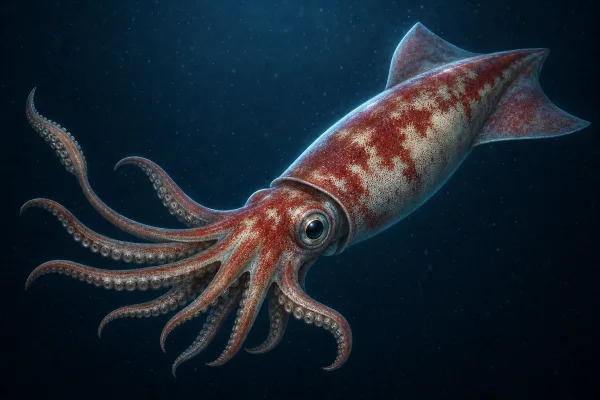
Squid make up the largest share of the diet in most regions, which is one reason swordfish follow the daily vertical movement of the deep scattering layer. They also take mackerel, hake, herring, lanternfish, sardines and other schooling fish, along with occasional deep-sea crustaceans. Because adults lack teeth, prey is either swallowed whole or reduced to pieces first.
- Squid & octopus
- Bony fish
- Crustaceans
How it hunts
A swordfish hunts by moving into a concentration of squid or schooling fish and sweeping its bill through it in fast lateral strokes, then collecting the injured animals. Large eyes and a heated retina allow it to work in light levels far below what most fish can use, and it frequently hunts in cold water at depth where its warm brain gives it a reaction-time advantage over its prey. Near the surface at night it takes fish that rise from deeper water.
Behavior
Social structure: Mostly solitary
Swordfish are normally encountered alone and are widely spaced even where they are abundant. Loose concentrations form along productive temperature fronts, and fish are occasionally seen in pairs during the spawning season, but there is no evidence of coordinated hunting.
Active period: Day & night
Active by day and night, but on a strongly layered schedule: deep and cold through daylight hours, shallow and near the surface after dark, tracking the vertical migration of the animals it eats.
Reproduction
Broadcast spawning.
Eggs and sperm are released into warm surface water, with fertilization external and no parental care. Spawning happens year-round in equatorial waters and seasonally at higher latitudes, wherever surface temperatures exceed about 75 degrees Fahrenheit. Large females release several million eggs in batches over a season. Larvae hatch at about a sixth of an inch and grow quickly, developing the bill only after the first few weeks.
Predators and ecological role
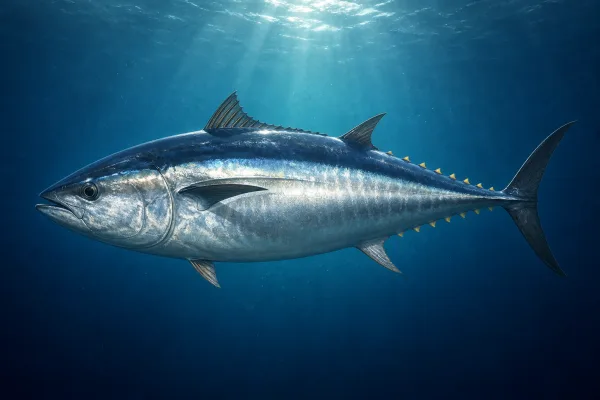
Adult swordfish are large enough that few animals take them, though large sharks and orcas do. Juveniles and small adults are eaten by tunas, dolphinfish, marlin and sharks, and eggs and larvae are consumed by a wide range of surface feeders.
By feeding at depth during the day and near the surface at night, swordfish connect the midwater food web to the surface one, transferring energy between layers that most predators cannot bridge. They are among the principal consumers of oceanic squid, and their own larvae supply the surface plankton community.
Conservation and threats
Least Concern Assessed 2011 · population unknown
Swordfish are assessed as Least Concern globally because the species is widespread and several stocks are considered healthy, but the picture varies by region. The North Atlantic stock was overfished in the 1990s and rebuilt under international quotas, while the Mediterranean stock has been depleted for decades and is subject to separate recovery measures.
Pelagic longlines take most of the commercial catch, and juvenile swordfish are a persistent share of that catch in the Mediterranean, where undersized fish have long been landed in quantity. Swordfish also turn up as bycatch in tuna fisheries and in drift nets where those remain in use. As a long-lived predator, the species accumulates mercury, which underlies the consumption advisories issued for it in the United States.
Main pressures
- Targeted fishing
- Bycatch in other fisheries
- Chemical pollution
Notable details
- A heater organ derived from eye muscle keeps a swordfish's brain and retinas up to about 25 degrees Fahrenheit warmer than the water, sharpening vision in cold water at depth.
- Adult swordfish have no scales and no teeth; larvae hatch with both and lose them as they grow.
- Magnetic imaging of the head revealed an oil-producing gland at the base of the bill, which researchers proposed spreads a film over the skin to reduce drag.
- Tag records place swordfish deeper than 9,000 feet, making the species one of the deepest-ranging of the large predatory fish.
Sources
-
The IUCN Red List of Threatened Species
International Union for Conservation of Nature
Global conservation assessments, population trends and threat classifications for every species profiled here.
-
Species Directory
NOAA Fisheries
Management-grade biology, distribution and stock information for species in United States waters.
-
FishBase
FishBase Consortium
Compiled length, weight, growth and depth records for fish species, drawn from the primary literature.
-
Smithsonian Ocean
Smithsonian National Museum of Natural History
Peer-reviewed public science writing on marine life, ecosystems and ocean change.
Figures on this page were last checked against these sources on .