Overview
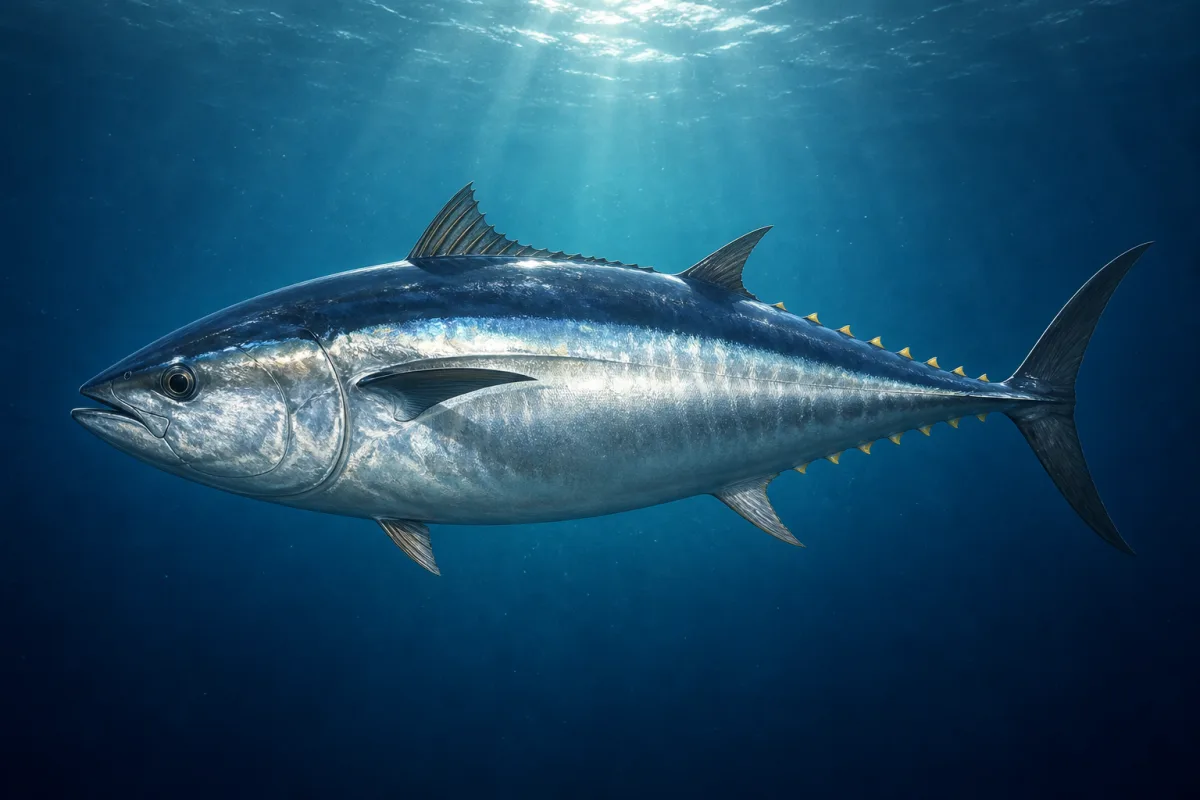
The Atlantic bluefin is the largest of the tunas and among the most powerful swimmers in the ocean. Mature fish commonly run 6 to 8 feet long, and the largest reliably recorded individuals approach 15 feet and roughly 1,500 pounds. Weight varies enormously with feeding condition, so two fish of the same length caught in different seasons can differ by a third. The body is a thick spindle with a narrow, stiff, crescent tail that works less like a paddle than a propeller blade.
Bluefin are regional endotherms. Dense networks of intertwined arteries and veins trap metabolic heat before it can be lost across the gills, keeping the swimming muscles, viscera, eyes and brain well above the temperature of the surrounding water. A fish feeding off Newfoundland in water near 45 degrees Fahrenheit can hold its core close to 70. That internal warmth widens its range enormously, allowing the same population to exploit cold, productive northern feeding grounds and warm subtropical spawning grounds within a single year.
Two spawning populations are recognized: an eastern stock that spawns in the Mediterranean Sea and a western stock that spawns in the Gulf of Mexico. Conventional tagging, electronic tags and the chemical signature locked into ear stones all show that fish from both origins mix on North Atlantic feeding grounds while returning to their natal region to spawn, which is why the two are assessed and managed separately. Deep quota cuts and tighter catch documentation after 2007 allowed the eastern stock to rebuild substantially, while the western stock remains far below its historical size.
Where it lives
Both sides of the North Atlantic and its adjacent seas, from the Gulf of Mexico and Brazil north to Newfoundland and Labrador, and from the Canary Islands and West Africa north to Norway and Iceland, including the entire Mediterranean. Spawning is confined to the Gulf of Mexico and the Mediterranean, while feeding migrations carry fish into cold, plankton-rich waters at high latitudes.
Habitat
- Open ocean
- Continental shelf
- Coastal waters
What it eats
Small bluefin take crustaceans, larval fish and other zooplankton. Larger fish shift to schooling forage species, with herring, mackerel, sand lance, sardines, anchovies and squid dominating the diet in most regions. Because a bluefin burns energy at a high rate, it feeds heavily on the northern grounds and converts that surplus into the fat reserves that fund the long migration to spawn.
- Bony fish
- Squid & octopus
- Crustaceans
- Zooplankton & krill
How it hunts
Bluefin run down schooling prey in open water rather than ambushing it. Warm eyes and brain sharpen vision and shorten reaction time in cold water, and the stiff, narrow tail delivers acceleration with little drag. Groups often work together, spreading into a broad curved rank that drives baitfish toward the surface before individual fish cut through the school. Fins fold into grooves along the body during a rush, leaving an almost unbroken profile.
Behavior
Social structure: Schools
Bluefin travel in schools sorted by size, sometimes mixed with albacore, skipjack or yellowfin. Schools are fluid rather than fixed, forming and dispersing around prey, and giant individuals are often seen in small groups of similar-sized fish.
Active period: Day & night
Active around the clock and never fully at rest, since a bluefin must keep swimming to push water across its gills. Feeding tends to peak in daylight and at dusk, when schooling prey is easiest to see.
Reproduction
Broadcast spawning.
Eggs and sperm are released into warm surface water and fertilization is external. A large female may shed several million eggs across a spawning season, and eggs hatch in about two days. Eastern fish mature at roughly 4 to 5 years, western fish considerably later, and that difference in maturity age is one reason the western stock recovers more slowly.
Predators and ecological role
Adult bluefin have few predators. Orcas take them regularly in the Strait of Gibraltar, and large sharks account for some losses. Juveniles are eaten by a long list of pelagic hunters, including billfish, larger tunas, sharks and seabirds, and mortality in the first year is very high.
Bluefin are both a major consumer of forage fish and a mechanism for moving energy across the ocean, feeding at high latitudes and spawning in subtropical seas thousands of miles away. Their concentrated feeding shapes the behavior of sardine, herring and mackerel schools, and their own eggs and juveniles feed a wide range of smaller predators.
Conservation and threats
Least Concern Assessed 2021 · population increasing
The 2021 global reassessment moved Atlantic bluefin from Endangered to Least Concern, reflecting a substantial rebuilding of the eastern stock after catch limits were cut sharply in the late 2000s. The improvement is real but uneven: the western stock is still a fraction of its historical size, and the category depends on continued restraint by the international commission that sets quotas.
Bluefin are among the most valuable fish in the world, which keeps pressure on the stock even under quota. Unreported and misreported catch has been documented repeatedly in the Mediterranean, and fish caught for ranching are hard to account for once transferred to pens. Purse seines and longlines also take undersized fish. Warming surface waters are shifting the temperature windows that spawning depends on.
Main pressures
- Targeted fishing
- Bycatch in other fisheries
- Illegal trade
- Ocean warming
Notable details
- A heat-exchange network of intertwined blood vessels keeps a bluefin's muscles, gut, eyes and brain warmer than the sea, which is why the species can feed in cold northern water that other tunas avoid.
- The pectoral fins and first dorsal fin fold flat into grooves in the body, reducing drag during a high-speed run.
- Chemical signatures in a tuna's ear stones record the water it hatched in, allowing researchers to tell Mediterranean-born fish from Gulf of Mexico-born fish caught side by side on the same feeding ground.
- The species was reassessed from Endangered to Least Concern in 2021 after the eastern stock rebuilt under sharply reduced quotas.
Sources
-
The IUCN Red List of Threatened Species
International Union for Conservation of Nature
Global conservation assessments, population trends and threat classifications for every species profiled here.
-
Species Directory
NOAA Fisheries
Management-grade biology, distribution and stock information for species in United States waters.
-
FishBase
FishBase Consortium
Compiled length, weight, growth and depth records for fish species, drawn from the primary literature.
-
Smithsonian Ocean
Smithsonian National Museum of Natural History
Peer-reviewed public science writing on marine life, ecosystems and ocean change.
Figures on this page were last checked against these sources on .