
What the numbers mean
The tiger shark and the great hammerhead patrol the same reefs, flats and channel mouths across the warm coastal seas of the world, and they reach similar maximum sizes. Almost everything else about how they make a living diverges. One has the widest diet recorded for any large shark. The other has narrowed onto a single group of prey and rebuilt its head around locating it. Generalism and specialization are the two standard answers to the problem of making a living, and these species are unusually clean examples of each.
The comparison also carries a sharp conservation edge. The tiger shark is listed as Near Threatened and the great hammerhead as Critically Endangered, and the gap is not simply a matter of how many of each are caught. It reflects the value of hammerhead fins, a slower replacement rate, and an unusual physiological fragility: individuals caught on lines show extreme stress responses and often die after release, which undercuts the management tool most commonly applied to sharks.
Two heads, two ways of finding food
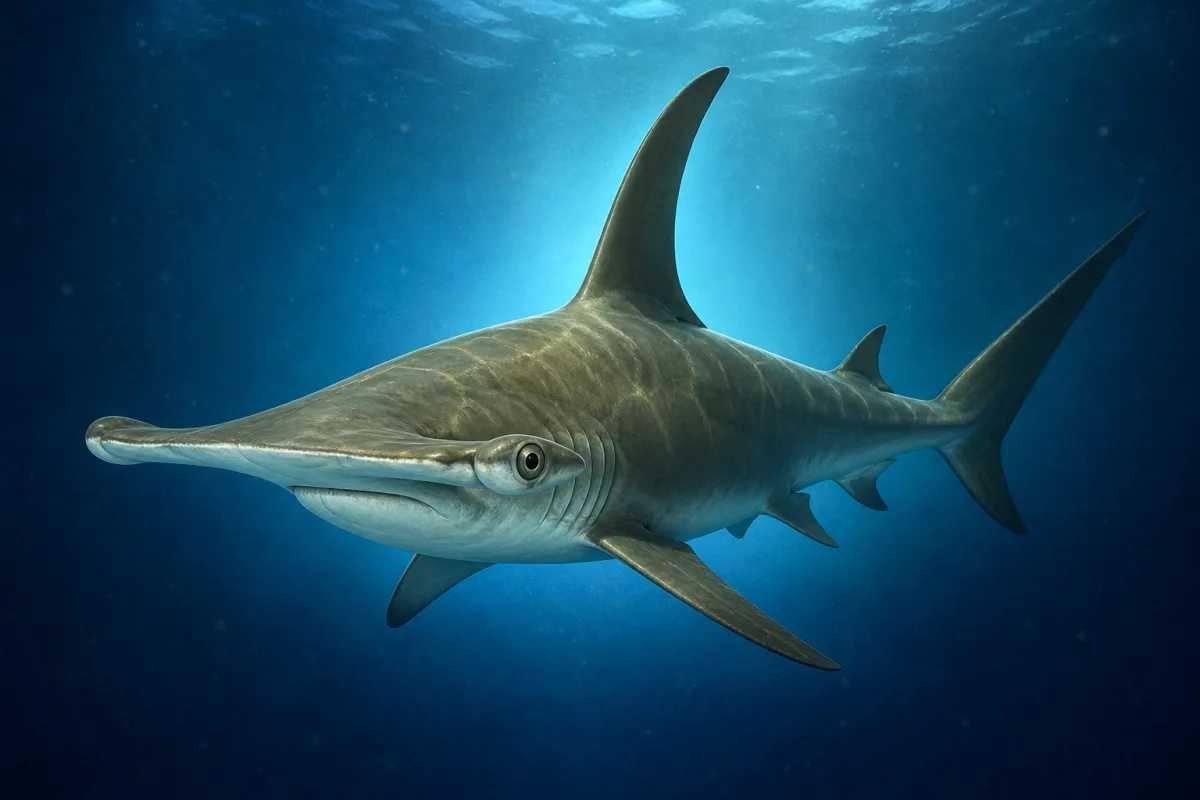
The hammerhead's cephalofoil is the most heavily modified head in any shark, and it does several jobs at once. It spreads the ampullae of Lorenzini, the pores that detect weak electric fields, across a much wider surface than a conventional snout allows, which is what lets the shark find a stingray lying completely buried under sand. Eyes at the far tips give a wide field of view with good binocular overlap in front, and swinging the head from side to side while swimming fills in most of the remaining blind area. The head also works as a forward hydrofoil, contributing to the tight turns the species makes.
The great hammerhead is separated from its relatives by the shape of that structure. The front edge is nearly straight with a shallow notch at the center rather than curved and scalloped, and the first dorsal fin is strikingly tall and pointed. Hunting is largely a matter of detection: the shark sweeps its head from side to side just above the bottom, passing its sensors over a wide strip of seafloor, and once a ray is located it uses the flattened head to press the animal against the bottom while it feeds.
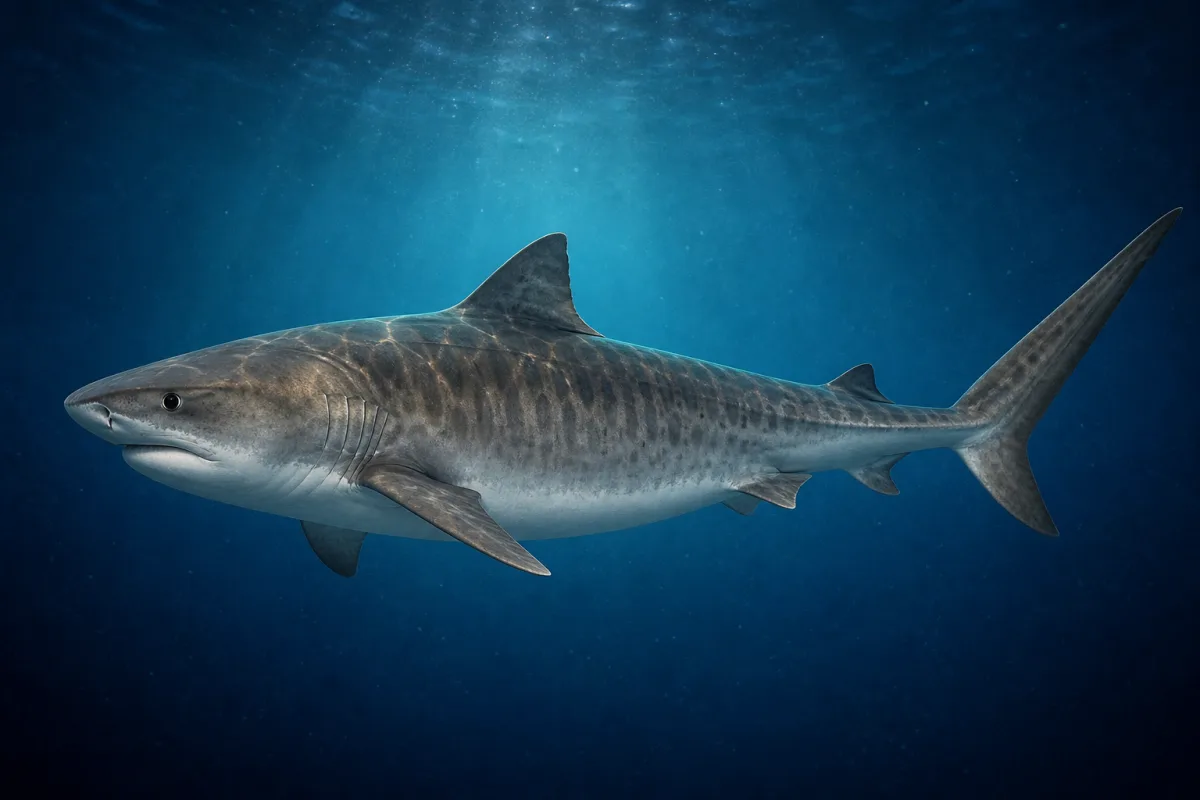
The tiger shark works with a conventional head and a broader search. It has a blunt, broad snout and relies on smell, hearing and electroreception to locate food while cruising slowly along reef edges, drop-offs and channel mouths. Its detection problem is different in kind: rather than resolving a buried target in a narrow strip of sand, it is covering long distances at low energy cost and evaluating whatever it encounters.
Similar sizes, different proportions
The two species converge on a similar upper limit. Tiger sharks commonly reach 10 to 14 feet, with the largest carefully measured individuals approaching 18 feet, and the largest documented great hammerheads reach about the same. Both attract longer claims that rarely survive review. Below the maximum they differ: most mature hammerheads fall between 10 and 12 feet, so a typical adult of that species is smaller than a typical adult tiger shark, and the heaviest verified hammerheads were large pregnant females rather than exceptional animals in general.
Mass separates them more clearly than length. A tiger shark is heavy-bodied, with typical adults near 1,100 pounds and the largest approaching 2,000, and its weight varies widely with girth, recent feeding and pregnancy. A great hammerhead is a more slender animal for its length, with the heaviest verified individuals near 1,280 pounds. In both cases weights for a given length can differ by a third or more, which is worth remembering before reading much into a single reported figure.
Their markings age differently too. The dark vertical bars that give the tiger shark its name are boldest in juveniles and fade steadily with growth, so large adults can look almost uniformly gray and are sometimes mistaken for other species. The hammerhead's identifying feature is structural rather than pigmented and does not change, which is part of why individual sharks can be recognized in photographs across many years. That matters for the records each species leaves behind, since an animal that looks much the same at 5 feet and at 15 is far easier to follow through a long-term study than one whose appearance changes as it grows.
The widest diet and one of the narrowest
No other shark eats such a range of food as the tiger shark. Sea turtles, seabirds, bony fish, rays, smaller sharks, squid, crabs and carrion all appear in its stomachs, along with indigestible objects swallowed by mistake. The teeth explain part of it: upper and lower teeth are identical in shape, an unusual arrangement among sharks, and both are broad and deeply notched with coarse serrations that work against turtle shell and bone rather than slicing cleanly. Diet broadens sharply with size, and sharks past roughly 7 feet add turtles, seabirds and marine mammal carrion.
The great hammerhead has gone the other way. Stingrays and other batoids form an unusually large share of its diet, alongside smaller sharks, groupers, jacks, catfish, squid and crabs. It is one of very few predators that regularly feeds on large rays, including species armed with venomous tail spines, and it appears to be little troubled by them: one examined specimen carried close to a hundred stingray barbs embedded in the tissue of its mouth and throat, with no sign that its feeding had been impaired.
Timing follows the food. Tiger sharks forage mostly after dark, moving from deeper water onto shallow reef flats and seagrass beds, and they gather seasonally where food concentrates. At French Frigate Shoals in the Northwestern Hawaiian Islands they mass around the reef flats in early summer, when young albatrosses make their first flights and often land on the water. Hammerheads concentrate their foraging around dawn, dusk and darkness, when rays move out of shelter onto open flats.
One wanderer and one resident
Tiger sharks move more than their reputation as reef residents suggests. Tagging in the Atlantic and Pacific has tracked individuals covering thousands of miles between continental shelves and open ocean, with many returning to the same seasonal grounds, and archival tags record repeated dives into much deeper water during those offshore movements. They are unhurried about it. Accelerometer tags in Hawaii recorded routine swimming close to walking pace, with short accelerations reserved for the final approach.
The great hammerhead stays put. It shows strong site fidelity, returning to the same flats and channels in the same months year after year, and some sharks in the Bahamas have been identified at the same site across more than a decade. It also keeps to shallower water, usually hunting in less than 250 feet, where the tiger shark ranges into water several times deeper. Unlike the scalloped hammerhead, which forms large daytime schools at seamounts, the great hammerhead is almost always alone.
That difference in movement cuts both ways for conservation. A resident shark is easy to remove from a known location and easy to protect there: safeguarding a small number of flats and channels can benefit a disproportionate share of a regional population. A wide-ranging shark cannot be protected by any single measure, but it is also not concentrated anywhere long enough to be depleted site by site. The tiger shark's seasonal gatherings are the exception, since a predictable concentration at a known place and time is exactly the situation in which a wide-ranging animal becomes locally vulnerable.
How quickly each replaces itself
The tiger shark is unusually productive for a large shark. Unlike most of its relatives it forms no placental connection, and embryos are nourished by yolk and uterine secretions through a gestation thought to last 13 to 16 months. Litters are large by shark standards, commonly 30 to 40 pups and occasionally more than 70, each about 20 to 30 inches at birth, with females reproducing every second or third year. Ages come from vertebral growth bands and reach at least 40 years, a figure that may be conservative.
The great hammerhead produces far fewer young. Embryos are nourished through a yolk-sac placenta, gestation lasts about 11 months, and litters run 6 to 42 pups roughly 2 feet long, with females apparently breeding only every second year. Newborns have their cephalofoil folded backward against the body during birth, which allows the wide head to pass through the birth canal. Vertebral bands checked against bomb radiocarbon in the northwestern Atlantic give a maximum near 44 years, though sample sizes remain small.
Set those numbers side by side and the difference in resilience becomes clear. A tiger shark population can absorb losses that a hammerhead population cannot, simply because it puts more pups in the water per adult female per year. That arithmetic is the underlying reason two sharks living in the same places under similar fishing pressure sit three categories apart on the Red List. Neither is quick by the standards of a bony fish, however. Both take many years to mature and both breed at intervals of two years or more, so the comparison is between slow and slower rather than between fast and slow.
Two categories and the reasons behind them
The great hammerhead was listed as Critically Endangered in the global shark reassessment published in 2019, following steep regional declines. Its large fins are among the most valuable in the fin trade, which drives both targeted fishing and retention of incidental catch in longline, gillnet and trawl fisheries. The compounding problem is post-release mortality: because captured animals so often die even when released, protections that rely on releasing sharks deliver far less benefit than they would for hardier species. Hammerheads were added to CITES Appendix II in 2013, and the species is protected in Florida state waters and several other jurisdictions.
The tiger shark is listed as Near Threatened with a decreasing trend, still relatively common in some regions but declining across much of its range. It is caught deliberately for meat, fins, skin and liver oil and taken incidentally in longline and gillnet fisheries, while beach protection programs in Australia and South Africa remove a further share each year. The requiem shark family was added to CITES Appendix II in 2022, with the listing taking effect in late 2023.
Both species matter to their habitats in ways that are not obvious from their diets. Long-term work in Shark Bay, Western Australia, showed that dugongs and green turtles avoid the richest seagrass patches when tiger sharks are present, so the shark shapes the meadow largely without eating the grazers. Where great hammerheads have been removed, ray numbers have increased in some coastal systems, with knock-on effects on the shellfish and buried invertebrates those rays dig for.