Overview
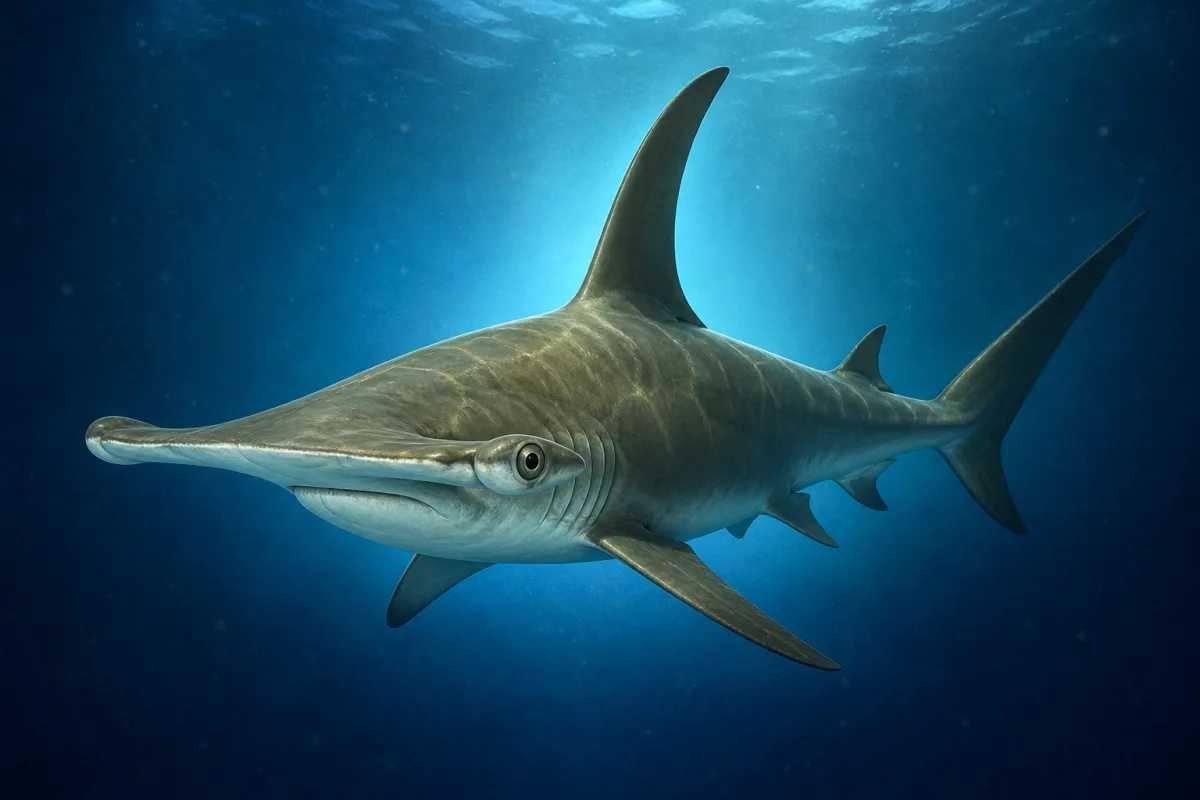
The great hammerhead is the largest of the hammerhead sharks and easy to separate from its relatives. The front edge of the head, called the cephalofoil, is nearly straight with a shallow notch at the center, rather than curved and scalloped, and the first dorsal fin is strikingly tall and pointed. Most adults measure 10 to 12 feet. The largest documented individuals reach about 18 feet, though animals that size are exceptional and rarely encountered.
The cephalofoil is the defining feature and serves several purposes at once. It spreads the ampullae of Lorenzini, the pores that detect weak electric fields, across a much wider surface than a conventional snout allows, which helps the shark find prey buried under sand. Eyes at the far tips give a wide field of view with good binocular overlap in front. The head also works as a forward hydrofoil, contributing to the tight turns the species makes when following prey across open flats.
Great hammerheads are strongly associated with stingrays. They hunt over sand and seagrass flats, in channels and along reef edges in warm water worldwide, and rays and skates appear in their stomachs far more often than in those of other large sharks. They are also among the most physiologically fragile large sharks: individuals caught on lines show extreme stress responses and often die after release, which complicates catch-and-release management and makes them especially difficult to conserve.
Where it lives
Tropical and warm-temperate seas worldwide, including Florida, the Bahamas, the Gulf of Mexico, the Caribbean, both coasts of Central America, West and southern Africa, the Red Sea, the Indian Ocean, Southeast Asia, northern Australia and the central Pacific islands. It occurs both close inshore and over open water between islands.
Habitat
- Coastal waters
- Coral reefs
- Continental shelf
- Sandy flats & seagrass beds
- Open ocean
What it eats
Stingrays and other batoids form an unusually large share of the diet, alongside smaller sharks, groupers, jacks, catfish, squid and crabs. The species is one of the few predators that regularly feeds on large rays, including species armed with venomous tail spines, and it appears to be little troubled by them.
- Sharks & rays
- Bony fish
- Squid & octopus
- Crustaceans
How it hunts
Hunting is mostly a matter of detection. Great hammerheads sweep the head from side to side just above the bottom, passing the electrical sensors over a wide strip of seafloor and picking up the faint fields of rays hidden under sand. Once a ray is located the shark uses the flattened head to press it against the bottom while it feeds. Video from the Bahamas shows the sharks turning sharply and repeatedly to stay with a ray that breaks cover, a maneuver the cephalofoil helps make possible.
Behavior
Social structure: Mostly solitary
Unlike the scalloped hammerhead, which forms large daytime schools at seamounts, the great hammerhead is almost always alone. Individuals show strong site fidelity, returning to the same flats and channels in the same months year after year, and some Bahamian sharks have been identified at the same site across more than a decade.
Active period: Dawn & dusk
Foraging concentrates around dawn, dusk and the hours of darkness, when rays move out of shelter onto open flats; daytime activity is generally lower.
Reproduction
Live birth, placental young.
Embryos are nourished through a yolk-sac placenta, and the cephalofoil of newborn pups is folded back along the body so they can be born head first. Gestation lasts about 11 months and produces 6 to 42 pups, each roughly 2 feet long. Females appear to breed only every second year, giving the species a slow rate of population replacement.
Predators and ecological role
Adults have essentially no predators other than the occasional orca. Pups and juveniles are taken by larger sharks, including bull sharks and other great hammerheads, which is why nursery areas tend to be shallow inshore waters.
By concentrating on rays and other batoids, the great hammerhead occupies a niche few large sharks fill. Where it has been removed, ray numbers have increased in some coastal systems, with knock-on effects on the shellfish and buried invertebrates those rays dig for. Its site fidelity means local protection of a small number of flats and channels can benefit a disproportionate share of the regional population.
Conservation and threats
Critically Endangered Assessed 2018 · population decreasing
Listed as Critically Endangered in the global shark reassessment published in 2019, following steep regional declines. Very high mortality during and after capture means even released animals frequently die. Hammerheads were added to CITES Appendix II in 2013, and the species is protected in Florida state waters and several other jurisdictions.
The large fins are among the most valuable in the fin trade, which drives both targeted fishing and retention of incidental catch in longline, gillnet and trawl fisheries. Post-release mortality is exceptionally high, so protections that rely on releasing captured sharks deliver less benefit than they would for hardier species. Loss and degradation of shallow coastal habitat removes nursery and foraging ground.
Main pressures
- Targeted fishing
- Bycatch in other fisheries
- Fin trade
- Coastal development
- Habitat loss
Notable details
- Placing the eyes at the tips of the cephalofoil gives hammerheads better binocular overlap in front than conventional sharks, and swinging the head from side to side while swimming fills in most of the remaining blind area.
- Spreading the electroreceptive pores across the wide head lets a great hammerhead locate a stingray lying completely buried beneath sand.
- One examined specimen carried close to a hundred stingray barbs embedded in the tissue of its mouth and throat, with no sign that they had impaired its feeding.
- Newborn pups have their cephalofoil folded backward against the body during birth, which allows the wide head to pass through the birth canal.
Sources
-
The IUCN Red List of Threatened Species
International Union for Conservation of Nature
Global conservation assessments, population trends and threat classifications for every species profiled here.
-
Species Directory
NOAA Fisheries
Management-grade biology, distribution and stock information for species in United States waters.
-
Florida Program for Shark Research
Florida Museum of Natural History
Shark biology, size records and documented interaction data.
-
FishBase
FishBase Consortium
Compiled length, weight, growth and depth records for fish species, drawn from the primary literature.
-
Convention on International Trade in Endangered Species of Wild Fauna and Flora
CITES Secretariat
Appendix listings governing international trade in the species profiled here.
Figures on this page were last checked against these sources on .