Overview
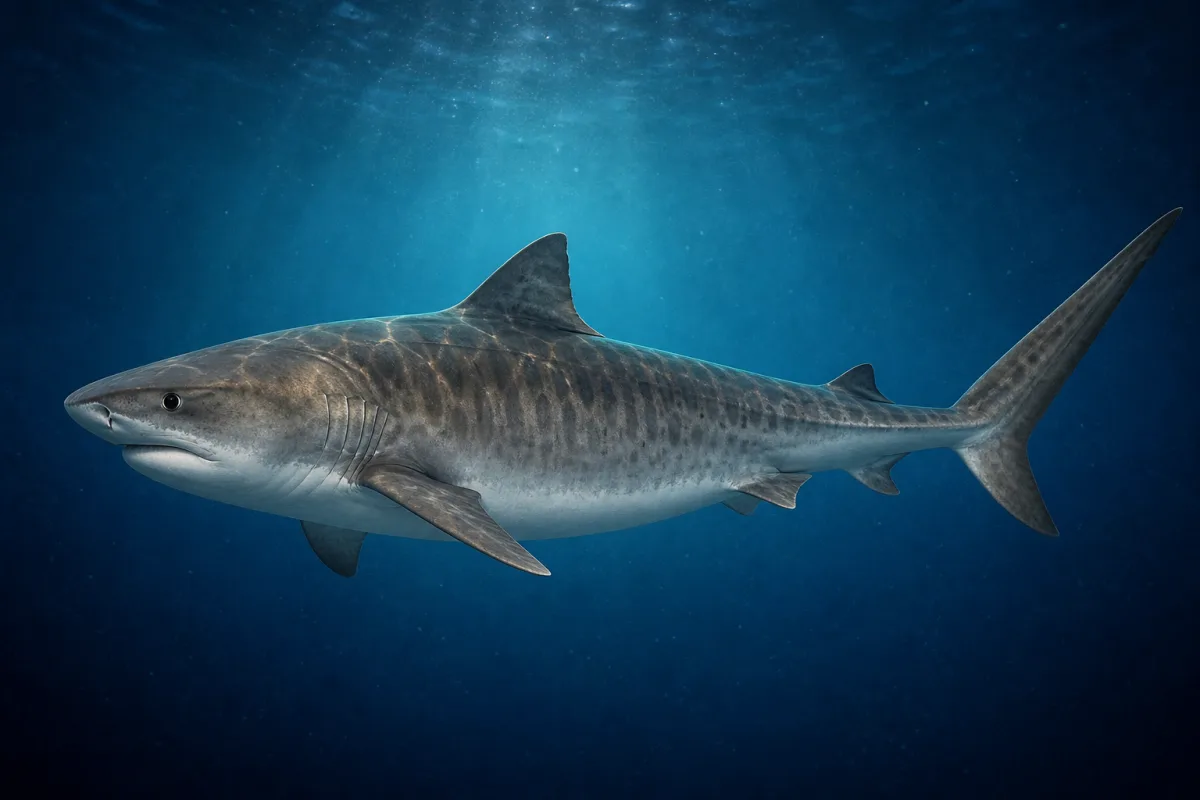
The tiger shark is a heavy-bodied coastal and reef shark named for the dark vertical bars that mark its flanks. Those bars are boldest in juveniles and fade with age, so large adults can look almost uniformly gray. Adults commonly reach 10 to 14 feet, and the largest carefully measured individuals approach 18 feet. Longer animals are reported from time to time, but few of those claims come with measurements that hold up to review.
No other shark eats such a wide range of food. Tiger sharks take sea turtles, seabirds, bony fish, rays, smaller sharks, squid, crabs and carrion, and their stomachs regularly yield indigestible objects swallowed by mistake. The teeth explain part of this. Upper and lower teeth are the same shape, broad and deeply notched with coarse serrations along the outer edge, and they work against turtle shell and bone rather than slicing cleanly the way narrow, blade-like teeth do.
Tiger sharks move more than their reputation as reef residents suggests. Tagging in the Atlantic and Pacific has tracked individuals covering thousands of miles between continental shelves and open ocean, with many returning to the same seasonal grounds. In Shark Bay, Western Australia, long-term research showed that dugongs and green turtles shift where they graze when tiger sharks are present, thinning their use of the richest seagrass. The shark's influence on that system runs partly through avoidance rather than through what it eats.
Where it lives
Tropical and warm-temperate seas worldwide, including the Gulf of Mexico, the Caribbean, the southeastern United States, the Hawaiian Islands, northern Australia, southern Africa and the wider Indo-Pacific. It is most abundant over continental and island shelves and near river mouths, and crosses deep water between those areas.
Habitat
- Coastal waters
- Coral reefs
- Continental shelf
- Estuaries & river mouths
- Sandy flats & seagrass beds
- Open ocean
What it eats
The diet broadens sharply with size. Small tiger sharks feed mainly on bony fish, small rays and invertebrates. Once past roughly 7 feet they add sea turtles, seabirds, larger sharks and marine mammal carrion. At French Frigate Shoals in the Northwestern Hawaiian Islands, tiger sharks concentrate around the reef flats in early summer, when young albatrosses make their first flights and often land on the water.
- Sea turtles
- Bony fish
- Sharks & rays
- Seabirds
- Squid & octopus
- Carrion & whale falls
How it hunts
Tiger sharks are unhurried searchers rather than sprinters. They cruise slowly along reef edges, drop-offs and channel mouths, covering long distances at low energy cost and relying on smell, hearing and electroreception to locate food. Accelerometer tags in Hawaii recorded routine swimming close to walking pace, with short accelerations reserved for the final approach. The saw-edged teeth allow them to feed on prey with hard shells or thick skin that most sharks cannot process, and they scavenge readily whenever a carcass is available.
Behavior
Social structure: Mostly solitary
Normally encountered alone. Loose gatherings form where food is concentrated, such as around a whale carcass or a seasonal seabird colony, and individuals in those gatherings space themselves by size rather than forming any lasting group.
Active period: Nighttime
Most foraging happens after dark, when tiger sharks move from deeper water onto shallow reef flats and seagrass beds; during the day they tend to stay offshore and deeper.
Reproduction
Live birth, yolk-fed young.
Unlike most of its relatives, the tiger shark does not form a placental connection. Embryos are nourished by yolk and by uterine secretions through a gestation thought to last 13 to 16 months. Litters are large by shark standards, commonly 30 to 40 pups and occasionally more than 70, each about 20 to 30 inches long at birth. Females appear to reproduce every second or third year.
Predators and ecological role
Full-grown tiger sharks have almost no natural predators; orcas have been recorded killing them on a handful of occasions, but such events are seldom observed. Juveniles are taken by larger sharks, including adult tiger sharks.
Tiger sharks are among the few predators capable of taking adult sea turtles and dugongs, and their presence changes how those grazers use seagrass meadows. That indirect effect on grazing pressure can matter as much to the habitat as the animals actually eaten. By consuming carcasses and diseased or injured animals, they also return energy to the food web that would otherwise settle to the seafloor.
Conservation and threats
Near Threatened Assessed 2018 · population decreasing
Widespread and still relatively common in some regions, but declining across much of its range under combined pressure from commercial and recreational fishing. The requiem shark family was added to CITES Appendix II in 2022, with the listing taking effect in late 2023.
Tiger sharks are caught deliberately for meat, fins, skin and liver oil, and taken incidentally in longline and gillnet fisheries. Beach protection programs in Australia and South Africa remove a further share each year. Coastal development degrades the shallow nurseries that young sharks depend on, and long life at the top of the food web leads to the buildup of mercury and other contaminants.
Main pressures
- Targeted fishing
- Bycatch in other fisheries
- Fin trade
- Habitat loss
- Chemical pollution
Notable details
- Tiger sharks gather at French Frigate Shoals in the Northwestern Hawaiian Islands during the weeks when young albatrosses leave their nests and make their first, often clumsy, water landings.
- Upper and lower teeth are identical in shape, an unusual arrangement among sharks, and their coarse serrations can cut through the shell of a sea turtle.
- Long-term work in Shark Bay, Western Australia, showed that dugongs and green turtles avoid the richest seagrass patches when tiger sharks are around, so the sharks shape the meadow without eating most of the grazers.
- The dark bars that give the species its name are strongest in young sharks and fade steadily with growth, leaving many large adults almost plain gray.
Sources
-
The IUCN Red List of Threatened Species
International Union for Conservation of Nature
Global conservation assessments, population trends and threat classifications for every species profiled here.
-
Species Directory
NOAA Fisheries
Management-grade biology, distribution and stock information for species in United States waters.
-
Florida Program for Shark Research
Florida Museum of Natural History
Shark biology, size records and documented interaction data.
-
FishBase
FishBase Consortium
Compiled length, weight, growth and depth records for fish species, drawn from the primary literature.
-
Smithsonian Ocean
Smithsonian National Museum of Natural History
Peer-reviewed public science writing on marine life, ecosystems and ocean change.
Figures on this page were last checked against these sources on .