
What the numbers mean
The giant squid and the colossal squid are routinely offered as candidates for the title of largest invertebrate, and the question is usually settled by whichever number a source happens to prefer. The honest answer is that they are largest in different ways. The giant squid is longer; the colossal squid is heavier and bulkier. Neither statement is controversial once the measurements are defined, and most of the confusion comes from figures that were never defined at all.
Both animals are also known from extraordinarily thin evidence. Giant squid have been examined in numbers above 130, most of them carcasses, strandings and trawl bycatch. Fewer than a dozen adult colossal squid have ever been reported. That is the entire basis for statements about how large these animals grow, and it means every published maximum is a record drawn from a small and biased sample rather than a description of a typical animal.
Mantle length, total length and stretched tentacles
Cephalopod size can be reported three ways, and they are not interchangeable. Mantle length measures the muscular body proper and is the figure specialists prefer, because it is the least distortable. Total length adds the arms and the two feeding tentacles. Arm-span figures, common for octopuses, stretch with handling. A squid's feeding tentacles are elastic and lengthen substantially when pulled, so a total length taken from a relaxed fresh carcass and one taken from a specimen laid out on a dock can differ by many feet for the same animal.
Apply those definitions and the comparison inverts depending on which is used. The giant squid's mantle is not known to exceed about 7 feet, while the mantle of the best documented colossal squid measured 8 feet. By mantle length, then, the colossal squid is the larger animal. By total length the ordering reverses, with the giant squid reaching roughly 43 feet in females measured relaxed after death against about 14 feet for that same colossal specimen once fully thawed.
This is where the well-known exaggerations come from. Reports of giant squid at 60 feet or more, common in older literature, have never been scientifically documented. Figures of around 40 feet for the colossal squid derive from tentacles stretched after death and are not supported. In both cases the inflated number is not invented so much as produced by an unstated method, which is why the mantle measurement has become the standard for anyone trying to compare the two seriously.
Why the shorter animal is the heavier one
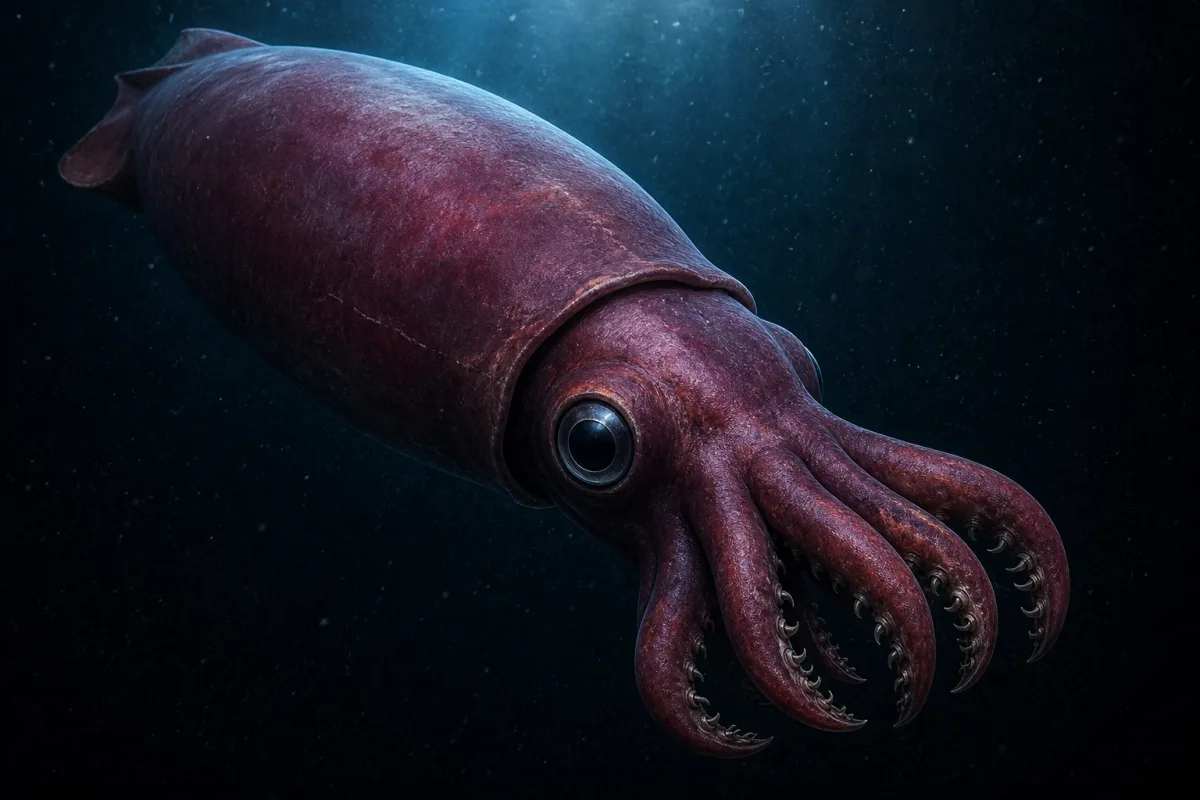
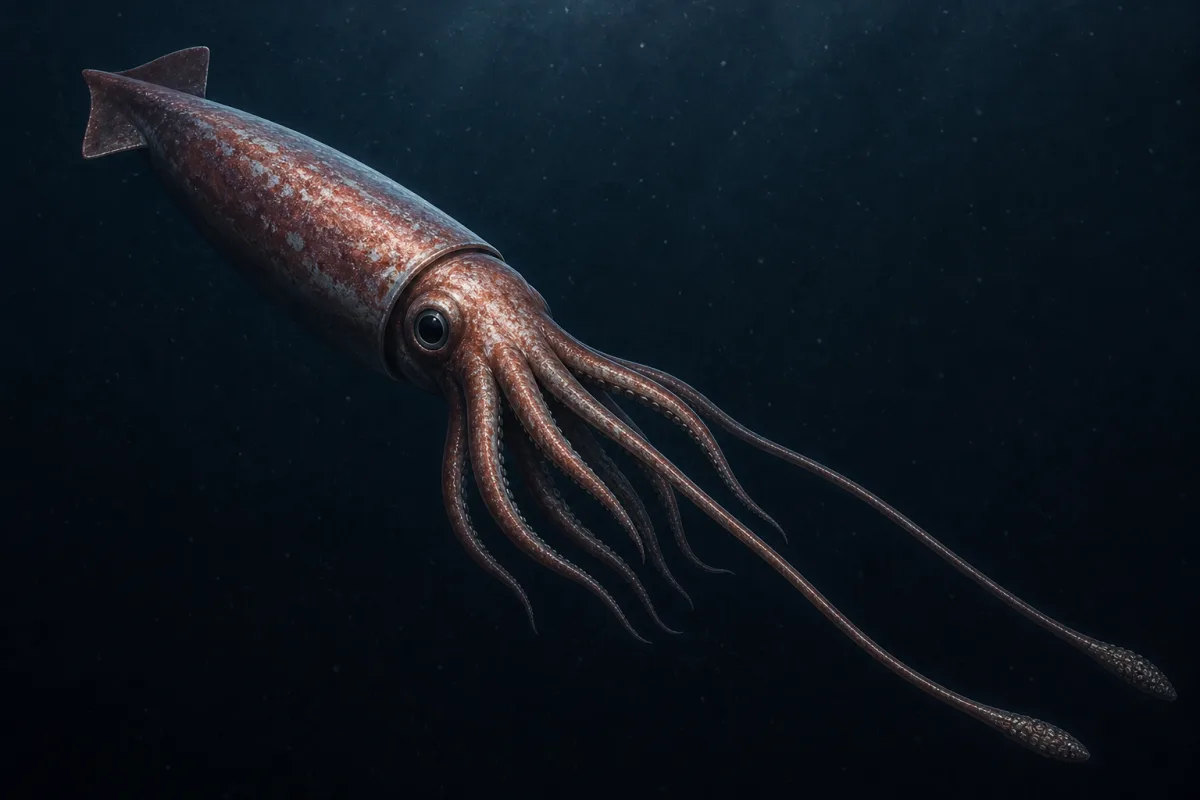
The two body plans differ more than the length figures suggest. The giant squid tapers: a relatively slender mantle, triangular fins, eight moderate arms and two very long feeding tentacles that account for much of its reach. The colossal squid is stout. Its mantle is broad and muscular rather than long and tapering, its arms are relatively short and thick, and it carries far more tissue per foot of body. The result is an animal that is shorter overall and roughly twice as heavy.
The numbers bear that out. The heaviest reliable giant squid weights are near 600 pounds, with females considerably outweighing males. The colossal squid specimen taken in the Ross Sea in February 2007 weighed 1,091 pounds, and it remains the only individual ever weighed properly. Beaks recovered from sperm whale stomachs are larger than that animal's, which implies individuals of roughly 1,300 pounds or more, though no such animal has been seen.
Their gripping equipment differs too, and it reflects the same difference in build. The giant squid's tentacle clubs carry suckers ringed with hard chitinous teeth, which leave the circular marks found on sperm whale skin. The colossal squid carries swiveling hooks alongside the suckers on each arm and tentacle club, an arrangement no other squid is known to have and one that suits holding prey as large as a 6-foot Antarctic toothfish.
Different oceans, different lives
Range is the cleanest distinction between them and the one least troubled by measurement. The giant squid occurs in all major oceans, generally in deep water over continental slopes, islands and offshore banks, and is scarce in polar seas. Strandings and captures cluster off New Zealand, Japan, Spain, Norway, Newfoundland, South Africa and the Falklands, a pattern that reflects where people look as much as where the animals are. The colossal squid is confined to the Southern Ocean, circumpolar from the Antarctic coast north toward the Antarctic Convergence.
Diet is inferred for both, but with different confidence. Giant squid stomachs point to deep-water fish such as orange roughy and hoki along with other squid, including members of its own species. Colossal squid stomach contents are almost unknown; the 2007 specimen was hauled up on a longline while holding an Antarctic toothfish, which is close to the whole of the direct evidence. Everything else about its feeding comes from anatomy and from where the animals happen to be caught.
Their hunting styles probably differ as well. Deep-sea footage from 2004 and 2012 showed the giant squid as an active predator that shoots its two long tentacles out to seize prey moving faster than itself. The colossal squid appears less suited to pursuit: the mantle is bulky, the fins are small relative to the body, and buoyancy comes from ammonium chloride held in the tissues, which suggests an animal that drifts and ambushes rather than one that cruises.
How each one is found
For most of their history, both species arrived through other animals. The colossal squid was described in 1925 from two arm crowns found in the stomach of a sperm whale, and for decades most material came the same way or as bycatch on longlines set for Antarctic toothfish. Juveniles turn up more often, in Southern Ocean net samples and in the diets of albatrosses and other seabirds, which is one of the few ways researchers learn where the young occur.
Direct observation is very recent for both. A Japanese team photographed a hunting giant squid at about 3,000 feet in 2004 and filmed one at the surface in 2012, and researchers recorded the first footage in United States waters in the Gulf of Mexico in 2019. For the colossal squid the wait ran a full century: in March 2025 a remotely operated vehicle filmed a foot-long juvenile at about 2,000 feet near the South Sandwich Islands, the first confirmed footage of a living animal.
The eyes of both species are extraordinary, and here the colossal squid holds the record cleanly. One eye recovered nearly intact from the 2007 specimen measured about 11 inches across, the largest eye ever studied in any animal, with a lens the size of an orange and its own light organ attached. The giant squid's eyes are roughly 10 inches, and in both cases the leading explanation is the same: detecting the faint bioluminescence stirred up by a large body moving through dark water.
Short lives, and two listings that rest on very little
Neither animal lives long. Giant squid ages are inferred from growth increments in the statoliths of a few specimens, with published estimates running from about two to twelve years and none settled. Colossal squid ages are inferred from related species rather than measured at all, and no adult has ever been aged, though near-freezing water may slow growth enough to extend the figure. Both are presumed to spawn once and die, and no spawning, egg mass or hatchling has been observed in the wild for either.
Fecundity is the other side of that arrangement. Mature female giant squid carry very large numbers of small eggs, with estimates running into the millions. An endoscope passed through the 2007 colossal squid female revealed ovaries holding thousands of eggs. In both species the reproductive details are odd and poorly documented: male giant squid appear to implant sperm packets directly into the female's arms, where they have been found embedded in the tissue.
Both species are listed as Least Concern, and in both cases that category rests on range rather than on counts. Neither is targeted by a fishery. Giant squid are taken occasionally in deep trawls around New Zealand and the southwest Atlantic; colossal squid are caught a few at a time on Antarctic toothfish longlines. There is no abundance estimate for either species anywhere, no monitoring, and at present no practical way to detect a change if one occurred.