Overview
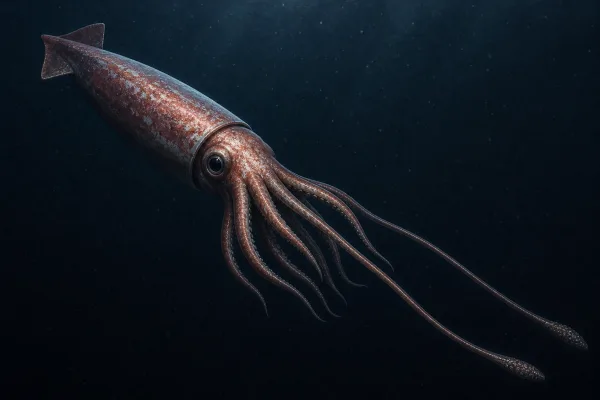
The colossal squid is the heaviest invertebrate on record, though it is shorter than the giant squid. The best documented specimen, taken in the Ross Sea in February 2007, weighed 1,091 pounds, with a mantle 8 feet long and a total length near 14 feet once fully thawed. Beaks recovered from sperm whale stomachs are larger than that animal's, which implies individuals of 1,300 pounds or more. Figures around 40 feet come from tentacles stretched after death and are not supported.
Almost everything known about the species rests on a handful of animals. It was described in 1925 from two arm crowns found in a sperm whale, and for decades most material arrived the same way or as bycatch on longlines set for Antarctic toothfish. Fewer than a dozen adults have been reported. Juveniles appear more often in Southern Ocean net samples, and in March 2025 a remotely operated vehicle filmed a foot-long juvenile at about 2,000 feet near the South Sandwich Islands.
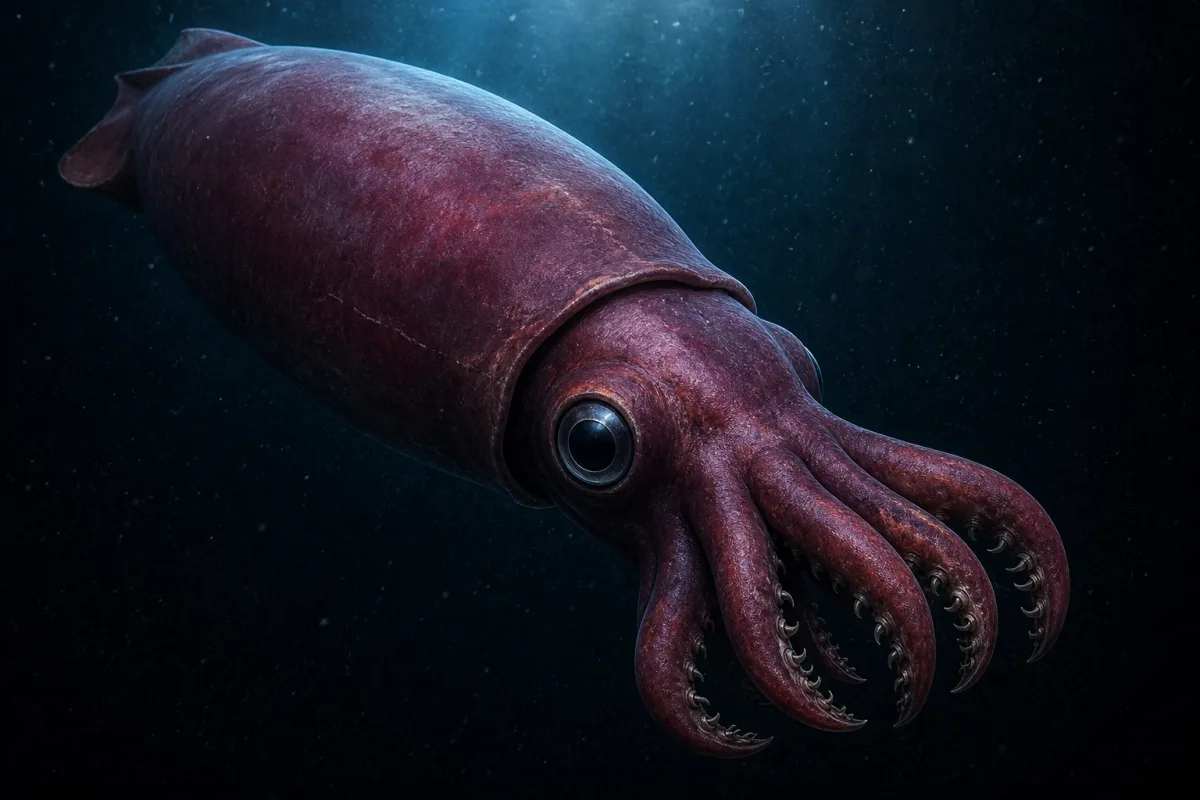
Its body plan differs from other large squid in ways that matter. The mantle is broad and muscular rather than long and tapering, the arms are relatively short and thick, and each arm and tentacle club carries swiveling hooks alongside the suckers, a grip found in no other squid. One eye recovered nearly intact measured about 11 inches across, the largest eye ever studied, and carried its own light organ for use in water where sunlight never reaches.
Where it lives
Circumpolar in the Southern Ocean, from the Antarctic coast north toward the Antarctic Convergence, with records from the Ross Sea, South Georgia and the South Sandwich Islands. Scattered sub-Antarctic records off southern South America, South Africa and New Zealand suggest the northern edge of the range is poorly defined.
Habitat
- Deep sea
- Open ocean
What it eats
Stomach contents are almost unknown, so diet is largely inferred from anatomy and from where the animals are caught. Antarctic toothfish appear to be important prey: the 2007 specimen was hauled up on a longline while holding a toothfish. Other midwater fish and smaller squid are likely, and the hooked tentacles suit large prey that struggles.
- Bony fish
- Squid & octopus
How it hunts
No adult has been watched hunting, so the account is built from body structure. The animal is not built for pursuit: the mantle is bulky, the fins are small relative to the body, and its buoyancy comes from ammonium chloride held in the tissues, which suggests it drifts rather than cruises. Enormous eyes make it a visual ambusher in a world lit only by bioluminescence, and the swiveling hooks on the arms and tentacle clubs give it a hold on prey as large as a 6-foot toothfish.
Behavior
Social structure: Mostly solitary
Every specimen recovered so far has been alone, and there is no evidence of grouping at any life stage. Whether adults ever concentrate to spawn is simply unknown, since the sample is far too thin to say anything about distribution or density.
Active period: Day & night
Below about 1,000 feet the day-night cycle carries little meaning, and adults are assumed to be active around the clock. Juveniles taken in nets show some movement between depths.
Reproduction
Spawns once, then dies.
An endoscope passed through the 2007 female revealed ovaries holding thousands of eggs. Like other squid, the species is presumed to spawn once and then die, but no eggs, mating or spawning has ever been observed, and the paralarvae described from net samples are the only early stages known. Nothing is established about spawning depth or season.
Predators and ecological role
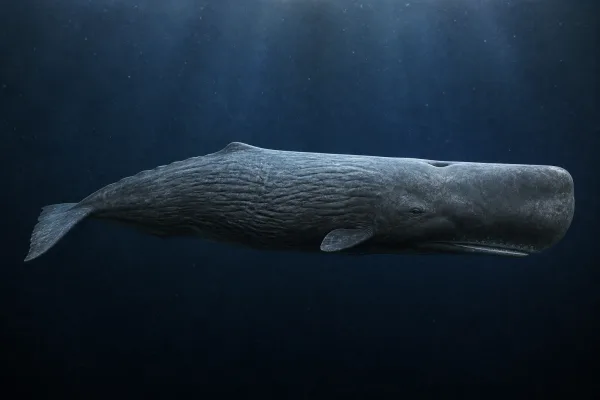
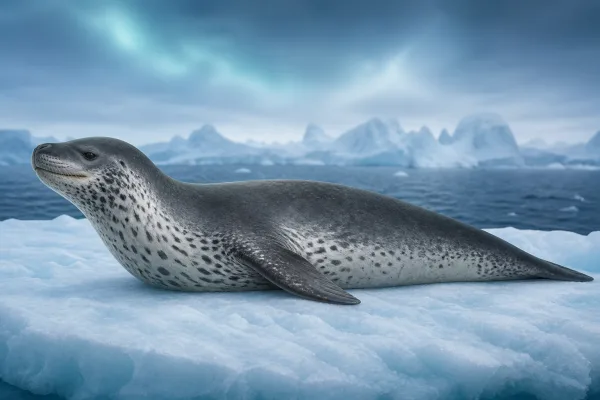
Sperm whales are the principal predator, and colossal squid beaks are common in their stomachs; sleeper sharks, southern elephant seals and Patagonian toothfish also take them. Juveniles are eaten by albatrosses and other Southern Ocean seabirds, which is one of the few ways researchers learn where the young occur.
The species converts midwater fish and squid into large packages of biomass that sperm whales and other deep-diving predators depend on, linking the mesopelagic Southern Ocean to animals that breathe at the surface. Because it is both a large predator and a major prey item, it likely matters more to that food web than its scarcity in collections suggests.
Conservation and threats
Least Concern Assessed 2014 · population unknown
Listed as Least Concern because no fishery targets the species and its range covers the entire Southern Ocean. That assessment rests on almost no population data; there is no abundance estimate and no way at present to detect a change.
Incidental capture on Antarctic toothfish longlines is the only documented direct interaction with people, and it involves a few animals a year. Warming and freshening of Southern Ocean water masses, along with fishing pressure on toothfish, are plausible indirect pressures, but neither has been measured against this species.
Main pressures
- Bycatch in other fisheries
- Climate change
Notable details
- The species was named in 1925 from two arm crowns found in the stomach of a sperm whale, and fewer than a dozen adults have been reported since.
- In March 2025, a century after it was described, a remotely operated vehicle filmed a foot-long juvenile near the South Sandwich Islands, the first confirmed footage of a living colossal squid.
- An eye recovered nearly intact from the 2007 specimen measured about 11 inches across, the largest eye measured in any animal, with a lens the size of an orange.
- Its tentacle clubs carry two rows of hooks that swivel on their bases, an arrangement no other squid is known to have.
Sources
-
SeaLifeBase
SeaLifeBase Project
Companion database to FishBase covering non-fish marine organisms, including cephalopods.
-
Monterey Bay Aquarium Research Institute
MBARI
Deep-sea observations, including remotely operated vehicle records of squid and midwater predators.
-
Smithsonian Ocean
Smithsonian National Museum of Natural History
Peer-reviewed public science writing on marine life, ecosystems and ocean change.
-
World Register of Marine Species
WoRMS Editorial Board
Authority used for accepted scientific names, families and taxonomic placement.
-
The IUCN Red List of Threatened Species
International Union for Conservation of Nature
Global conservation assessments, population trends and threat classifications for every species profiled here.
Figures on this page were last checked against these sources on .