
What the numbers mean
The great white shark and the orca are the two best-known large predators of temperate coasts, and they turn up in the same places: seal colonies off central California, Guadalupe Island, South Africa and southern Australia. Both stay warm in cold water, both hunt marine mammals, and both return to the same sites year after year. The interesting comparison is not a ranking but how differently a fish and a mammal arrive at the same job.
There is also a documented ecological interaction, and it runs one way. Orcas have been recorded killing white sharks, and at several aggregation sites the sharks have left for months after orcas appeared. Researchers have described the pattern carefully and are candid about how much of it remains unexplained. Reporting what was observed is a different exercise from imagining a confrontation, and the observations turn out to be more interesting than any hypothetical would be.
Warm-bodied and warm-blooded are not the same thing
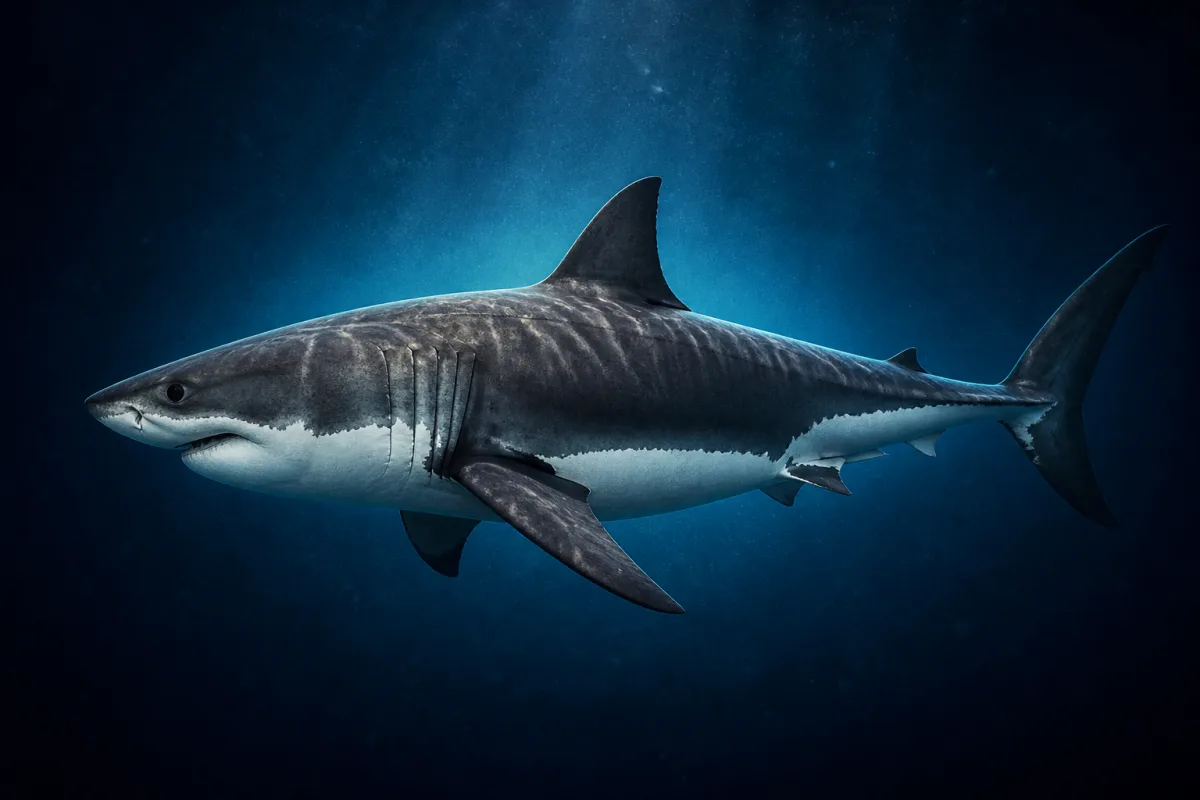
The white shark is a regional endotherm, which is a narrower claim than warm-blooded. A counter-current heat exchanger in the bloodstream traps heat produced by the swimming muscles before it can be lost at the gills, keeping muscle, stomach, brain and eyes several degrees above the surrounding water. The rest of the animal runs at sea temperature. That partial warmth is expensive but productive: warm muscle contracts faster and recovers sooner, which buys sustained cruising power in cold seas.
The orca is a mammal and holds its entire body at a high, constant temperature regardless of the water, insulated by blubber and fueled by a correspondingly large appetite. The difference in commitment shows in the maps. Orcas occur from the pack ice of both poles to the tropics and are the most widely distributed mammal in the ocean, with the highest densities in cold, productive regions. White sharks are scarce in equatorial waters and absent from polar seas altogether.
The same difference shapes breathing and rest. An orca surfaces to breathe and sleeps one brain hemisphere at a time while the group swims slowly in a tight line. A shark takes oxygen from water passing over its gills and has no comparable constraint, which is one reason it can spend months offshore in the open Pacific without any need to come up. Neither arrangement is better; they are different bills for the same warmth.
Size, build and which sex is larger
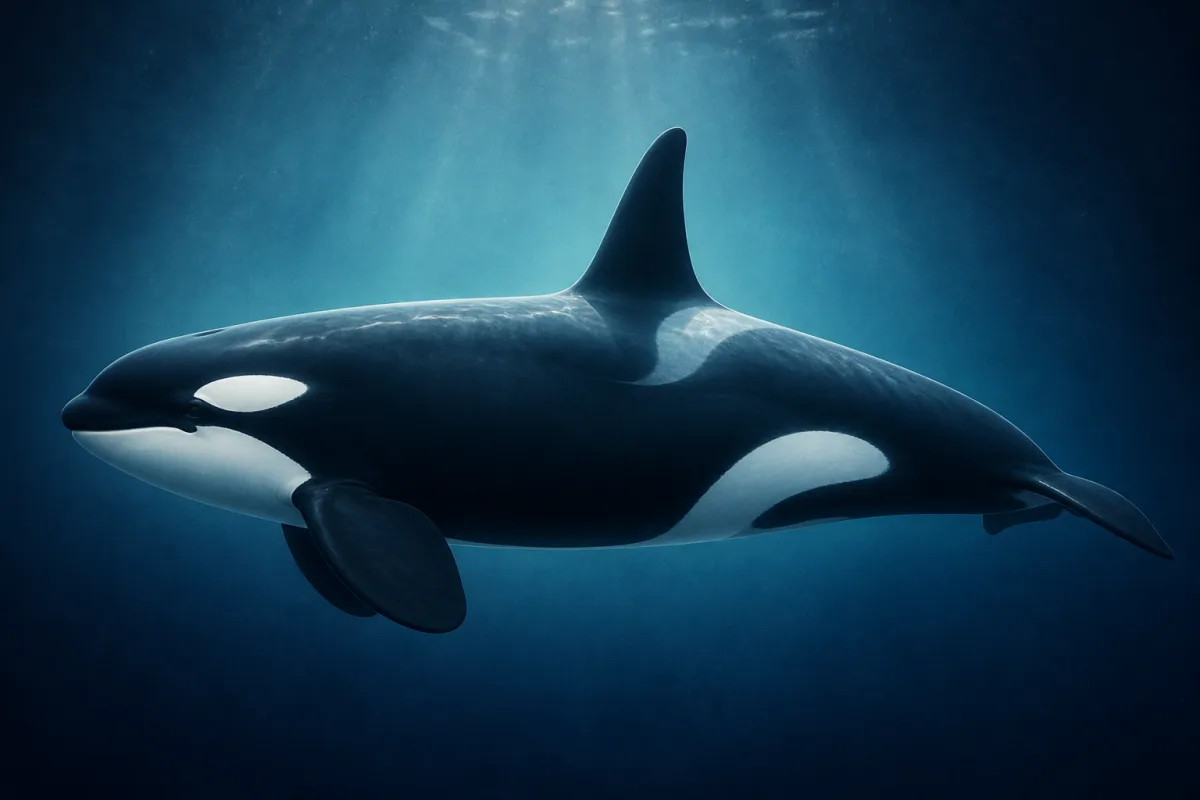
The orca is substantially the larger animal. Adult males reach roughly 30 feet and can weigh up to about 10 tons, with a dorsal fin that stands 6 feet tall and is visible from a great distance. White sharks reach close to 20 feet in the largest carefully verified individuals, with weights up to roughly 2 tons. Both figures describe exceptional animals: typical adults of either species fall well short, and the shark's weight climbs steeply with length and with feeding condition.
Which sex is larger differs between them. Female white sharks average considerably bigger than males, the usual pattern among sharks and tied to the demands of carrying young. Male orcas are the larger sex, averaging about three feet longer than females and carrying the tall straight fin, while females have a shorter, curved one. In orcas, body size also varies as much between populations as between the sexes, with some Antarctic fish-eating orcas barely two-thirds the length of large North Pacific males.
Their body plans reflect the medium each moves through in different ways. The shark's dark dorsal surface and pale belly are countershading, useful to an animal that attacks vertically. The orca's bold black-and-white pattern serves a different purpose entirely, and its saddle and eye patch are distinctive enough that individual animals are identified from photographs, which is how researchers have followed known orcas across decades. White sharks are identified individually as well, but from the ragged trailing edge of the dorsal fin rather than from any color pattern, and those records generally span years rather than the lifetimes available for known orcas.
An individual learner and an inherited culture
White sharks are usually encountered alone, but the species is not asocial. Sharks gather at productive sites and sort themselves into a size-based feeding order in which larger animals displace smaller ones, and individuals off Guadalupe Island have been recorded repeatedly in the company of the same associates. What is absent is transmission. A shark's hunting skill is built from its own experience, and its diet shifts with age as its jaws and teeth become capable of handling larger prey.
Orca behavior is inherited socially rather than individually acquired. Resident orcas live in matrilines that stay together for life, related matrilines form pods, and pods that share a call repertoire form clans. Each group carries its own dialect, its own preferred prey and its own methods. Hunting techniques are learned: orcas off Patagonia strand themselves on shingle beaches to reach young sea lions, a maneuver adults spend years teaching to calves, and Antarctic groups swim in formation to wash seals off ice floes.
That difference has an unusual consequence. In the northeastern Pacific, resident orcas eat fish, mostly Chinook salmon, while Bigg's orcas in the same inlets eat only marine mammals; the two forms do not mix or interbreed, and genetic work published in 2024 proposed recognizing them as separate species. A white shark population contains no such divisions. Two orcas in the same bay may occupy entirely different ecological positions, while two white sharks of the same size are doing broadly the same thing.
Two ways of catching a seal
The white shark's method is vertical and brief. It patrols deep water beneath a colony, using a dark back against the seafloor and a white belly against the light, then strikes upward in a single high-speed rush that sometimes carries it clear of the surface. Against prey that can defend itself it uses a bite-and-wait approach, releasing the animal after an initial wound and returning once it weakens, which reduces the risk of injury from teeth, claws or flukes. Electroreceptors in the snout detect prey the shark cannot see.
Orcas hunt cooperatively, with roles that vary by population. Mammal-hunting groups are small, typically three to seven animals, because a large group is harder to feed and harder to conceal. They fall silent while searching, relying on passive listening rather than echolocation, since seals and porpoises can hear the same clicks a fish cannot. Fish-eating orcas have no such constraint and vocalize almost continuously, circling herring schools, driving them upward and stunning fish with tail slaps.
The two approaches suit different constraints. A shark hunting alone must reduce a single attempt to the lowest possible risk, which is why the strike is fast and the follow-up patient. A group of orcas can spread risk across several animals and attempt maneuvers no individual could complete, which is why their repertoire includes techniques that take years to teach and are confined to the population that developed them. Timing differs too. White sharks are active around the clock with a clear peak in the first hours after sunrise, when low light favors an ambush from below, while orca foraging follows the availability of prey rather than the light.
What researchers observed when orcas arrived
Orcas are the only documented predator of adult white sharks. The interaction has been recorded on a small number of occasions, and its clearest signature is not the killing itself but what follows. At aggregation sites where both species occur, including waters off central California and South Africa, tagged white sharks have left within a short time of orcas appearing and stayed away for weeks or months. Because individual sharks return to the same coastal sites year after year, a season-long absence is a conspicuous departure from normal behavior.
What is not established is why. The sharks may be responding to the orcas directly, to chemical traces left in the water, or to something else entirely, and the events themselves are rarely witnessed. Much of the record comes from tagging and photo identification rather than from observation, and it is not clear whether this reflects a general relationship between the two species or the behavior of particular orcas that have learned to target sharks, in the same way other groups specialize on herring or on seals.
The consequences ripple outward in ways researchers are still measuring. White sharks shape where and how seals and sea lions forage, so removing them from a site for months changes the behavior of everything below them, and orcas may take some of the same prey while they are present. This is one of the clearer available examples of a predator being displaced by another predator in the open ocean, and it is worth reporting as what it is: a documented, partially understood ecological effect.
One listed species and one that cannot be listed
The white shark is assessed as Vulnerable with a decreasing trend. Accidental capture in gillnets and longlines is the main pressure, compounded by demand for jaws, teeth and fins and by beach protection programs that still kill sharks in some regions. Low reproductive output and late maturity, near 26 years in females, make losses slow to replace. The species is protected in United States, Australian, South African and New Zealand waters and listed on CITES Appendix II.
The orca has no usable global category. It is listed as Data Deficient, because the recognized ecotypes differ in diet, calls, appearance and genetics to a degree that makes one worldwide assessment close to meaningless, and several may prove to be separate species. Individual populations are therefore evaluated on their own: the Southern Resident group of the northeastern Pacific numbers about 75 animals and is listed as endangered under United States law, and several small, isolated populations elsewhere are considered at high risk.
Their threats differ as much as their categories. The shark is caught, deliberately and accidentally, and its recovery depends on how much gear it encounters. The orca is not fished at all; its problems are contamination, prey decline and noise. Long life at the top of the food web has left some populations among the most contaminated animals ever measured, with PCB concentrations high enough that modeling predicts suppressed reproduction for decades after the compounds were banned in the 1970s.