Overview
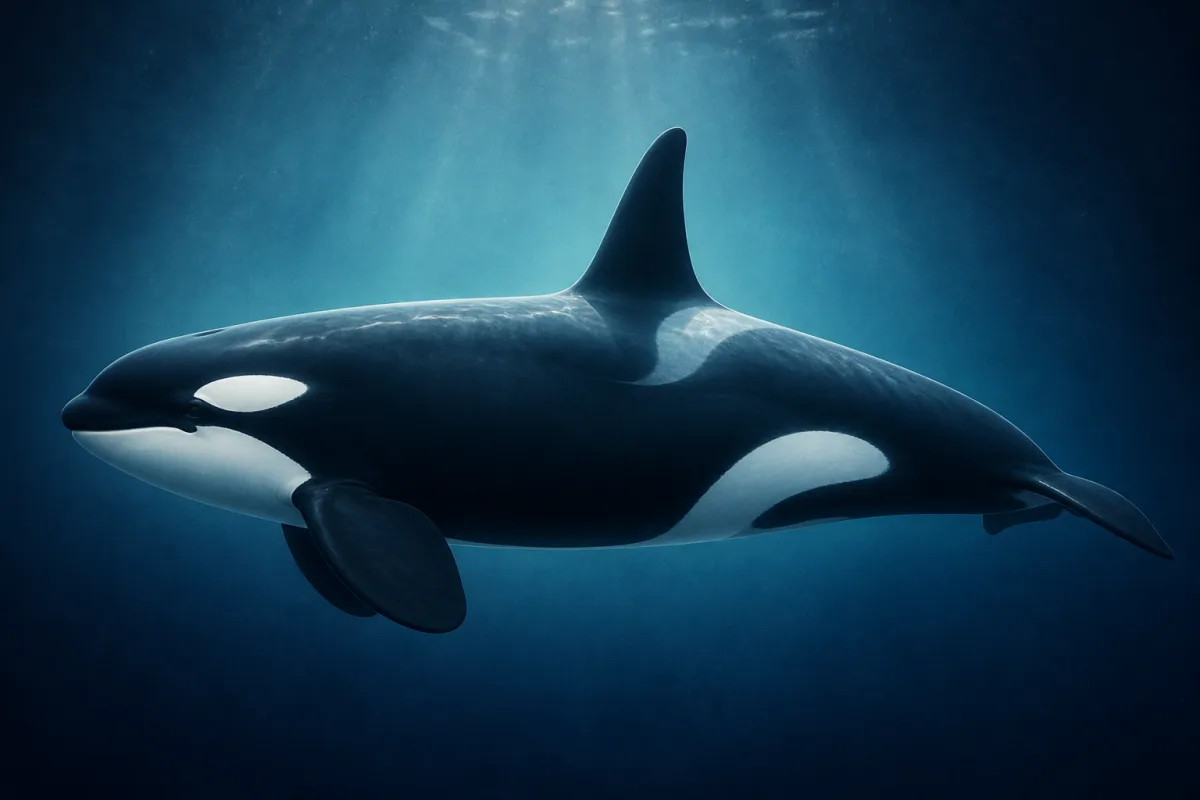
The orca is the largest member of the dolphin family and the most widely distributed mammal in the ocean, found from the pack ice of both poles to the tropics. Adult males reach roughly 30 feet and carry a dorsal fin that can stand 6 feet tall, visible from a great distance. Females are noticeably smaller, with a shorter, curved fin. Body size varies as much between populations as between the sexes: some Antarctic orcas that specialize on fish are barely two-thirds the length of large North Pacific males.
What distinguishes the species is not size but culture. Orcas live in durable groups built around related females, and each group carries its own repertoire of calls, its own preferred prey and its own methods. In the North Pacific the differences are stark. Resident orcas eat fish, mostly Chinook salmon; Bigg's orcas in the same inlets eat only marine mammals. The two forms do not mix or interbreed, and genetic work published in 2024 proposed recognizing them as separate species. That question is not yet settled.
Hunting methods are learned rather than instinctive, and they differ sharply by region. Orcas off Patagonia strand themselves on shingle beaches to reach young sea lions and then work their way back to the water, a maneuver adults spend years teaching to calves. In the Antarctic, groups swim in formation to wash seals off ice floes. Off northern Norway, they herd herring into dense balls and stun them with tail slaps. Each of these traditions is confined to the population that developed it.
Where it lives
Every ocean and most seas, from the marginal ice zones of the Arctic and Antarctic to equatorial waters. Densities are highest in cold, productive regions such as the northeastern Pacific, Norwegian and Icelandic waters, the Antarctic Peninsula and the Ross Sea. Tropical records are widespread but sparse.
Habitat
- Coastal waters
- Continental shelf
- Open ocean
- Sea ice & polar shelves
- Kelp forests & rocky reefs
What it eats
Diet is a population trait rather than a species trait. Resident orcas of the northeastern Pacific take salmon almost exclusively and show a strong preference for large Chinook. Bigg's orcas in the same waters eat seals, sea lions, porpoises and gray whale calves. Norwegian orcas follow herring, New Zealand groups specialize on rays and small sharks, and some Antarctic types focus on Antarctic toothfish. Individuals seldom switch.
- Marine mammals
- Bony fish
- Sharks & rays
- Squid & octopus
- Seabirds
How it hunts
Orcas hunt cooperatively, using coordinated roles that vary by population. Herring specialists circle a school, drive it toward the surface and stun fish with tail slaps before collecting them one at a time. Groups targeting seals on ice create a wave that washes the floe clear. Mammal-hunting orcas fall silent while searching, relying on passive listening rather than echolocation, because their prey can hear the same clicks. Fish-eating orcas have no such constraint and vocalize almost continuously.
Behavior
Social structure: Stable pods
Resident orcas live in matrilines that stay together for life, with sons and daughters remaining alongside their mother. Related matrilines form pods, and pods that share a call repertoire form clans. Mammal-hunting groups are smaller and more fluid, typically three to seven animals, because a large group is harder to feed and harder to conceal.
Active period: Day & night
Active by day and night, with rest taken in short bouts during which the group swims slowly in a tight line and one brain hemisphere sleeps at a time.
Reproduction
Live birth, milk-fed young.
Gestation lasts about 17 months, the longest of any dolphin, and produces a single calf roughly 8 feet long. Calves nurse for a year or more and stay with their mother indefinitely. Calving intervals average five years. Females stop reproducing around age 40 but often live for decades afterward, and these post-reproductive females lead the group to salmon in years when fish are scarce.
Predators and ecological role
None. Adult orcas are not preyed upon anywhere in their range, and mortality is driven almost entirely by prey availability, disease, contaminant load and human activity rather than by other animals.
As the ocean's only cosmopolitan apex predator, orcas influence the distribution and behavior of seals, sea lions, porpoises and even large whales. The recovery of sea otters, the movements of white sharks off South Africa and the timing of gray whale migration have all been linked to orca presence. Because separate populations specialize on different prey, their ecological effect is highly local.
Conservation and threats
Data Deficient Assessed 2017 · population unknown
The global listing is Data Deficient rather than a confident category. The recognized ecotypes differ in diet, calls, appearance and genetics, and several may prove to be separate species, which would make a single worldwide assessment meaningless. Individual populations are therefore evaluated on their own: the Southern Resident group of the northeastern Pacific numbers about 75 animals and is listed as endangered under United States law, and several small, isolated populations elsewhere are considered at high risk.
Long life and a high position in the food web make orcas among the most contaminated animals measured. PCB concentrations in some populations are high enough that modeling predicts suppressed reproduction for decades even though the chemicals were banned in the 1970s. Fish-eating populations are additionally limited by declines in large salmon, and vessel noise reduces the range over which they can find prey by echolocation.
Main pressures
- Chemical pollution
- Depletion of prey
- Underwater noise
- Vessel strikes
- Entanglement in gear
Notable details
- Orcas are one of only a handful of mammals known to go through menopause, and post-reproductive grandmothers lead their groups to salmon in years when fish are scarce.
- Every pod has its own vocal dialect, shared with related matrilines, so a recording alone can identify which family a group belongs to.
- Fish-eating and mammal-eating orcas share the same inlets in the northeastern Pacific but have not interbred for hundreds of thousands of years.
- PCB levels measured in some orca populations are among the highest recorded in any animal, decades after the compounds were banned.
Sources
-
The IUCN Red List of Threatened Species
International Union for Conservation of Nature
Global conservation assessments, population trends and threat classifications for every species profiled here.
-
Species Directory
NOAA Fisheries
Management-grade biology, distribution and stock information for species in United States waters.
-
International Whaling Commission
IWC
Cetacean population status, ship-strike and entanglement reporting.
-
Smithsonian Ocean
Smithsonian National Museum of Natural History
Peer-reviewed public science writing on marine life, ecosystems and ocean change.
Figures on this page were last checked against these sources on .