
What the numbers mean
The shortfin mako and the sailfish are the two animals most often named when someone asks which fish is fastest, and both reputations rest on numbers that modern measurement does not support. The sailfish's famous figure near 68 miles per hour traces to a single line-stripping test from the 1940s. The mako's widely repeated 45 miles per hour rests on brief, poorly documented observations. Careful work places both animals considerably lower, and the reasons are more interesting than the claims.
Underneath the speed question sit two very different fish. One is a warm-bodied shark with a cartilaginous skeleton, a long gestation and very few young. The other is a bony fish with an enormous folding dorsal fin, a bill it uses to injure prey, and a habit of hunting in loose groups. They occupy overlapping warm water and eat some of the same schooling fish, but almost nothing about the way they are built is comparable.
What the measurements actually show
The best current figure for a sailfish is about 22 miles per hour, derived from studies that combine muscle contraction time with stride length and from video of feeding strikes. Both approaches measure the animal rather than the equipment attached to it. The 68-mile-per-hour claim came from timing how fast line left a reel during a single test, a method that mixes the fish's swimming speed with boat movement, line angle and drag, and it has never been reproduced by any modern technique.
The mako's number is better supported but still smaller than its reputation. Instrumented animals have been recorded near 30 miles per hour in short bursts. That is a genuine measurement taken from a tag on a swimming shark, and it is the figure worth quoting. Ordinary cruising for either species is a small fraction of its maximum, which is the detail most often lost: a burst is something an animal does for a second or two in the final approach, not a pace it holds.
It is also worth noting what a maximum speed is for. Neither fish uses it to travel. The mako covers ocean basins at cruising pace, with satellite-tagged individuals recording more than 8,000 miles in a year, and the sailfish spends most of its time patrolling the warm surface layer. Speed is deployed in seconds-long episodes at the end of a hunt, which is precisely why it is so difficult to measure and so easy to overstate.
Two ways to build a fast fish
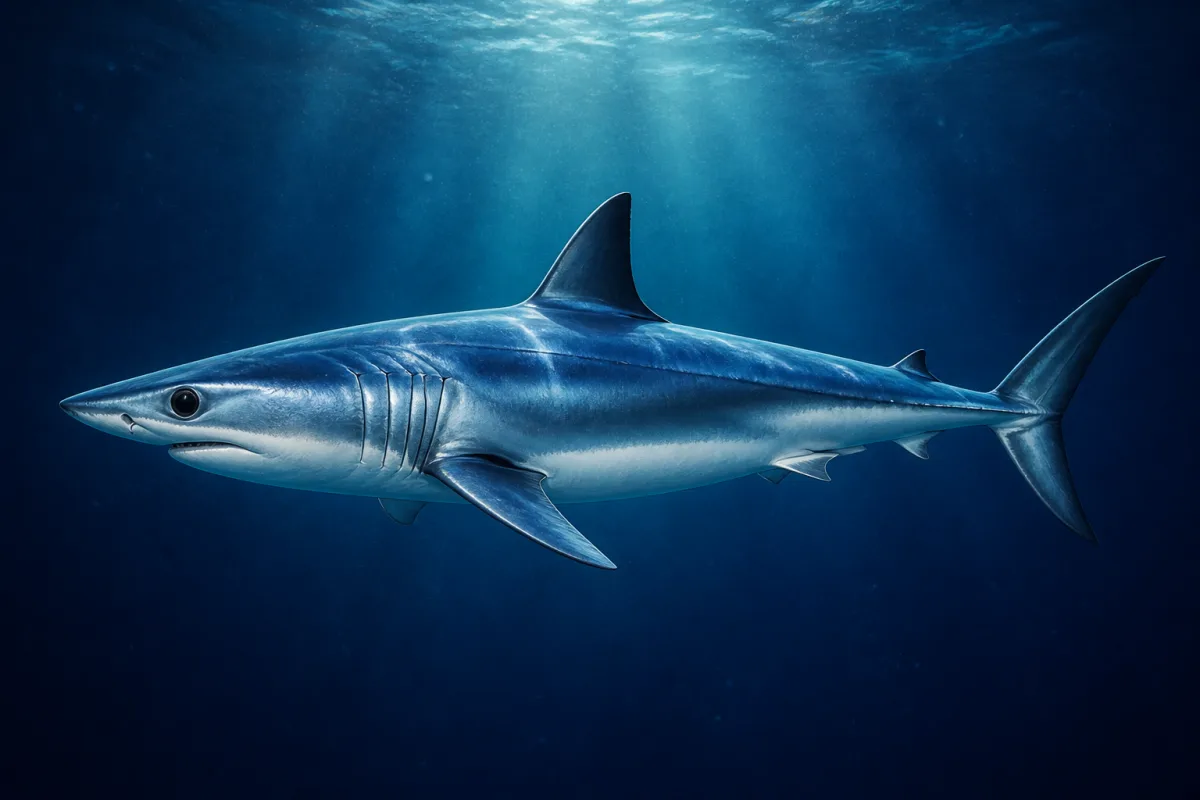
The mako is built along the lines of a tuna: a stiff, nearly cylindrical body, a sharply pointed snout, narrow keels at the tail base and a crescent-shaped caudal fin with lobes of almost equal length. Stiffness matters here. A body that flexes little converts muscle effort into forward thrust with minimal side-to-side waste, and the tail shape reduces the drag penalty that a broad fin would impose at speed.
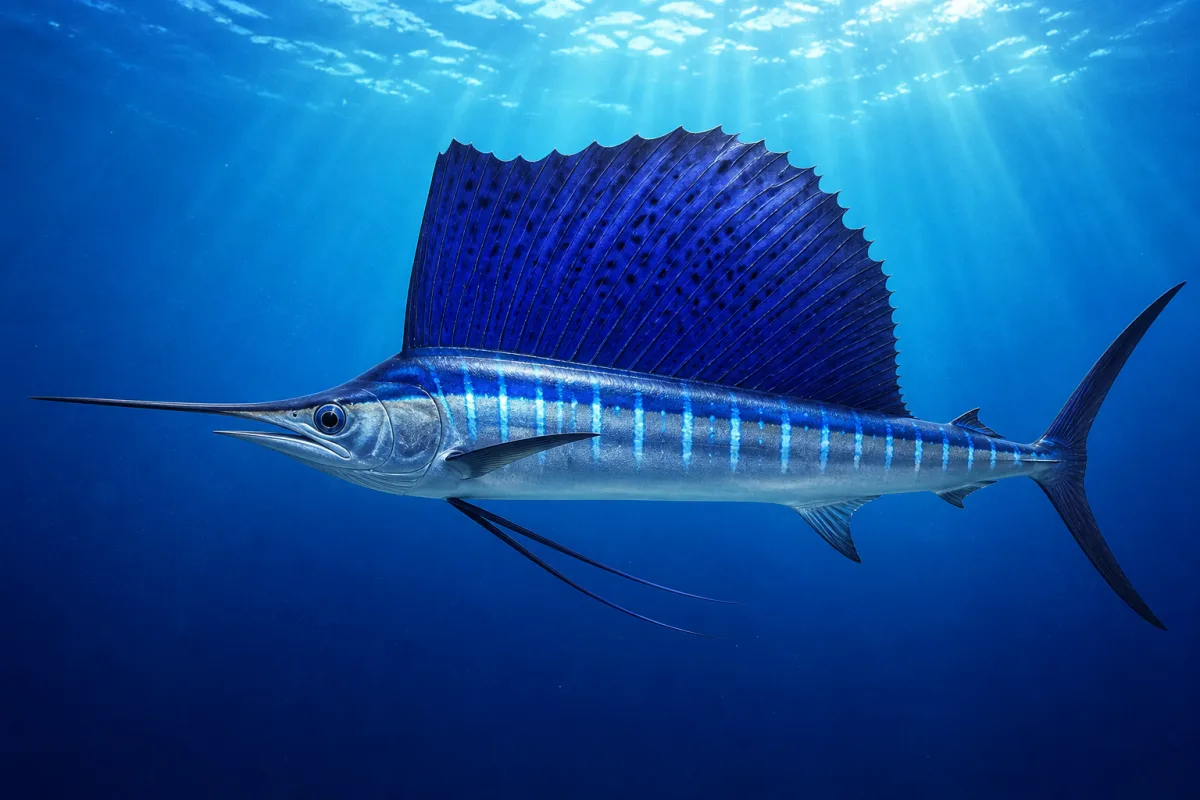
The sailfish is slim and laterally compressed rather than heavy, and its most conspicuous feature spends most of its time hidden. The first dorsal fin can stand taller than the body is deep, but it folds down into a groove along the back while the fish is cruising and is raised during feeding and in close encounters with other sailfish. A swimming sailfish therefore looks far more streamlined than the mounted specimens that shape most people's mental image of it.
The two are wildly different in mass. Both reach broadly similar lengths, the mako to about 13 feet and the sailfish to about 11, but a sailfish of a given length weighs a fraction of what a marlin, swordfish or mako of the same length does. Typical sailfish run around 66 pounds and the heaviest verified individuals approach 220, while a large mako can exceed 1,200. One animal is built out of muscle; the other out of surface area.
Warm muscle against warm water
The mako carries its temperature with it. Networks of small parallel blood vessels trap the heat produced by its swimming muscles instead of losing it at the gills, keeping muscle, viscera and eyes several degrees above the surrounding sea. That warmth extends the range of water the shark can hunt in effectively, and it uses that range: makos spend most of their time in the upper 300 feet but make regular deeper excursions, with a small number of archival tags recording a maximum near 2,400 feet, following prey into cold water where a fish at ambient temperature would slow down.
The sailfish takes the opposite approach and stays where the water is already warm. It concentrates in seas above about 70 degrees Fahrenheit, spends most of its time in the warm mixed layer above roughly 60 feet, and makes only short dives below the thermocline. Its vertical world is a thin slice of the one the mako occupies, and its distribution is correspondingly tied to tropical and subtropical fronts, shelf edges and offshore banks.
That difference has a conservation consequence that has nothing to do with fishing gear. Expanding low-oxygen zones in tropical oceans compress the surface layer sailfish depend on, squeezing the fish into a thinner band of habitat and concentrating them where gear is set. A species with a warm body and a wide depth range has somewhere to go when conditions change at the surface; one tied to the mixed layer has considerably less room.
Hunting alone and hunting in company
Makos hunt in open water without cover, so pursuit replaces ambush. Warm muscle and a stiff, high-aspect tail let them close on fast prey and change direction sharply at speed, and they often approach from below and behind, where a target's field of view is poorest. The teeth are long, narrow and smooth-edged, curving inward and visible even when the mouth is shut, and they grip slippery fish rather than cutting them. Makos are encountered alone in almost all circumstances.
Sailfish hunt in loose groups of a dozen or more and work bait schools cooperatively. A hunting fish approaches from below or the side, raises its sail, and inserts only the bill into the mass of sardines rather than charging through it, delivering rapid taps or a hard lateral slash before collecting the injured fish that fall out of formation. The bill carries small tooth-like denticles and works as a tool for disabling prey rather than as a spear.
The cooperation is real and measurable. Capture success per attack rises when several sailfish work a school together, because a bait ball breaks up under sustained pressure and taking turns keeps it intact and available for longer than any single fish could manage. Sailfish also flush rapid color changes across the skin while hunting, patterns that appear to coordinate the group and may reduce collisions when several fish enter a bait ball at once.
A fast life and a slow one
The sailfish lives in a hurry. Young fish grow roughly 4 to 5 feet in their first year, among the fastest growth rates measured in any bony fish, and the species matures early and rarely exceeds 13 years. Spawning is external: eggs and sperm are released into warm surface water with no parental care, and a female sheds millions of eggs in batches across an extended season. Most sailfish in commercial and recreational catches are under five years old.
The mako runs on a much longer cycle. Embryos develop without a placenta and feed on unfertilized eggs supplied by the mother, producing 4 to 25 pups about 2 feet long after a gestation of 15 to 18 months. Females rest a year or more between litters and do not begin breeding until around 18 years of age. Bomb radiocarbon dating, which uses the mid-century atmospheric carbon-14 spike as a time marker, showed makos live about twice as long as researchers previously believed, to roughly 32 years.
The categories follow directly. Sailfish are assessed as Least Concern because they are widespread, fast-growing and early-maturing, which makes them more resilient to fishing than the slower-growing billfish assessed alongside them, though regional catch trends raise concern in parts of the eastern Atlantic and western Indian Ocean and the stock assessments remain data-limited. The mako moved from Vulnerable to Endangered in 2019, and North Atlantic assessments concluded the population would need decades of near-zero catch to rebuild.