Overview
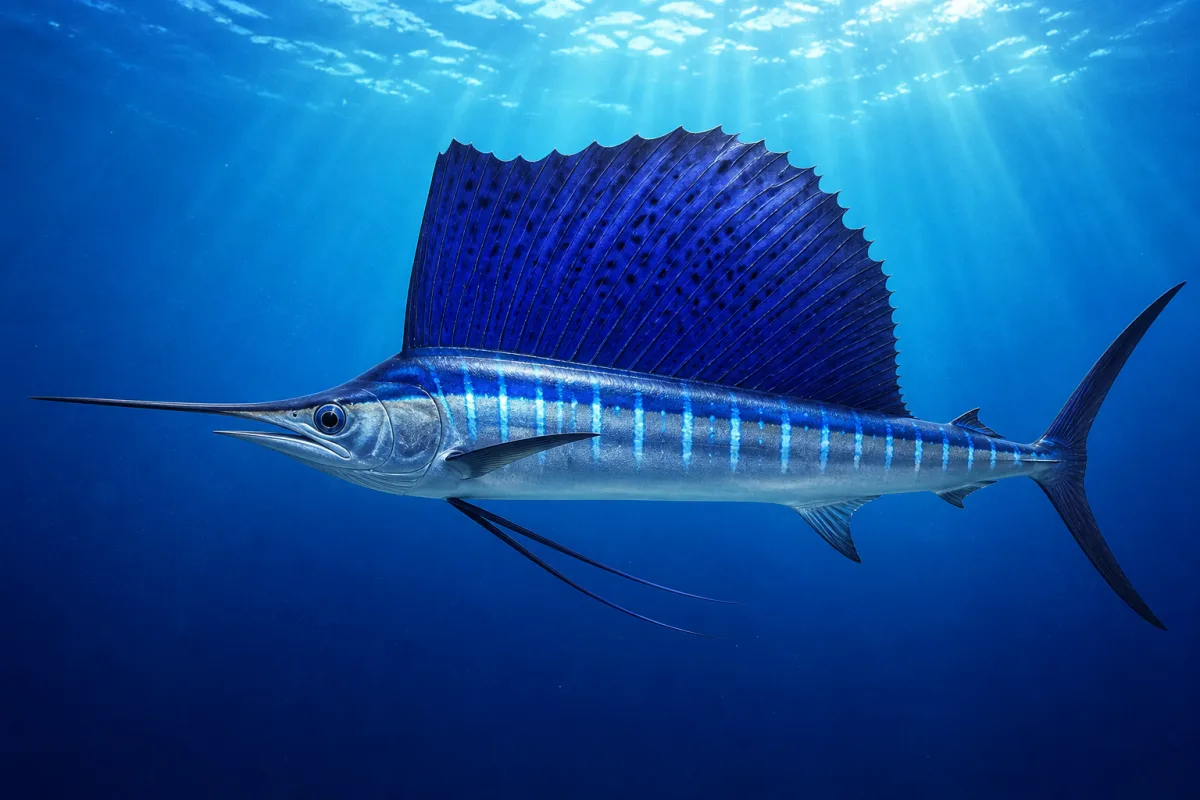
The sailfish is the most immediately recognizable of the billfish, thanks to a first dorsal fin that can stand taller than the body is deep. That sail folds down into a groove along the back when the fish is cruising and is raised during feeding and in close encounters with other sailfish. The body is slim and compressed rather than heavy, so a sailfish of a given length weighs far less than a marlin or a swordfish of the same size. Atlantic fish average noticeably smaller than Indo-Pacific ones.
Group hunting is the behavior that sets the species apart. Off the Yucatan Peninsula and elsewhere, sailfish gather in loose groups of a dozen or more and work sardine schools together, taking turns entering the bait ball while the others hold position around it. Underwater video shows each fish inserting its bill into the school and delivering rapid taps or a hard sideways slash, then picking up the injured sardines that fall out of formation. Capture success per attack rises when several sailfish cooperate this way.
The bill is a tool for disabling prey, not a spear. Its surface carries small tooth-like denticles, and a slash across a sardine's flank leaves scale damage and injuries that reliably slow the fish down. Sailfish also flush with rapid color changes while hunting, driven by pigment cells in the skin, and the shifting bars and silver flashes appear to coordinate the group and may reduce collisions when several fish enter a bait ball at once.
Where it lives
Warm waters of the Atlantic, Pacific and Indian Oceans, including the Caribbean, the Gulf of Mexico and the Mediterranean, generally where surface temperatures stay above about 70 degrees Fahrenheit. Sailfish concentrate over shelf edges, current fronts and offshore banks, and move poleward in summer along the eastern coasts of the Americas, Africa and Asia. Many authorities treat Atlantic and Indo-Pacific fish as one species with two populations.
Habitat
- Open ocean
- Continental shelf
- Coastal waters
What it eats
Sardines, anchovies, mackerel, needlefish, halfbeaks and other small schooling fish make up most of the diet, along with squid. Sailfish stay above the thermocline far more than swordfish do, so their prey is largely surface-associated rather than drawn from deep water. Feeding is concentrated in short, intense bouts when a school is located.
- Bony fish
- Squid & octopus
- Crustaceans
How it hunts
A hunting sailfish approaches a bait school from below or from the side, raises its sail, and inserts only the bill into the mass of fish rather than charging through it. Short taps reposition prey and a fast lateral slash injures several sardines at once; the fish then collects the animals that drop out of the school. Because a bait ball breaks up under sustained pressure, groups alternate turns, which keeps the school intact and available for longer than a single fish could manage.
Behavior
Social structure: Loose aggregations
Sailfish are not schooling fish, but they gather in loose, temporary groups of a few to several dozen where prey concentrates, and they hunt within those groups in an orderly rotation. The associations dissolve once the bait school disperses.
Active period: Daytime
Chiefly a daylight hunter that relies on vision to locate schools near the surface, with feeding often heaviest in the morning. Activity drops sharply after dark.
Reproduction
Broadcast spawning.
Spawning takes place in warm surface water, often in pairs or with several males trailing a single female, and eggs are released and fertilized in open water with no parental care. Females spawn in batches through an extended season, releasing millions of eggs in total. Larvae hatch small and grow with remarkable speed, which shortens the period when they are vulnerable to surface predators.
Predators and ecological role
Large sharks and orcas take adult sailfish, and false killer whales are documented predators of billfish in general. Juveniles are eaten by tunas, dolphinfish, other billfish and seabirds, and eggs and larvae feed a broad range of plankton-feeding animals.
Sailfish are a major daytime predator of small schooling fish in warm surface waters, and their group feeding concentrates prey near the surface where seabirds, tunas and dolphins also benefit. Their fast growth and short lifespan mean they cycle energy through the pelagic food web more quickly than longer-lived predators.
Conservation and threats
Least Concern Assessed 2011 · population unknown
Sailfish are assessed as Least Concern because the species is widespread, fast-growing and early-maturing, which makes it more resilient to fishing than the slower-growing marlins assessed alongside it. Regional catch trends nonetheless raise concern in parts of the eastern Atlantic and the western Indian Ocean, and stock assessments remain data-limited.
Most sailfish mortality comes from pelagic longline and gillnet fisheries aimed at tuna, where sailfish are landed as incidental catch, and from artisanal fisheries in West Africa and South Asia. Recreational fisheries are largely catch-and-release but still cause some post-release mortality. Expanding low-oxygen zones in tropical oceans compress the surface layer sailfish depend on, which concentrates them where fishing gear is set.
Main pressures
- Bycatch in other fisheries
- Targeted fishing
- Ocean warming
Notable details
- The dorsal sail folds flat into a groove along the back while cruising and is raised during feeding, so a swimming sailfish looks far more streamlined than its mounted specimens suggest.
- The bill carries small tooth-like denticles and is used to tap and slash prey rather than to impale it, a mechanism documented on underwater video off Mexico.
- Sailfish flash rapid color changes across the body while hunting in groups, produced by pigment cells in the skin.
- Young sailfish grow roughly 4 to 5 feet in their first year, among the fastest growth rates measured in any bony fish.
Sources
-
The IUCN Red List of Threatened Species
International Union for Conservation of Nature
Global conservation assessments, population trends and threat classifications for every species profiled here.
-
Species Directory
NOAA Fisheries
Management-grade biology, distribution and stock information for species in United States waters.
-
FishBase
FishBase Consortium
Compiled length, weight, growth and depth records for fish species, drawn from the primary literature.
-
Smithsonian Ocean
Smithsonian National Museum of Natural History
Peer-reviewed public science writing on marine life, ecosystems and ocean change.
Figures on this page were last checked against these sources on .