
What the numbers mean
Blue sharks and shortfin makos live in the same water, eat overlapping prey and are caught on the same gear, which makes them one of the more instructive pairings in the open ocean. They belong to different families and are built on different principles. The blue shark is a requiem shark, slim and long-finned, running at the temperature of the sea around it. The mako is a mackerel shark, stiff and heavily muscled, and it keeps itself warm.
The comparison matters because their conservation outcomes have diverged sharply despite nearly identical exposure to fishing. The blue shark is the most frequently caught shark in high-seas longline fisheries, taken in the tens of millions each year, and is listed as Near Threatened. The mako is caught on the same lines in far smaller numbers and is listed as Endangered. The difference lies almost entirely in how each species reproduces.
Two designs for the same water
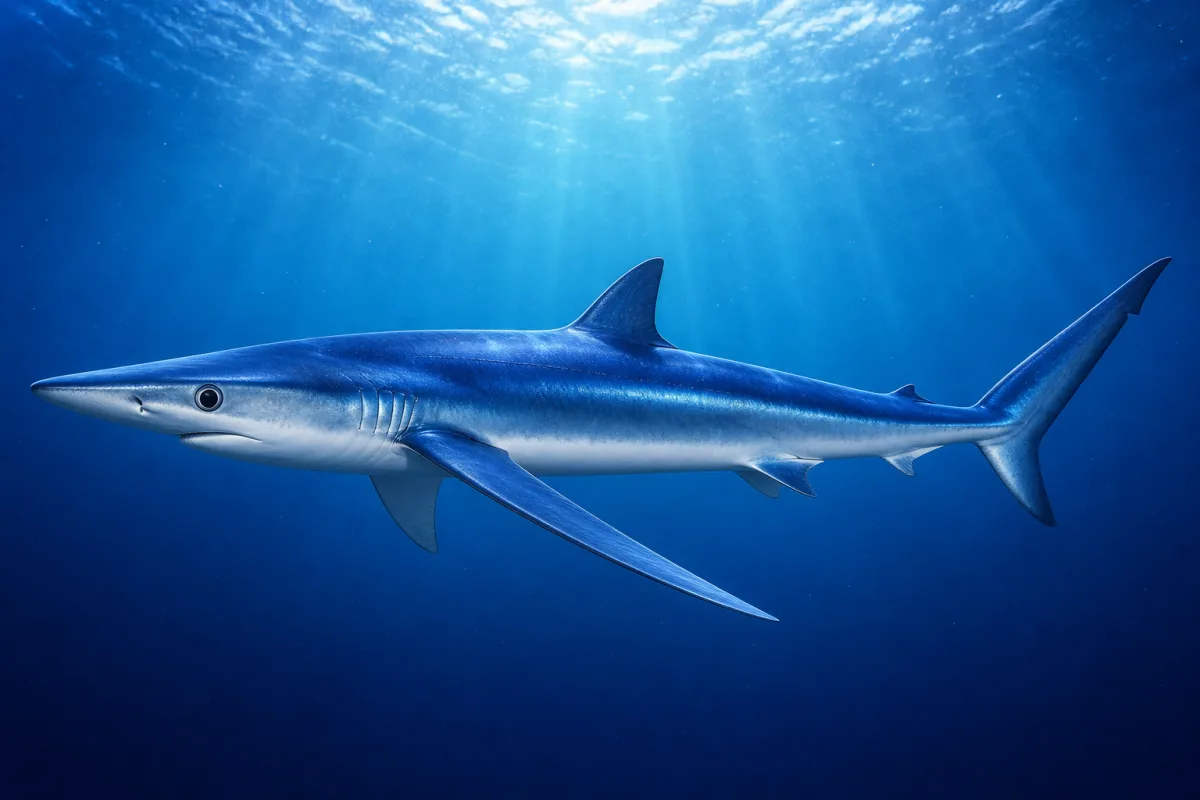
The blue shark is the most lightly built of the large requiem sharks: a slim tapered body, a long pointed snout, large eyes and pectoral fins that are unusually long and narrow. The color gives it the name, a deep indigo along the back shading to bright blue on the flanks and abrupt white below, a pattern that fades within hours of death. Adults commonly measure 6 to 9 feet, with the largest verified individuals near 12 feet.
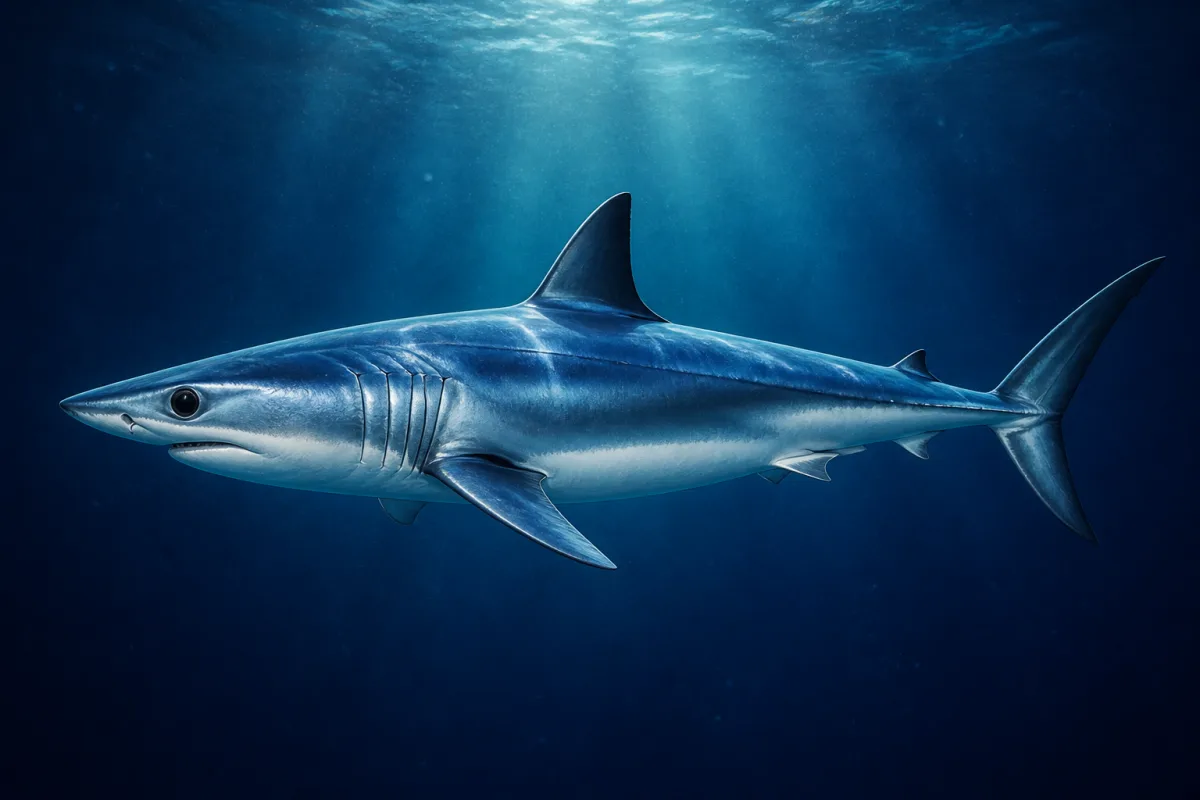
The mako is built along the lines of a tuna. The body is stiff and nearly cylindrical, with narrow keels at the tail base and a crescent-shaped caudal fin whose lobes are almost equal in length, an arrangement that converts muscle effort into thrust with very little side-to-side waste. The back is deep metallic blue and the snout sharply pointed. Adults also run 6 to 9 feet, and the largest reliably recorded individuals reach about 13 feet.
The two are far apart in mass at the same length. A blue shark is light for its size, with typical animals near 120 pounds and the heaviest verified individuals around 530. A mako of similar length is much denser with muscle, and the largest verified individuals reach roughly 1,250 pounds. Weight in the mako rises far faster than length, so a 13-foot female can outweigh a 9-foot one several times over.
Warm muscle and the price of it
The mako is a regional endotherm, like its relatives the great white and the porbeagle. Networks of small parallel blood vessels called retia mirabilia trap the heat produced by the swimming muscles instead of losing it at the gills, keeping muscle, viscera and eyes several degrees warmer than the surrounding water. Warm muscle contracts faster and recovers sooner. That supports both long-distance cruising and the short accelerations used to catch fast schooling fish, and it lets the shark work cooler water than most large pelagic fish.
The blue shark has no such system and does not need one, because it is built for economy rather than acceleration. Its long pectoral fins generate lift, allowing it to glide for long stretches with minimal effort, and much of its travel is a slow climb-and-descend pattern through the water column. Large eyes and a well-developed sense of smell locate food across considerable distances, so the animal spends its energy on searching rather than on chasing.
Speed figures are worth handling carefully for both. Instrumented makos have been recorded near 30 miles per hour in short bursts, and figures around 45 circulate widely but rest on brief, poorly documented observations. In either case ordinary cruising is a small fraction of the number. Blue sharks have no comparable measurement, and none is really needed: the species is not a sprinter and its record-setting trait is distance rather than pace.
Overlapping prey, different equipment
Squid are the mainstay of the blue shark's diet across most of its range, followed by small schooling fish such as herring, anchovies, hake and mackerel. It also takes pelagic crustaceans, scavenges from whale carcasses and fishery discards, and occasionally catches seabirds resting on the surface. Its teeth are thin and curved with fine serrations, suited to soft-bodied prey, and it often feeds at night near the surface where squid rise from deeper water, working through a concentration steadily rather than in short rushes.
The mako's diet is dominated by schooling fish: bluefish, mackerel, herring and sardines, with tuna and swordfish added as the shark grows. Stomach studies off the northeastern United States found bluefish making up the majority of identifiable prey. Its teeth are long, narrow and smooth-edged, curving inward and protruding from the jaws even when the mouth is shut, and they grip slippery fish rather than cutting through them. Larger makos increasingly take prey that is itself fast and warm-bodied.
Both cross entire ocean basins, though for different reasons. Blue sharks tagged since the 1960s have made transatlantic crossings and journeys of more than 5,500 miles, broadly following the clockwise circulation of the North Atlantic, and populations separate by size and sex over enormous distances. Satellite-tagged makos have covered more than 8,000 miles in a year, moving between the U.S. East Coast and the mid-Atlantic or between New Zealand and the tropical Pacific. Those routes carry both species repeatedly through the same fishing grounds.
Litters of 135 against litters of four
Blue sharks reproduce on a scale no other shark matches. Embryos are nourished through a yolk-sac placenta, gestation lasts about 9 to 12 months, and litters of 25 to 50 pups are ordinary; the largest recorded litter held 135. Pups are about 16 inches at birth. Females can store sperm for months after mating, which allows a shark that meets a mate only rarely in the open ocean to time fertilization independently of when it encountered one.
The mako takes the opposite approach. Embryos develop without a placenta and feed on unfertilized eggs produced by the mother, a strategy called oophagy that yields few but large young. Gestation runs 15 to 18 months and produces 4 to 25 pups about 2 feet long, after which females appear to rest for a year or more, making the effective cycle roughly three years. They do not begin breeding until around 18 years old.
Lifespan compounds the difference. Validated blue shark ages rarely exceed 16 years, and fishing pressure is heavy enough that few reach even that. Makos can live to about 32, a figure that doubled after bomb radiocarbon dating showed vertebral counts had been underestimating age. A short-lived, prolific species and a long-lived, slow-breeding one respond to the same removal rate in completely different ways, and that is the heart of this comparison.
Same longlines, different categories
Pelagic longline fleets targeting tuna and swordfish account for almost all mortality in both species. Blue sharks are caught in greater numbers than any other shark, with annual totals estimated in the tens of millions, and their fins are among the most frequently identified in market surveys of the fin trade. Makos are taken on the same gear both incidentally and as retained catch for their meat and fins, with recreational fisheries adding to the total in the North Atlantic and off California.
The blue shark is listed as Near Threatened with a decreasing trend. It remains numerous and highly productive by shark standards, which is why the category is not higher, but the catch levels are enormous and stock assessments in several regions carry substantial uncertainty. The requiem shark family was added to CITES Appendix II in 2022, with the listing taking effect in late 2023. Because blue sharks are caught almost everywhere longlines are set, their catch rates are one of the clearest available signals of change in high-seas food webs.
The mako moved from Vulnerable to Endangered in the global shark reassessment published in 2019. North Atlantic stock assessments concluded that the population was overfished and would need decades of near-zero catch to rebuild, which prompted a retention ban that took effect in 2022, and the species was added to CITES Appendix II in 2019. Late maturity and a multi-year breeding cycle mean the recovery will be measured against a clock the fishery does not control.