Overview
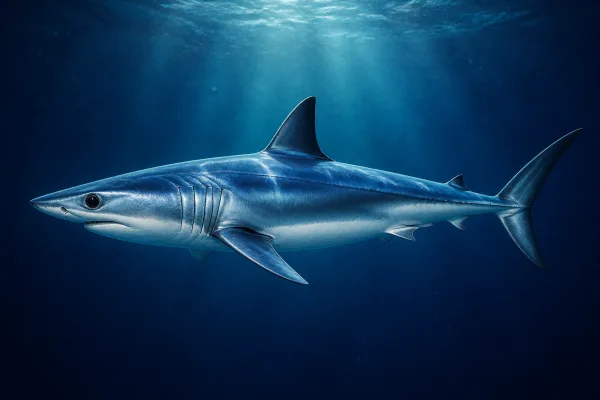
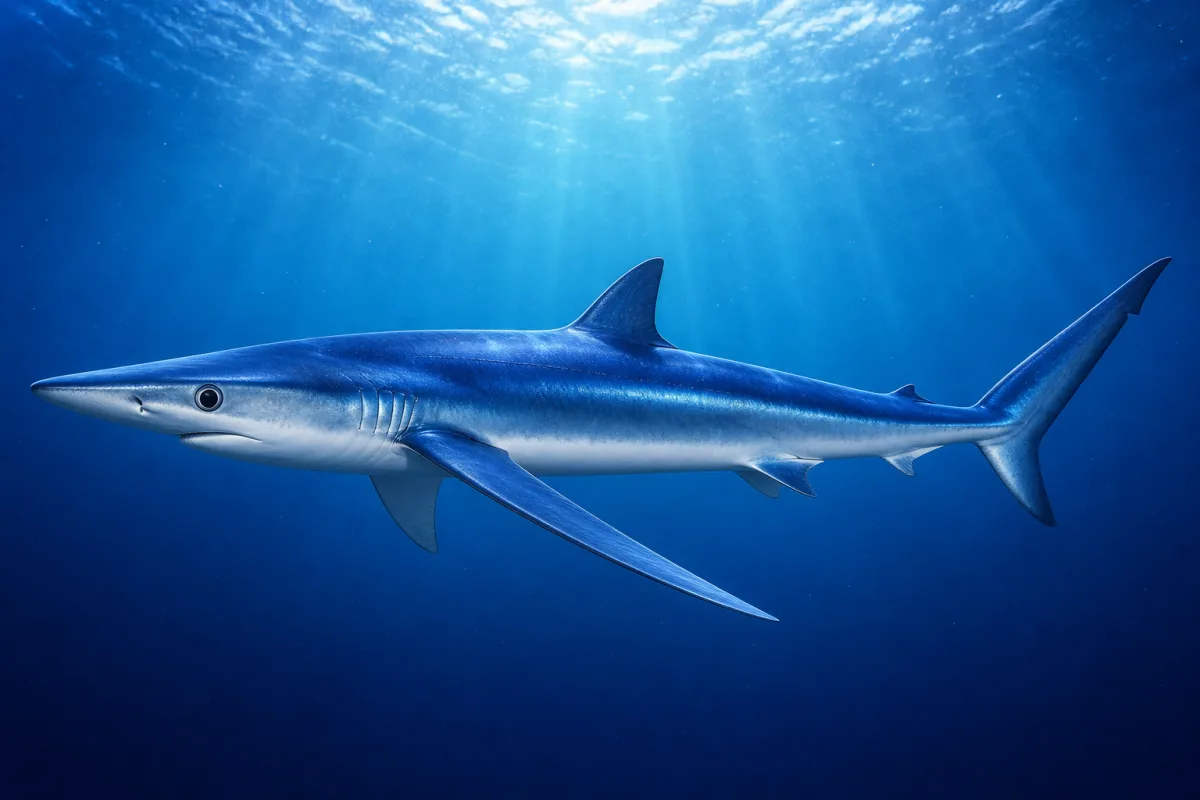
The blue shark is the most lightly built of the large requiem sharks. The body is slim and tapered, the snout long and pointed, the eyes large, and the pectoral fins unusually long and narrow. Its color is the source of the name: a deep indigo along the back that shades to bright blue on the flanks and abrupt white below, a pattern that fades within hours of death. Adults commonly measure 6 to 9 feet, with the largest verified individuals near 12 feet.
Few fish are more widely distributed. Blue sharks occupy the open ocean from the subarctic to the subtropics in every basin, and they move constantly. Tagging programs run since the 1960s have recorded transatlantic crossings and journeys of more than 5,500 miles, with individuals broadly following the clockwise circulation of the North Atlantic. Populations separate by size and sex across enormous distances, so a given region may hold mostly juveniles, mostly males or mostly mature females at any one time.
The species reproduces on a scale no other shark matches. Litters of 25 to 50 pups are ordinary and the largest recorded litter held 135. That output has not protected it. Blue sharks are the most frequently caught shark in high-seas longline fisheries, taken in the tens of millions each year, mostly as bycatch on gear set for tuna and swordfish, and their fins are among the most common in international trade.
Where it lives
Open ocean worldwide, from roughly 60 degrees north to 50 degrees south, including the North Atlantic off New England and Atlantic Canada, the Gulf Stream, the eastern and central Pacific, the waters off California and Baja California, the Indian Ocean and the Mediterranean. It approaches shore only where deep water comes close to the coast.
Habitat
- Open ocean
- Continental shelf
- Deep sea
- Seamounts & offshore banks
What it eats
Squid are the mainstay across most of the range, followed by small schooling fish such as herring, anchovies, hake and mackerel. Blue sharks also take pelagic crustaceans, scavenge from whale carcasses and fishery discards, and occasionally catch seabirds resting on the surface. Their teeth, thin and curved with fine serrations, suit soft-bodied prey.
- Squid & octopus
- Bony fish
- Crustaceans
- Carrion & whale falls
- Seabirds
How it hunts
Blue sharks are built for economy rather than acceleration. The long pectoral fins generate lift, allowing the shark to glide for long stretches with minimal effort, and much of its travel is a slow climb-and-descend pattern through the water column. Large eyes and a well-developed sense of smell let it detect food across considerable distances. Feeding is opportunistic and often takes place at night near the surface, where squid rise from deeper water; the shark works through a concentration steadily rather than in short rushes.
Behavior
Social structure: Loose aggregations
Frequently found in numbers where food is plentiful, and strongly segregated by size and sex over large areas, so groups tend to be made up of similar animals. These are gatherings of convenience rather than organized schools, and the composition changes constantly.
Active period: Day & night
Active at all hours, with a pronounced daily vertical rhythm: shallower and nearer the surface at night, deeper and in colder water through the day.
Reproduction
Live birth, placental young.
Embryos are nourished through a yolk-sac placenta. Gestation lasts about 9 to 12 months, and litters are the largest known for any shark: commonly 25 to 50 pups and, in one recorded case, 135. Pups are about 16 inches at birth. Females can store sperm for months after mating, which allows fertilization to be timed independently of when males are encountered.
Predators and ecological role
Larger sharks, including shortfin makos and great whites, take blue sharks, and orcas have been recorded doing so on rare occasions. Young sharks are the most vulnerable, but human fisheries account for a share of mortality far larger than all natural predation combined.
As the most abundant large shark in the open ocean, the blue shark is a principal consumer of squid and small schooling fish across an enormous area, and a significant scavenger of material that would otherwise sink. Its numbers make it a useful indicator for pelagic ecosystems: because it is caught almost everywhere longlines are set, trends in blue shark catch rates give one of the clearest available signals of change in high-seas food webs.
Conservation and threats
Near Threatened Assessed 2018 · population decreasing
Still numerous and highly productive by shark standards, which is why the category is not higher, but catch levels are enormous and stock assessments in several regions carry substantial uncertainty. The requiem shark family was added to CITES Appendix II in 2022, with the listing taking effect in late 2023.
Pelagic longline fleets targeting tuna and swordfish account for almost all mortality. Blue sharks are caught in greater numbers than any other shark, with annual totals estimated in the tens of millions, and their fins are among the most frequently identified in market surveys of the fin trade. Entanglement in lost gear and ingestion of floating debris add smaller but measurable pressures.
Main pressures
- Bycatch in other fisheries
- Fin trade
- Targeted fishing
- Plastic debris
Notable details
- The largest litter recorded in any shark was a blue shark carrying 135 pups; litters of 25 to 50 are routine.
- Females have skin more than twice as thick as males across parts of the body, an adaptation associated with the bites males deliver while courting.
- Tagged blue sharks have crossed the Atlantic and covered distances greater than 5,500 miles, broadly following the clockwise circulation of the North Atlantic gyre.
- Females can store sperm for months before fertilizing their eggs, which lets a shark that meets a mate only rarely in the open ocean choose when to begin a pregnancy.
Sources
-
The IUCN Red List of Threatened Species
International Union for Conservation of Nature
Global conservation assessments, population trends and threat classifications for every species profiled here.
-
Species Directory
NOAA Fisheries
Management-grade biology, distribution and stock information for species in United States waters.
-
FishBase
FishBase Consortium
Compiled length, weight, growth and depth records for fish species, drawn from the primary literature.
-
Florida Program for Shark Research
Florida Museum of Natural History
Shark biology, size records and documented interaction data.
-
Smithsonian Ocean
Smithsonian National Museum of Natural History
Peer-reviewed public science writing on marine life, ecosystems and ocean change.
Figures on this page were last checked against these sources on .