
What the numbers mean
Orcas and sperm whales are both toothed whales, both found in every ocean, and both organized around long-lived family groups led by females. Beyond that the resemblance ends. One hunts in the sunlit upper water and takes warm-blooded prey; the other spends most of its life below the reach of daylight, feeding on squid it locates by sound. Comparing them is a way of seeing how far a single lineage of air-breathing predators has spread.
The differences begin with scale. A large male sperm whale approaches 52 feet and can weigh several times what the biggest orca does, while orcas top out near 30 feet. But size is the least interesting contrast. What separates them is where each species puts its effort: the sperm whale invests in a nose that generates the loudest sound in the ocean, and the orca invests in learned behavior that differs from one population to the next.
Two very different bodies
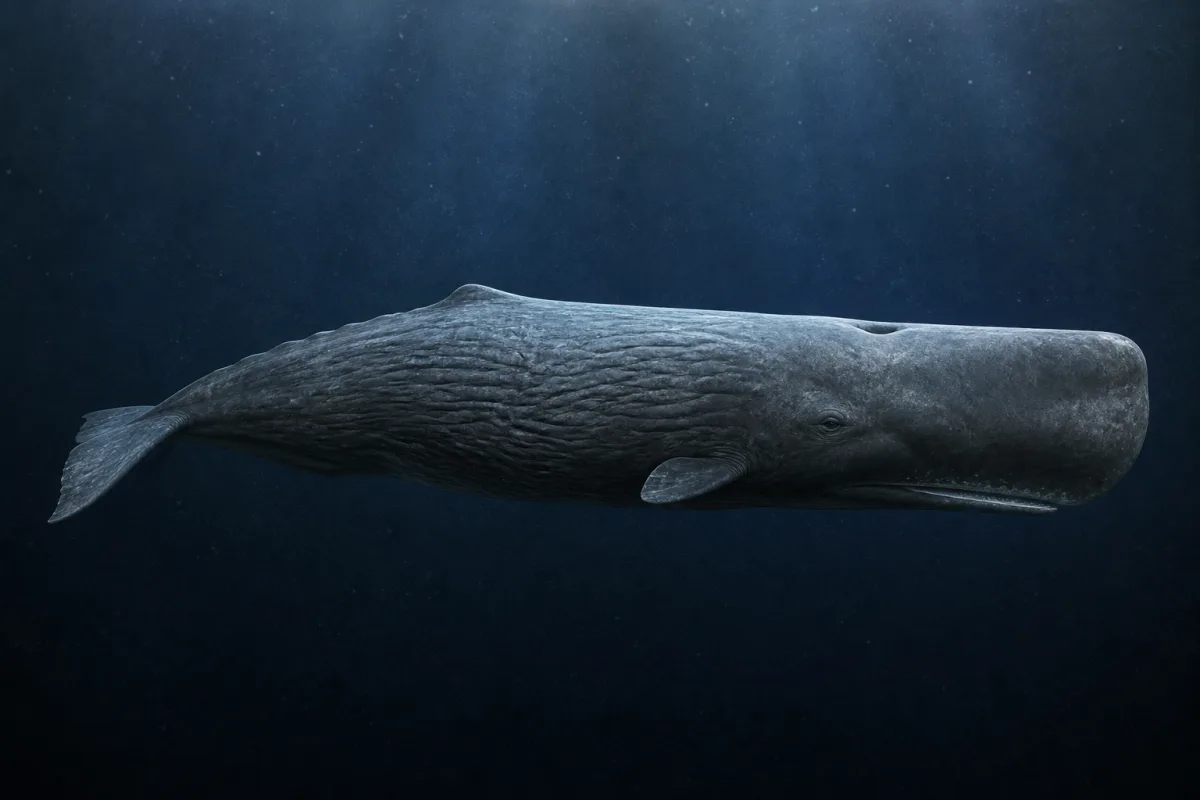
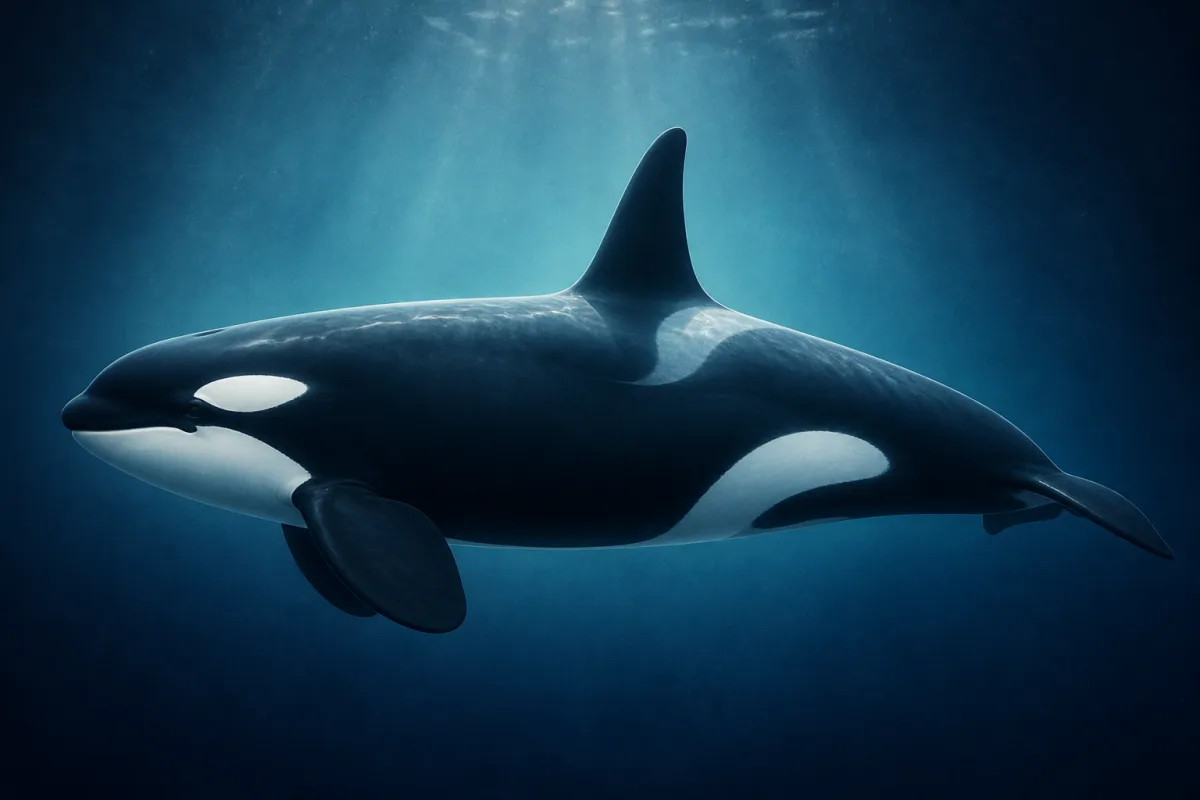
The sperm whale is built around its head. The blunt, boxy forehead accounts for roughly a third of the animal's length and holds the spermaceti organ, a reservoir of waxy oil that shapes and focuses sound. Functional teeth sit only in the narrow lower jaw. The orca, by contrast, has the compact, tapered body of a dolphin, with conical teeth in both jaws and a dorsal fin that can stand 6 feet tall on an adult male. One animal is organized around producing and receiving sound; the other around maneuvering.
Both species show large differences between the sexes, but not to the same degree. Male orcas average about three feet longer than females and carry a far taller fin. In sperm whales the gap is extreme: females mature near 36 feet and around 15 tons, while large males reach roughly 52 feet and can weigh close to three times as much. No other cetacean is so unevenly divided. That difference matters beyond appearance, because male and female sperm whales occupy different parts of the ocean for most of the year.
Orca size also varies by population in a way sperm whale size does not. Some Antarctic orcas that specialize on fish are barely two-thirds the length of large North Pacific males, so a single figure for the species conceals real regional differences. Sperm whales are more uniform in build across their range, and the variation that matters in that species is between the sexes rather than between regions. In both cases a published maximum describes an exceptional individual rather than a typical one.
Where each whale does its hunting
Sperm whales feed in the deep sea, mostly on squid taken between about 1,300 and 4,000 feet. A typical foraging dive lasts around 45 minutes, and well-supported tag records reach roughly 6,500 feet. Most of the animal's day is spent descending and ascending rather than traveling horizontally. Orcas work much shallower water. Most foraging happens in the upper 200 feet, though tagged animals in offshore populations have recorded dives beyond 3,000 feet. The two species can share a stretch of ocean and still rarely occupy the same water.
That difference in depth sets almost everything else. A sperm whale hunts in permanent darkness, so it finds prey with clicks generated in its nose, switching from slow scanning pulses to rapid buzzes in the final seconds before capture. Prey is likely taken by suction rather than by biting, since animals with broken or missing jaws have been found in good condition. Orcas hunt where vision still works and several populations rely on it. Mammal-hunting orcas fall silent while searching, because seals and porpoises can hear the same clicks a fish cannot.
Speed reflects the same split. Orcas have been recorded in brief bursts near 35 miles per hour, useful for closing on prey that can turn and accelerate. Sperm whales sprint at roughly 19 miles per hour at most, and ordinary travel is closer to 3. A squid at 3,000 feet cannot outrun a whale that has already located it in the dark, so the sperm whale spends its energy on breath-holding and sound production rather than on acceleration.
Diet, and how narrow it can be
Sperm whale diet is remarkably consistent worldwide: squid by a wide margin, most of them medium-sized species weighing a few pounds rather than the giants that draw attention, along with deep-water fish such as grenadiers and lanternfish. High-latitude males eat proportionally more fish. Orca diet, by contrast, is a population trait rather than a species trait. Resident orcas of the northeastern Pacific take salmon almost exclusively and show a strong preference for large Chinook, while Bigg's orcas in the same inlets eat seals, sea lions, porpoises and gray whale calves.
Those two forms do not mix or interbreed, and genetic work published in 2024 proposed recognizing them as separate species, a question that is not yet settled. Elsewhere, Norwegian orcas follow herring, New Zealand groups specialize on rays and small sharks, and some Antarctic types concentrate on toothfish. Individuals seldom switch. The result is that a sperm whale anywhere in the world is doing broadly the same job, while two orcas from the same bay may occupy entirely different ecological positions.
Hunting methods follow the same pattern. Orca techniques are learned rather than instinctive and differ sharply by region: intentional stranding on Patagonian beaches to reach young sea lions, wave-washing seals off Antarctic ice floes, herding herring into dense balls and stunning them with tail slaps off northern Norway. Each tradition is confined to the population that developed it and takes years to pass on. Sperm whale foraging shows nothing comparable, because a whale hunting alone in the dark has little to coordinate and little that a companion could demonstrate.
Families built around older females
Both species live in matrilineal societies, and in both the oldest females matter disproportionately. Resident orcas live in matrilines that stay together for life, with sons and daughters remaining alongside their mother. Related matrilines form pods, and pods that share a call repertoire form clans. Female orcas stop reproducing around age 40 but often live for decades afterward, and these post-reproductive animals lead their groups to salmon in years when fish are scarce. Orcas are one of only a handful of mammals known to go through menopause.
Sperm whale society is divided by sex in a way orca society is not. Females and their young live in units of roughly six to twelve that can hold together for decades, while males leave in their teens, drift toward colder and more productive latitudes, and return to the tropics only to breed. Much of an adult male's life is spent alone. Units associate into clans defined by shared patterns of clicks called codas, and clans with different repertoires share the same waters without mixing, an arrangement that parallels orca dialects.
The reason sperm whale units hold together is partly practical. A calf cannot follow its mother to 3,000 feet, so members take turns staying near the surface with the young while others feed at depth. That arrangement also addresses the species' one documented predator: orcas take sperm whale calves and juveniles left near the surface, and groups respond by gathering tightly with the young in the center. Healthy adults are effectively beyond reach because of their size, and direct observations of any of this remain scarce.
Two conservation stories with different causes
Sperm whales carry the clearer history. Commercial whaling removed an estimated three-quarters of a million animals in the twentieth century, with the heaviest losses among large males, and because males are not physically mature until close to 30, the population lost its breeding animals faster than it could replace them. Recovery has been slow and uneven, the global trend is not confidently known, and the species is assessed as Vulnerable. It has been listed as endangered in United States waters since 1970 and sits on CITES Appendix I.
The orca has no meaningful global category at all. It is listed as Data Deficient, not for want of study but because the recognized ecotypes differ in diet, calls, appearance and genetics to a degree that makes a single worldwide assessment close to useless. Populations are therefore evaluated on their own. The Southern Resident group of the northeastern Pacific numbers about 75 animals and is listed as endangered under United States law, and several small, isolated populations elsewhere are considered at high risk.
The pressures differ as well. Sperm whales are killed today mainly by entanglement in fishing gear and collisions with large vessels along shipping lanes that cross deep-water feeding grounds. Orcas face a subtler problem: long life near the top of the food web has left some populations among the most contaminated animals ever measured, with PCB concentrations high enough that modeling predicts suppressed reproduction for decades after the compounds were banned. Industrial noise affects both, since each depends on sound for nearly everything it does.