Overview
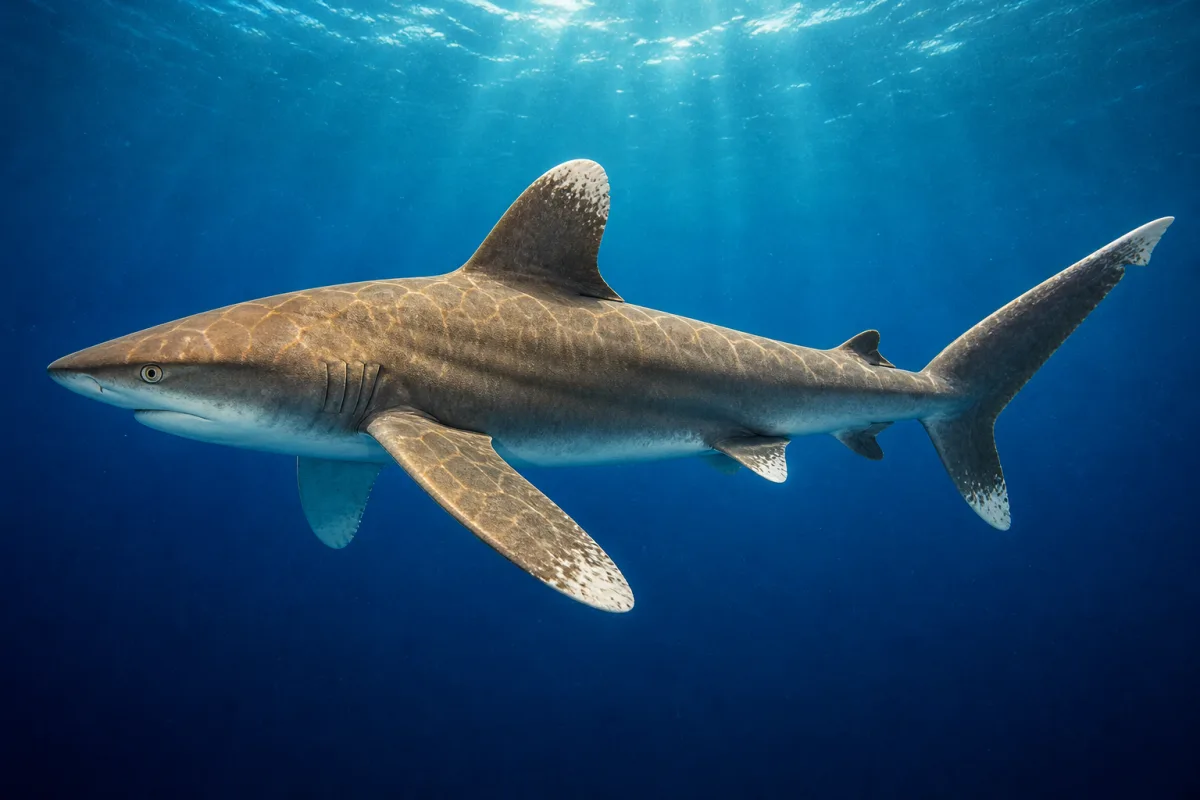
The oceanic whitetip is instantly recognizable. Its first dorsal fin is broad and rounded rather than pointed, its pectoral fins are exceptionally long and paddle-shaped, and the tips of both are mottled white, as though dipped in paint. The body is stocky and bronze to gray above with a pale belly. Adults usually measure 6 to 9 feet, and although records approaching 11 feet exist, they come from older literature and are seldom matched today.
This is a shark of the deep open sea, generally staying beyond the continental shelf in water warmer than about 68 degrees Fahrenheit. It spends most of its time in the sunlit upper layer, patrolling slowly with the long pectorals held out like wings, a posture that costs very little energy. Food is scarce and unpredictable out there, so the species is unhurried, persistent and highly investigative, examining almost anything unfamiliar it encounters.
Its history is the clearest example of how quickly an abundant ocean animal can be reduced. Mid-century accounts described the oceanic whitetip as possibly the most numerous large animal on Earth above 100 pounds. An analysis of Gulf of Mexico longline records found declines on the order of 99 percent between the 1950s and the late 1990s, and comparable losses have been documented in the Pacific. The species is now Critically Endangered.
Where it lives
Tropical and subtropical open ocean worldwide, roughly between 30 degrees north and 35 degrees south, including the Gulf of Mexico, the Caribbean, the Bahamas, the central and western Pacific, the Indian Ocean and the Red Sea. It is generally absent from cool water and from waters over the continental shelf, though it comes close to shore around oceanic islands with steep drop-offs.
Habitat
- Open ocean
- Seamounts & offshore banks
- Deep sea
What it eats
Tuna, mackerel, barracuda, dolphinfish, flying fish and squid make up most of the diet. Sea turtles, seabirds and pelagic crabs appear less often. Carrion matters more here than in coastal systems: floating whale and shark carcasses provide an enormous, risk-free meal in an environment where prey may not appear for days.
- Bony fish
- Squid & octopus
- Sea turtles
- Seabirds
- Carrion & whale falls
How it hunts
In open water there is nowhere to hide and nothing to hide behind, so the oceanic whitetip works on patience and coverage. It cruises slowly for long periods, using the wide pectoral fins as lifting surfaces, and responds strongly to sound, scent and unusual movement from far off. When it finds a concentration of food, such as a school of tuna driving baitfish upward or a carcass at the surface, it commits fully and feeds persistently. Investigative approaches to unfamiliar objects are typical rather than exceptional, and reflect how rarely food is encountered.
Behavior
Social structure: Mostly solitary
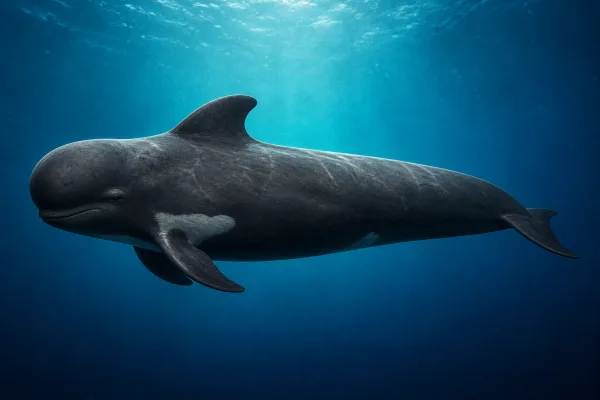
Usually alone across vast stretches of ocean. Numbers gather where food concentrates, and individuals are often accompanied by pilot fish and remoras. Tracking in the Bahamas found whitetips traveling in company with short-finned pilot whales, possibly using the whales' deep foraging to locate squid.
Active period: Day & night
Active day and night near the surface, with a modest daily rhythm in depth; tagged sharks tend to make their deepest dives during daylight hours.
Reproduction
Live birth, placental young.
Embryos are nourished through a yolk-sac placenta after the yolk is used up. Gestation lasts about 10 to 12 months and produces 1 to 15 pups, typically 5 or 6, each around 2 feet long. Females mature at roughly 6 to 7 years and appear to breed every other year, so the species replaces itself slowly for a shark of its size.
Predators and ecological role
Adults have few predators in the open ocean; larger sharks and, rarely, orcas are the only credible ones. Because pups are born at sea rather than in a sheltered nursery, young whitetips are exposed to other pelagic sharks from birth.
The oceanic whitetip is one of the few large predators spread through the vast, food-poor middle of tropical oceans, and it plays a significant part in clearing carcasses there. Its near-disappearance from parts of its range amounts to one of the largest recorded reductions of a marine predator, and the ecological consequences of that loss in open-ocean food webs are still not well measured.
Conservation and threats
Critically Endangered Assessed 2018 · population decreasing
Moved to Critically Endangered in the global shark reassessment published in 2019. Listed on CITES Appendix II in 2013, listed as Threatened under the U.S. Endangered Species Act in 2018, and covered by retention bans in the major tuna fishery management organizations, though compliance and survival after release remain uncertain.
Nearly all the pressure comes from pelagic longline and purse seine fisheries targeting tuna and swordfish, in which the whitetip is caught incidentally and historically retained for its large, valuable fins. Retention bans are now widespread, but many sharks die on the line before the gear is hauled, and post-release survival is not well documented.
Main pressures
- Bycatch in other fisheries
- Fin trade
- Targeted fishing
- Depletion of prey
Notable details
- Mid-twentieth-century researchers described the oceanic whitetip as possibly the most abundant large animal on Earth weighing more than 100 pounds.
- An analysis of United States longline logbooks estimated that the Gulf of Mexico population fell by roughly 99 percent between the 1950s and the late 1990s.
- Satellite tagging off Cat Island in the Bahamas found that individuals disperse thousands of miles across the Atlantic and then return to the same small area each spring.
- Oceanic whitetips have been tracked swimming in company with short-finned pilot whales, a pattern researchers suspect helps the sharks find squid the whales are already locating.
Sources
-
The IUCN Red List of Threatened Species
International Union for Conservation of Nature
Global conservation assessments, population trends and threat classifications for every species profiled here.
-
Species Directory
NOAA Fisheries
Management-grade biology, distribution and stock information for species in United States waters.
-
Florida Program for Shark Research
Florida Museum of Natural History
Shark biology, size records and documented interaction data.
-
FishBase
FishBase Consortium
Compiled length, weight, growth and depth records for fish species, drawn from the primary literature.
-
Convention on International Trade in Endangered Species of Wild Fauna and Flora
CITES Secretariat
Appendix listings governing international trade in the species profiled here.
Figures on this page were last checked against these sources on .