Overview
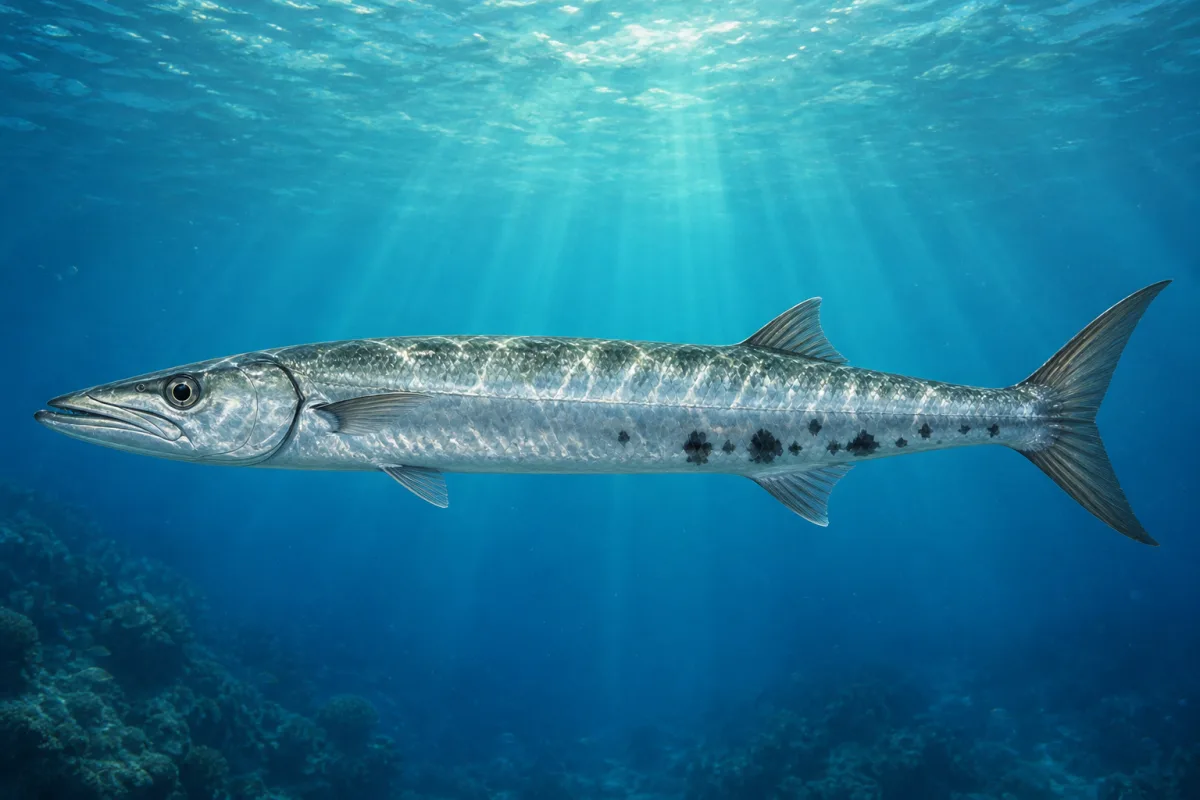
The great barracuda is built as a straight line: a long silver cylinder with a pointed head, a deeply forked tail and two small dorsal fins set far apart. Most fish seen on reefs are under 5 feet, and the published maximum near 6.5 feet rests on a handful of old records. The lower jaw projects slightly beyond the upper, and dark blotches scattered along the lower flanks give individual fish a recognizable pattern that divers use to identify residents of a particular reef.
Barracuda hunt by holding position. A fish will hover in mid-water above a reef edge, fins barely moving, then cover the last few body lengths to its prey in one short acceleration. The teeth are arranged in two functional sets, small outer teeth that grip and long inner canines that fit into sockets in the opposing jaw when the mouth closes, so a large barracuda can hold a struggling fish without needing a second bite. Vision drives the whole sequence.
Juveniles live somewhere quite different from adults. They spend their first months in shallow seagrass beds, mangrove creeks and estuaries, where cover is dense and larger predators are scarce, then move to reefs and offshore structure as they approach a foot in length. Adults are largely resident, using the same ledge, wreck or channel for long periods, which is why the loss of mangrove nursery habitat and the condition of local reefs both influence how many barracuda a coastline supports.
Where it lives
Tropical and subtropical waters worldwide except the eastern Pacific, including the western Atlantic from Massachusetts and Bermuda south through the Gulf of Mexico, the Caribbean and Brazil, the eastern Atlantic off West Africa, and the Indian and western Pacific Oceans from the Red Sea and East Africa to Australia and French Polynesia. The species has also entered the eastern Mediterranean.
Habitat
- Coral reefs
- Mangroves & lagoons
- Sandy flats & seagrass beds
- Coastal waters
What it eats
Barracuda eat fish almost exclusively, favoring silvery schooling species such as jacks, grunts, snappers, mullet, herrings and needlefish, with squid and shrimp taken opportunistically. Prey is usually swallowed whole when small, or cut into pieces by the inner canines when it is too large. Diet broadens with size, and large individuals will take fish more than a third of their own length.
- Bony fish
- Squid & octopus
- Crustaceans
How it hunts
A hunting barracuda relies on stillness and contrast. Its silver flanks make it hard to resolve against open water, and it will drift into position above or behind a school before accelerating in a single burst. Because that burst cannot be sustained, the approach matters more than the chase, and a failed rush is usually abandoned rather than repeated. Barracuda also follow larger animals, including divers, watching for prey flushed out of cover.
Behavior
Social structure: Mostly solitary
Adults are generally solitary and hold to a home range around a specific reef feature. Young and half-grown fish are far more social, forming schools of dozens over seagrass and shallow reef, and adults occasionally gather in loose groups where prey is concentrated.
Active period: Daytime
A daytime hunter dependent on clear water and good light, with activity concentrated in daylight hours and a lull at night, when it typically rests near structure.
Reproduction
Broadcast spawning.
Barracuda spawn in open water away from the reef, releasing eggs and sperm into the current with no parental care. Spawning occurs in spring and summer in higher latitudes and over longer seasons in the tropics, and a large female may release several tens of thousands of eggs in a batch. Larvae drift with currents before settling into shallow seagrass and mangrove nurseries.
Predators and ecological role
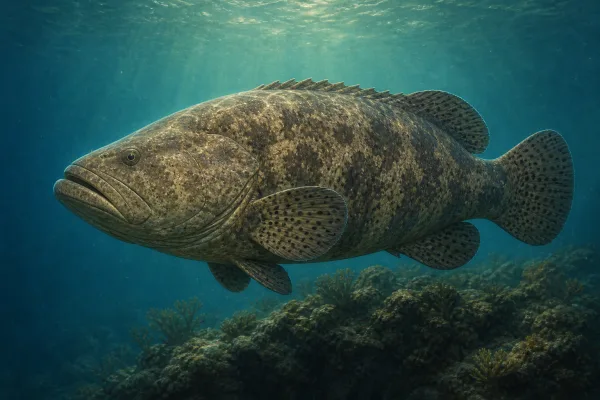
Adult barracuda are taken by sharks, goliath grouper, tuna and dolphins. Juveniles in seagrass and mangrove habitats are eaten by a wide range of predators, including larger barracuda, which makes cover the main reason young fish stay in those nurseries.
As a resident visual predator on mid-sized reef fish, the barracuda influences where schooling species can safely feed and how they use open water above the reef. It is also a route by which toxins move up the food web: ciguatoxin produced by reef microalgae accumulates through the fish it eats and concentrates in the largest, oldest individuals.
Conservation and threats
Least Concern Assessed 2015 · population unknown
The species is assessed as Least Concern because it is widespread, common across most of its range and not the target of large industrial fisheries. Local populations can be reduced by heavy nearshore fishing, and the global trend is not well quantified because catch records rarely separate barracuda from other reef predators.
Barracuda are caught by artisanal, subsistence and recreational fisheries throughout the tropics, though ciguatera concerns limit demand for large fish in some regions. The more serious long-term pressure is the loss of mangrove and seagrass nursery habitat to coastal construction and dredging, since juveniles depend on those shallow systems before they ever reach a reef.
Main pressures
- Targeted fishing
- Habitat loss
- Coastal development
Notable details
- Barracuda carry two functional sets of teeth: small gripping teeth on the outside and long inner canines that slot into sockets in the opposite jaw when the mouth closes.
- Ciguatoxin accumulates as barracuda grow, so the risk of poisoning from eating one rises with the size of the fish rather than with where it was caught.
- The dark blotches on a barracuda's lower flanks form a pattern unique enough that researchers and divers can recognize individual fish over years.
- Young barracuda spend their first months in mangrove creeks and seagrass beds and only move to reefs once they approach a foot in length.
Sources
-
The IUCN Red List of Threatened Species
International Union for Conservation of Nature
Global conservation assessments, population trends and threat classifications for every species profiled here.
-
FishBase
FishBase Consortium
Compiled length, weight, growth and depth records for fish species, drawn from the primary literature.
-
Smithsonian Ocean
Smithsonian National Museum of Natural History
Peer-reviewed public science writing on marine life, ecosystems and ocean change.
-
Animal Diversity Web
University of Michigan Museum of Zoology
Referenced accounts of anatomy, reproduction, behavior and life history.
Figures on this page were last checked against these sources on .