Overview
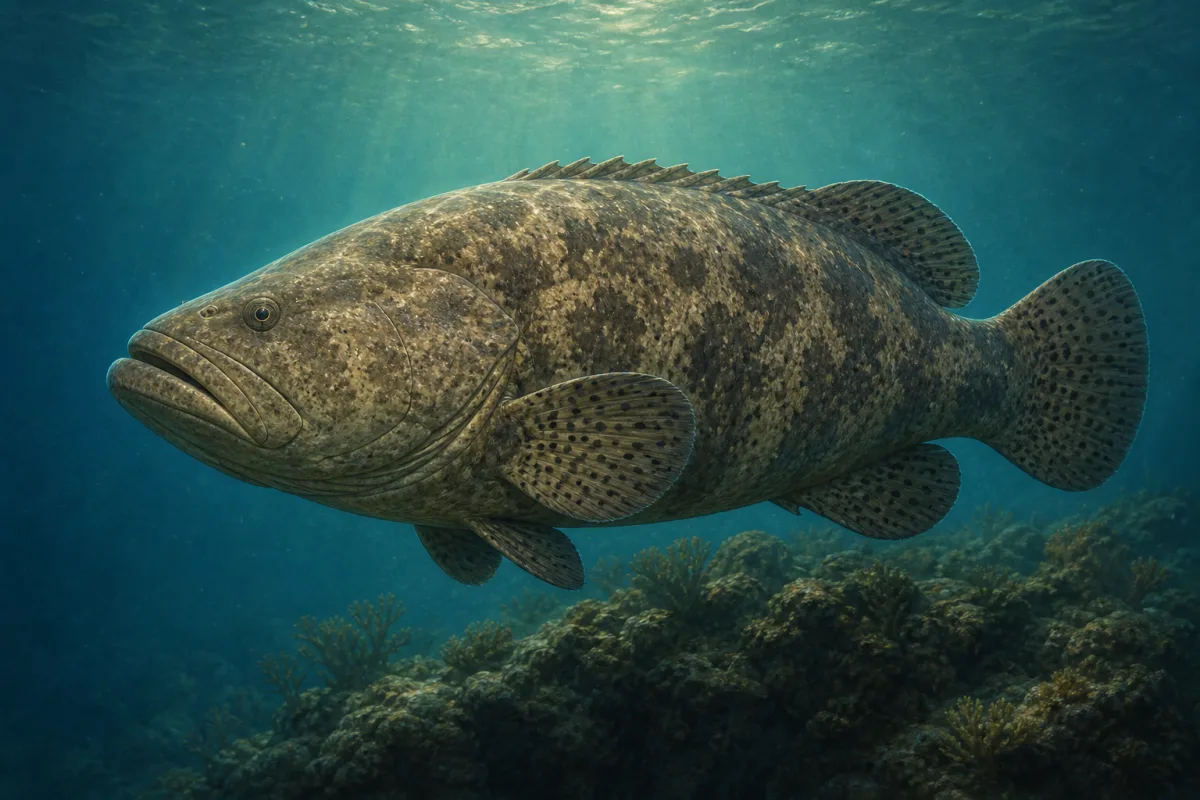
The Atlantic goliath grouper is the largest grouper in the Atlantic, reaching about 8 feet and several hundred pounds. It is broad rather than streamlined, with a huge mouth, small eyes set high on a blunt head, and mottled brown and olive coloring that breaks up its outline against a ledge or a wreck. The species was known as the jewfish until American fisheries bodies adopted the current name in 2001. Growth is slow throughout life, so a very large individual is necessarily an old one.
Goliath grouper feed by suction rather than pursuit. The fish opens its mouth and expands the floor of its throat so quickly that water and prey are drawn in as a single mass, a movement that takes a fraction of a second and requires almost no swimming. Crabs, lobsters and slow-moving fish make up most of the diet. The species also produces a low-frequency boom by contracting muscles against its swim bladder, a sound audible to divers and used to record aggregations with underwater microphones.
Reproduction depends on aggregation. Between roughly August and October, adults gather at specific wrecks, ledges and rock outcrops off Florida and elsewhere in the Caribbean, forming groups of dozens of fish that return to the same sites year after year around the new and full moon. That predictability made them extraordinarily easy to remove: spearfishing at a single known site could take a large share of a local breeding population in a season. Unlike many groupers, evidence that this species changes sex during life remains equivocal.
Where it lives
Western Atlantic from Florida and the northern Gulf of Mexico south through the Bahamas, the Caribbean and the coast of Brazil, with a separate population in the eastern Atlantic from Senegal to the Congo. Florida holds the best-studied population. The similar Pacific goliath grouper of the eastern Pacific is now recognized as a distinct species, so this name applies only to Atlantic fish.
Habitat
- Coral reefs
- Mangroves & lagoons
- Coastal waters
- Estuaries & river mouths
What it eats
Crustaceans dominate the diet, with crabs and spiny lobsters taken more often than anything else, followed by slow or bottom-associated fish such as toadfish, burrfish, catfish and stingrays, plus octopus. Fast open-water fish are a minor component, which fits a predator that feeds by suction from a stationary position rather than by running prey down.
- Crustaceans
- Bony fish
- Squid & octopus
- Seafloor invertebrates
How it hunts
Hunting is a matter of proximity and suction. The grouper rests against structure or moves slowly along the bottom until prey is within about a body length, then expands its mouth cavity to create negative pressure that pulls water and animal inward faster than either can react. Prey is swallowed whole; the teeth grip rather than cut, and crushing plates in the throat handle shells. Juveniles use the same technique on shrimp and small fish in mangrove roots.
Behavior
Social structure: Seasonally social
Adults are solitary for most of the year, holding a home site on a reef, ledge or wreck and defending it against other goliath grouper. In late summer they converge on traditional spawning sites in groups that can exceed 100 fish, then disperse again once spawning ends.
Active period: Day & night
Active by day and night, with feeding activity rising in low light and at night. During spawning aggregations, sound production and courtship peak after dark.
Reproduction
Broadcast spawning.
Spawning takes place in the water column above the aggregation site, with eggs and sperm released into the current and no parental care. Females mature at roughly 6 years and males slightly earlier, which is late for a reef fish and a central reason the species recovers slowly. Larvae drift for a few weeks before settling into mangrove creeks, where juveniles remain for around five or six years before moving offshore.
Predators and ecological role
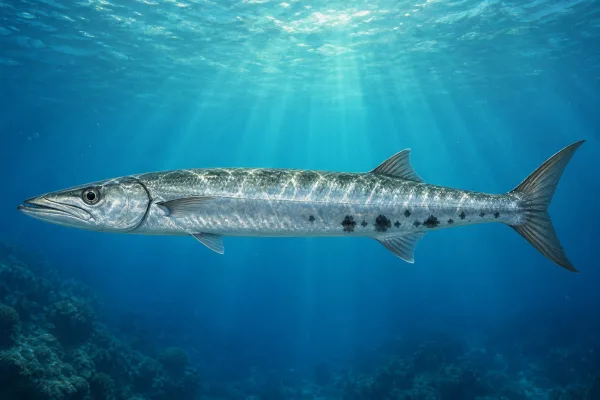
Adults have few predators, though large sharks take them, and predation by great hammerheads at Florida spawning aggregations has been recorded. Juveniles in mangroves are vulnerable to barracuda, larger groupers, sharks and wading birds, and eggs and larvae are consumed by planktonic feeders.
Goliath grouper are among the few remaining large-bodied predators of crabs and lobsters on Atlantic reefs, and their removal of slow bottom fish and invertebrates is a distinct ecological function that faster reef predators do not fill. Their aggregation sites concentrate reproduction and attract other predators, and their booms carry information about occupancy across the reef.
Conservation and threats
Vulnerable Assessed 2018 · population increasing
The species was listed as Critically Endangered in 2011 and reassessed as Vulnerable in 2018 after populations in United States waters began recovering. Harvest has been closed in Florida and federal Atlantic and Gulf waters since 1990. Florida approved a limited, permit-based recreational harvest that opened in 2023, drawing on the recovery while leaving the closure otherwise intact; populations elsewhere in the Caribbean and off Brazil remain poorly monitored.
Predictable spawning aggregations made the species easy to overfish, and illegal take still occurs at known sites. Mangrove clearing for coastal development removes the nursery habitat juveniles depend on for their first several years, a bottleneck that no fishing regulation can offset. Red tide events off southwest Florida have killed large numbers of adults, and hooking mortality from other fisheries adds to losses even where harvest is prohibited.
Main pressures
- Targeted fishing
- Habitat loss
- Coastal development
- Bycatch in other fisheries
Notable details
- Goliath grouper produce a low-frequency boom by vibrating muscles against the swim bladder, and researchers now count aggregations by listening for those sounds with underwater microphones.
- The oldest individual aged from growth bands in its ear stones was 37 years old, and fish that size were largely gone from Florida reefs before aging studies began.
- Juveniles spend roughly their first five or six years in mangrove creeks, sometimes in water shallow enough to expose their backs at low tide.
- Harvest was closed in United States waters in 1990, and the recovery that followed led the global assessment to move the species from Critically Endangered to Vulnerable in 2018.
Sources
-
The IUCN Red List of Threatened Species
International Union for Conservation of Nature
Global conservation assessments, population trends and threat classifications for every species profiled here.
-
Species Directory
NOAA Fisheries
Management-grade biology, distribution and stock information for species in United States waters.
-
FishBase
FishBase Consortium
Compiled length, weight, growth and depth records for fish species, drawn from the primary literature.
-
Smithsonian Ocean
Smithsonian National Museum of Natural History
Peer-reviewed public science writing on marine life, ecosystems and ocean change.
Figures on this page were last checked against these sources on .