Overview
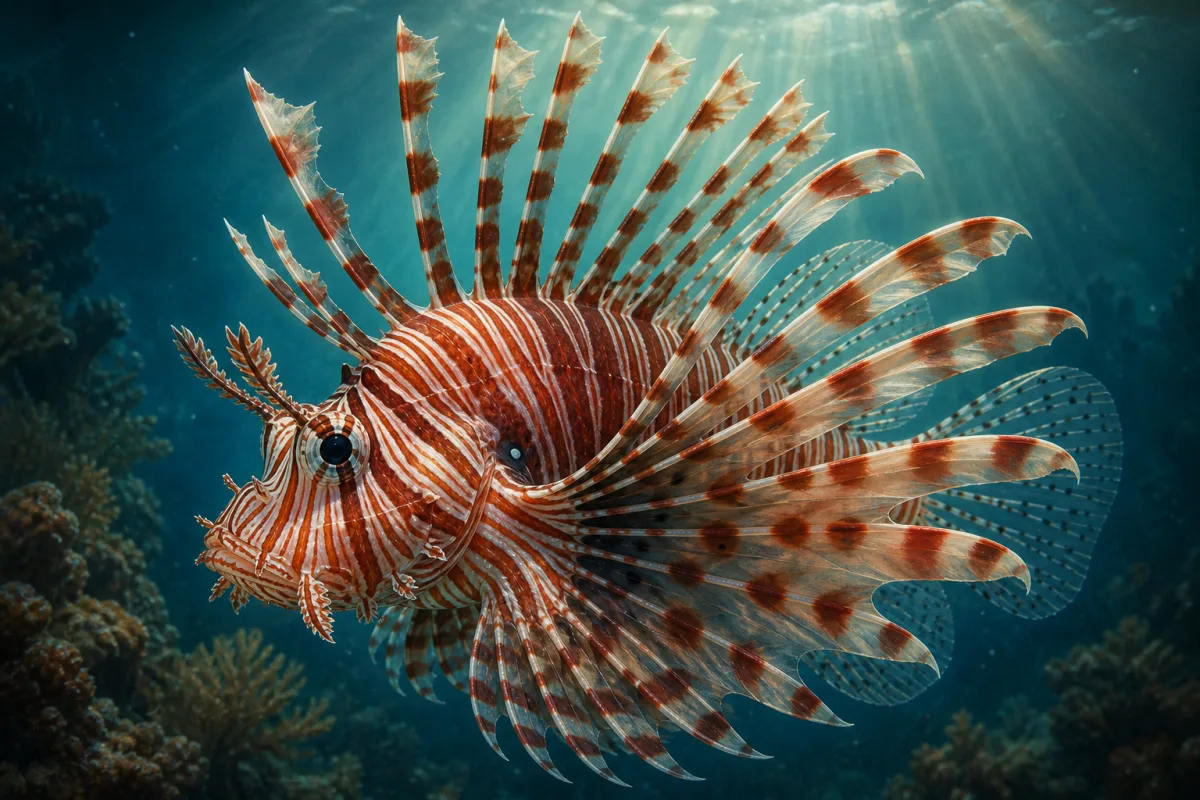
The red lionfish is a small predator with an outsized silhouette. Red-brown and white bands run across the body, and the elongated dorsal, pectoral and anal fin rays spread into a fan that can be twice the width of the fish itself. Most individuals are 10 to 14 inches long. The 18 spines along the back, pelvis and underside are venomous, but that venom is strictly defensive: it is delivered only when a spine punctures something, and plays no part in catching prey.
The species is native to the tropical Indian and western Pacific Oceans, from the Red Sea and East Africa to Japan, Australia and the central Pacific. It is also now established across the western Atlantic. The first records came from southeastern Florida in the mid-1980s, almost certainly from aquarium releases; populations expanded along the southeastern United States through the 1990s, reached Bermuda and the Bahamas, spread through the Caribbean and into the Gulf of Mexico by 2010, and have since been reported off Brazil and in the Mediterranean.
Several traits explain that success. Females release buoyant egg masses every few days year-round in warm water, so a single fish contributes enormous numbers of larvae to the currents. Lionfish tolerate a wide range of depths, salinities and habitats, from mangrove creeks to reefs more than 600 feet down. Atlantic prey species do not recognize them as a threat and do not flee, and predators large enough to eat them rarely do. Introduced lionfish also grow larger and reach higher densities than fish in their native range.
Where it lives
Native to the tropical Indian and western Pacific Oceans, from the Red Sea and East Africa east to Japan, Indonesia, Australia and Micronesia. Introduced and now established in the western Atlantic from Rhode Island south through the Carolinas, Bermuda, the Bahamas, the Gulf of Mexico and the entire Caribbean, with records extending to Brazil. Only fish in the northern part of the Atlantic range survive winter; the rest of the seasonal spread dies back each year.
Habitat
- Coral reefs
- Coastal waters
- Mangroves & lagoons
- Continental shelf
What it eats
Lionfish eat small fish and crustaceans, and the list of recorded prey in the Atlantic runs past 100 species, including juvenile grunts, wrasses, damselfish, parrotfish, gobies and cardinalfish along with shrimp and small crabs. The mouth is large relative to the body, so prey up to about half the lionfish's own length can be swallowed whole. Stomachs from the invaded range often hold multiple fish at once.
- Bony fish
- Crustaceans
How it hunts
A hunting lionfish drifts toward its target slowly, using the spread pectoral fins to corner prey against coral or a wall rather than to chase it. It also directs a jet of water at small fish, which tends to turn them head-on toward the lionfish and improves the odds of a successful strike. The strike itself is a suction event lasting a few hundredths of a second. Venomous spines defend the fish while it hunts in the open but are never used to subdue prey.
Behavior
Social structure: Mostly solitary
Mostly solitary, sheltering alone in crevices, under ledges or among structure during the middle of the day. Small groups form where prey and shelter are abundant, and there are documented cases of two or more fish herding prey at the same time.
Active period: Dawn & dusk
Feeding peaks at dawn and dusk, when small reef fish are moving between shelter and open water. Lionfish typically hold still in shade through the brightest hours.
Reproduction
Broadcast spawning.
A courting pair rises off the bottom and the female releases two buoyant, mucus-bound egg masses that are fertilized in open water and then drift with the currents. In warm water a female can spawn every few days throughout the year, releasing on the order of 20,000 to 30,000 eggs at a time and well over a million in a year. Larvae spend about a month in the plankton, which explains how quickly the species colonized the Caribbean.
Predators and ecological role
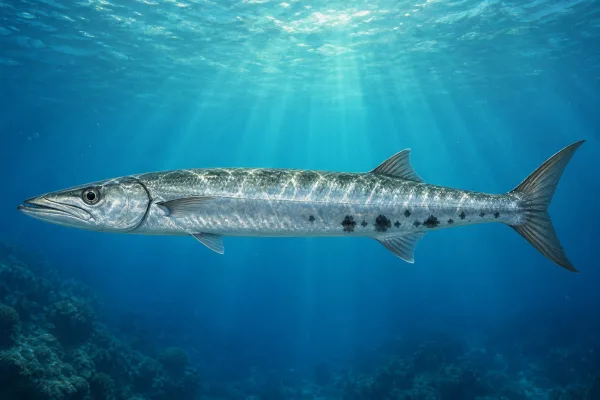
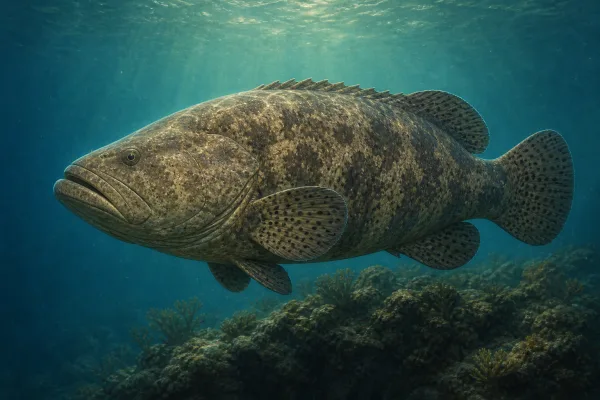
In the native range, groupers, moray eels, sharks, cornetfish and frogfish take lionfish. In the western Atlantic, documented predation is rare: a handful of records exist from Nassau grouper, tiger grouper and sharks, and there is no evidence that native predators control lionfish numbers. Venomous spines make the species costly to attack for animals that have not learned to handle it.
In its native range the red lionfish is one ambush predator among many, held in check by predators, competitors and parasites. In the western Atlantic it functions as an added predator that reef communities have no history with. A controlled experiment on Bahamian patch reefs found that a single lionfish reduced recruitment of small native fish by roughly three-quarters in five weeks, and regional surveys link high lionfish density to declines in small reef fish, including juveniles of species that graze algae or support fisheries. Organized removals reduce numbers locally but cannot reach deep reef populations, so the introduction is now treated as permanent and managed rather than reversible.
Conservation and threats
Least Concern Assessed 2022 · population unknown
Assessed as Least Concern: the native Indo-Pacific range is vast, and there is no evidence of decline there. The global trend is not well quantified, and the assessment concerns the species in its natural range rather than the introduced Atlantic population, which has expanded rapidly since the 1980s and is managed as an invasive species.
The species faces little conservation risk. Collection for the aquarium trade and food fisheries takes lionfish in parts of the native range, and coral reef degradation reduces the shelter it depends on there. In the invaded Atlantic the pressures run the other way: culling programs, spearfishing tournaments and a developing commercial fishery remove large numbers deliberately, though removal is only effective on reefs shallow enough for divers to work.
Main pressures
- Targeted fishing
- Habitat loss
- Ocean warming
Notable details
- The 18 venomous spines deliver a protein-based venom through grooved glandular tissue rather than a hollow needle, and because that venom breaks down with heat, hot-water immersion is the standard first aid for a sting.
- A female lionfish in warm water can release egg masses every few days year-round, amounting to more than a million eggs a year.
- Lionfish blow directed jets of water at small fish, which turns the prey to face them and raises the chance of a successful strike.
- On experimental patch reefs in the Bahamas, one lionfish cut the number of young native fish settling on a reef by about three-quarters over five weeks.
Sources
-
The IUCN Red List of Threatened Species
International Union for Conservation of Nature
Global conservation assessments, population trends and threat classifications for every species profiled here.
-
Species Directory
NOAA Fisheries
Management-grade biology, distribution and stock information for species in United States waters.
-
U.S. Geological Survey
USGS
Long-term research programs, including polar bear population and sea ice studies.
-
FishBase
FishBase Consortium
Compiled length, weight, growth and depth records for fish species, drawn from the primary literature.
-
Smithsonian Ocean
Smithsonian National Museum of Natural History
Peer-reviewed public science writing on marine life, ecosystems and ocean change.
Figures on this page were last checked against these sources on .