Overview
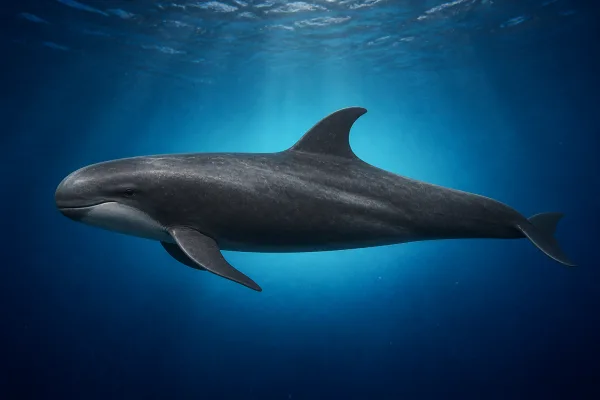
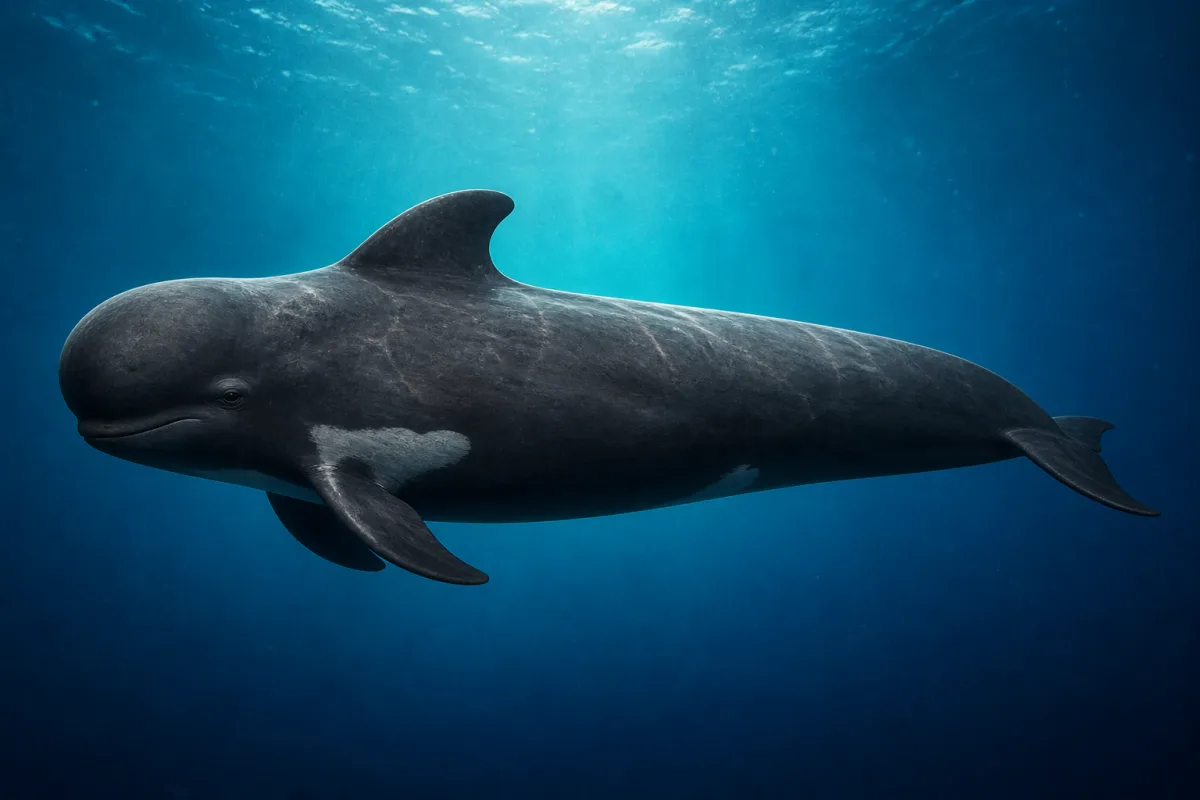
Short-finned pilot whales are stocky, charcoal-colored dolphins with a bulbous forehead that grows more pronounced with age, particularly in males. Large males reach about 24 feet and can weigh close to four tons; females rarely exceed 18 feet. The species occupies warm and tropical waters worldwide and overlaps narrowly with the long-finned pilot whale in a band of the North Atlantic. The two are nearly identical at sea and are usually separated only by flipper length and tooth count.
Foraging happens in the deep scattering layer, the dense band of squid and small fish that rises toward the surface each night. Tagged whales off the Canary Islands descend past 1,500 feet on dives of 15 to 20 minutes, producing regular clicks on the way down and rapid buzzes as they close on individual prey. The strategy is unusual among deep divers, most of which conserve energy at depth. Pilot whales instead spend it, which is why researchers describe their foraging as high cost and high reward.
Groups are built around females and are remarkably durable. Both sons and daughters typically remain with their mother's group for life, an arrangement shared with resident orcas and almost no other mammals; mating takes place when separate groups meet temporarily. Females stop reproducing in their late thirties or forties yet can live another twenty years, making this one of the clearest examples of menopause outside humans. Older females appear to carry knowledge of where and when food can be found.
Where it lives
Tropical, subtropical and warm temperate waters worldwide, generally where surface temperatures stay above about 20 degrees Celsius. Well studied around Hawaii, the Canary Islands, southern California, Japan and the Gulf of Mexico. The northern edge of the range shifts with warm currents, and in the western North Atlantic it meets the long-finned pilot whale near the latitude of New Jersey.
Habitat
- Open ocean
- Deep sea
- Continental shelf
- Seamounts & offshore banks
What it eats
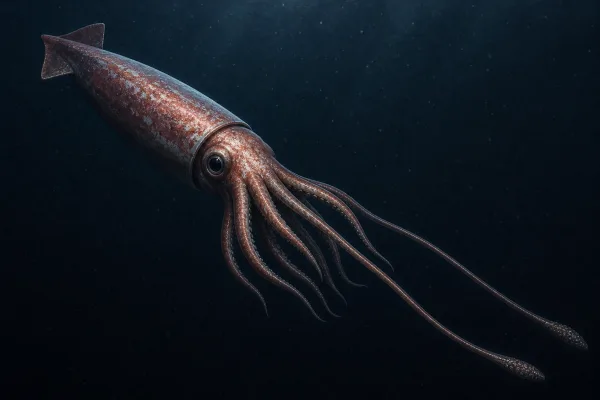
Squid dominate the diet in nearly every region studied, with several species taken in quantity and a preference for animals large enough to justify the cost of a deep dive. Fish, including mackerel, herring and small tuna, make up a smaller share and become more important in some coastal populations. Octopus appears occasionally. Feeding is concentrated where steep bathymetry brings deep water close to land.
- Squid & octopus
- Bony fish
How it hunts
Whales dive in loose formation, then separate to hunt individually in darkness. Echolocation clicks scan ahead during descent and shift to a rapid buzz in the final approach, at which point the whale accelerates hard rather than gliding. A single dive may include one or two of these sprints. Because the effort is anaerobic and the animal must return to the surface to recover, the technique only pays if the target is large, which shapes what the species will chase.
Behavior
Social structure: Stable pods
Groups typically number 15 to 40 animals and can be traced through generations of the same maternal line. Members rest, travel and often surface in synchrony, and calves are attended by females other than their mother. This cohesion is the leading explanation for the species' frequent mass strandings, in which healthy animals follow group members into shallow water.
Active period: Day & night
Deep foraging is concentrated after dark, when the squid layer rises within easier reach, while daylight hours are given over to resting and socializing at the surface in tight, slow-moving groups.
Reproduction
Live birth, milk-fed young.
Gestation lasts about 15 months and produces a single calf roughly 4.5 feet long. Nursing continues for at least two years and often much longer. Females calve every five to eight years, an interval that lengthens with age until reproduction ceases entirely around 40. Males mature later, near 15 years, and do not stay with the females they breed with.
Predators and ecological role
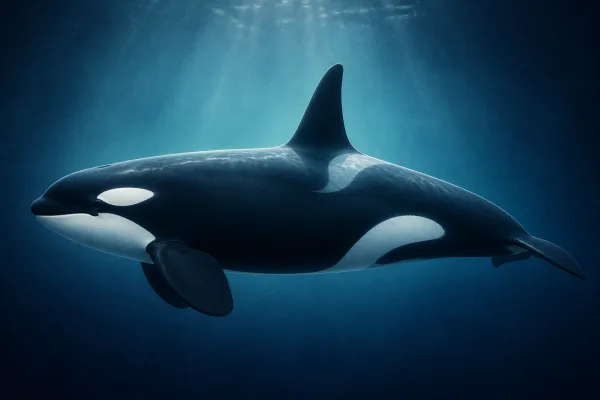
Predation on healthy adults is rarely recorded. Orcas and large sharks are the only realistic candidates, and calves are the most likely targets. Human activity and disease account for far more known deaths than any predator.
Pilot whales are among the principal consumers of mid-water squid in warm oceans, cropping a resource that is otherwise difficult for surface predators to reach. In moving between the deep scattering layer and the surface many times a day they transfer energy and nutrients upward, linking the twilight zone to the sunlit water above it.
Conservation and threats
Least Concern Assessed 2018 · population unknown
The species is widespread and reasonably abundant, so the global category is Least Concern, but regional pressures are uneven and the worldwide trend is not known. Drive hunts in Japan continue to remove animals each year, and the species is taken in small numbers in parts of the Caribbean. All pilot whales are protected in United States waters under the Marine Mammal Protection Act.
Incidental capture in longline and gillnet fisheries is the broadest pressure, and directed hunts persist in a few regions. Because the species depends entirely on sound to locate prey in darkness, intense underwater noise is a particular concern; pilot whales have been present in several mass stranding events associated with naval sonar exercises. Contaminants accumulate readily in a long-lived, squid-eating predator.
Main pressures
- Bycatch in other fisheries
- Hunting & persecution
- Underwater noise
- Chemical pollution
- Entanglement in gear
Notable details
- Females stop reproducing around age 40 but may live into their sixties, making pilot whales one of only a handful of mammals known to experience menopause.
- Tagged pilot whales sprint at roughly 20 miles per hour near the bottom of dives more than 1,500 feet deep, which earned them the nickname cheetahs of the deep sea.
- Both males and females remain in their mother's group for life, so a stranded group is often a single extended family.
- Short-finned and long-finned pilot whales are so similar in appearance that they are reliably told apart only by flipper length and the number of teeth.
Sources
-
The IUCN Red List of Threatened Species
International Union for Conservation of Nature
Global conservation assessments, population trends and threat classifications for every species profiled here.
-
Species Directory
NOAA Fisheries
Management-grade biology, distribution and stock information for species in United States waters.
-
International Whaling Commission
IWC
Cetacean population status, ship-strike and entanglement reporting.
-
Smithsonian Ocean
Smithsonian National Museum of Natural History
Peer-reviewed public science writing on marine life, ecosystems and ocean change.
Figures on this page were last checked against these sources on .