Overview
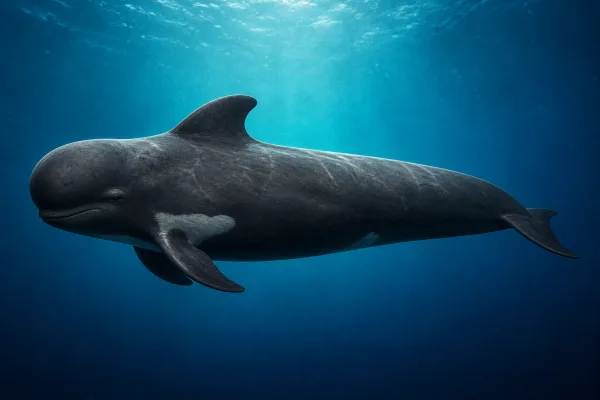
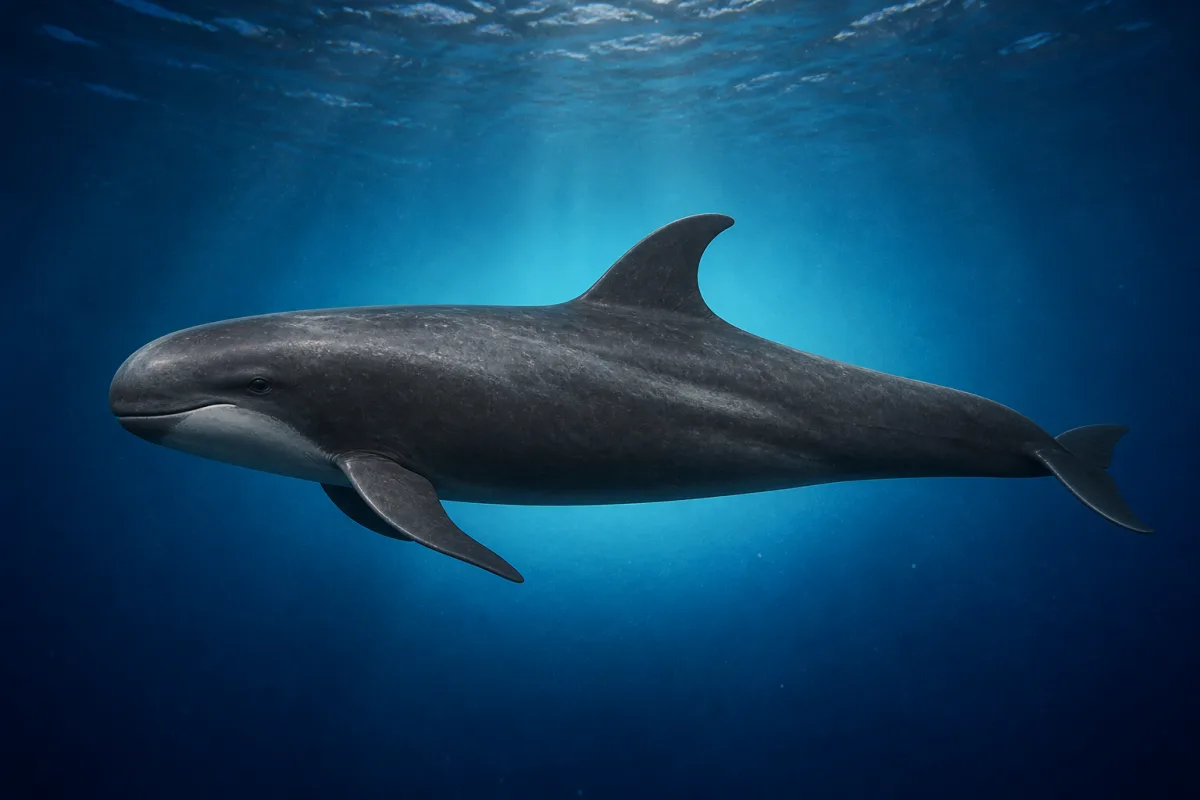
The false killer whale is a large, slender member of the dolphin family found in warm waters worldwide. It is uniformly dark gray to nearly black, with a tapered head that lacks any real beak and long, narrow flippers bent sharply near the midpoint. Males reach about 20 feet, females somewhat less. The species was described in 1846 from a subfossil skull unearthed in an English fen and was assumed to be extinct until a mass stranding in the Baltic fifteen years later produced living animals.
Group life is unusually loose in space but tight in structure. Animals travel in subgroups of a few individuals spread across 10 or more miles of open water, staying in acoustic contact and converging when one of them finds prey. They pursue large fish near the surface, including mahi-mahi, tuna and billfish, and are fast and persistent enough to catch prey that most dolphins cannot. Photo identification off Hawaii has followed the same individuals in the same associations for more than two decades.
Most false killer whales live far from land, but a small resident population stays close to the main Hawaiian Islands. That group numbers fewer than 200 animals, does not interbreed with the offshore form, and was listed as endangered under United States law in 2012. Its difficulties are the familiar ones for a long-lived predator in a heavily used ocean: competition with fisheries for large fish, injuries from hooks and lines, and contaminants that accumulate across a long life.
Where it lives
Tropical and warm temperate waters worldwide, generally in deep water beyond the continental shelf. Regularly recorded around Hawaii, the eastern tropical Pacific, the Gulf of Mexico, the Caribbean, northern Australia, Japan and the Indian Ocean. Occasional sightings reach cool temperate coasts, including the British Isles and the northeastern United States, but these are far outside the core range.
Habitat
- Open ocean
- Continental shelf
- Coastal waters
- Seamounts & offshore banks
What it eats
The diet is dominated by large open-ocean fish, notably mahi-mahi, yellowfin and skipjack tuna, wahoo, and juvenile billfish, supplemented with squid. Prey size is unusual for a dolphin: individual fish weighing 20 pounds or more are routinely taken and then broken apart or shared. Rare records exist of false killer whales taking small dolphins, but marine mammals are not a meaningful part of the diet.
- Bony fish
- Squid & octopus
How it hunts
Subgroups fan out across a wide front and search independently, closing on one another when prey is located. Fish are usually chased down in the upper water column rather than ambushed, and a captured fish is often carried to the surface and passed between animals. Food sharing is frequent and is not limited to relatives, which is rare among wild mammals. In several regions the whales have learned to take fish from longlines, a habit that brings them into repeated contact with fishing gear.
Behavior
Social structure: Stable pods
Individuals form long-term associations that persist for decades within a fluid, widely dispersed structure. The Hawaiian insular population is organized into distinct social clusters whose members mix readily within a cluster and rarely between them. Mass strandings of dozens of animals suggest that group cohesion overrides individual self-preservation in a crisis.
Active period: Day & night
Foraging occurs by day and night, though surface-active feeding is observed most often in daylight, when the whales pursue fast fish near the top of the water column.
Reproduction
Live birth, milk-fed young.
Gestation lasts roughly 15 to 16 months and produces a single calf about 6 feet long. Calving intervals are long, on the order of six or seven years, and females reach maturity between eight and eleven years. Reproductive output is low enough that a population of a few hundred animals can take generations to recover from even modest additional mortality.
Predators and ecological role
Adults have few natural predators. Large sharks and orcas are the only animals capable of taking one, and documented cases are rare enough that predation is not considered a significant source of mortality.
As one of the few predators of large, fast open-ocean fish, false killer whales occupy the same trophic level as the tunas and billfish they hunt, and they compete directly with commercial fisheries for the same stocks. Their scarcity across a vast range means they exert less influence on prey populations than their size suggests.
Conservation and threats
Near Threatened Assessed 2018 · population decreasing
The global assessment reflects a wide but thinly occupied range and evidence of decline in several regions. The main Hawaiian Islands insular population, numbering fewer than 200 animals, is separately listed as endangered under the United States Endangered Species Act. Drive fisheries in Japan and elsewhere have removed substantial numbers historically.
Interaction with longline fisheries is the most serious pressure. Whales that take hooked fish are frequently hooked or entangled themselves, and dorsal fin injuries are common in the Hawaiian population. Depletion of the large fish they depend on adds a second, slower pressure. Contaminant loads measured in Hawaiian animals are among the highest reported for any tropical dolphin.
Main pressures
- Bycatch in other fisheries
- Depletion of prey
- Chemical pollution
- Hunting & persecution
- Underwater noise
Notable details
- The species was named in 1846 from a fossil skull found in an English fen and was thought to be extinct until living animals stranded in the Baltic in 1861.
- False killer whales routinely hand captured fish to other members of the group, including adults they are not related to, a behavior documented in few wild mammals.
- The resident population around the main Hawaiian Islands numbers fewer than 200 animals and was declared endangered in 2012.
- A false killer whale and a bottlenose dolphin produced a hybrid calf at a Hawaii marine park in 1985, and that hybrid later bore calves of her own.
Sources
-
The IUCN Red List of Threatened Species
International Union for Conservation of Nature
Global conservation assessments, population trends and threat classifications for every species profiled here.
-
Species Directory
NOAA Fisheries
Management-grade biology, distribution and stock information for species in United States waters.
-
International Whaling Commission
IWC
Cetacean population status, ship-strike and entanglement reporting.
-
Smithsonian Ocean
Smithsonian National Museum of Natural History
Peer-reviewed public science writing on marine life, ecosystems and ocean change.
Figures on this page were last checked against these sources on .