Overview
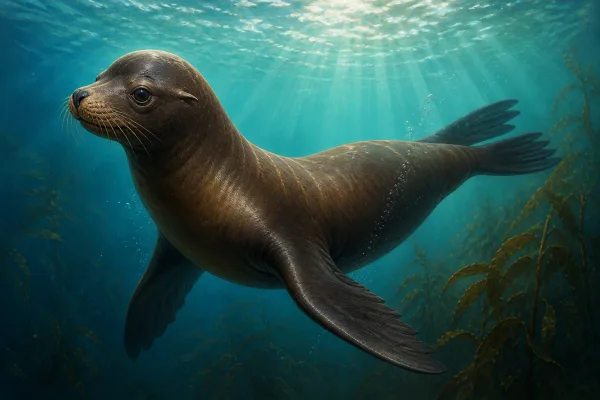
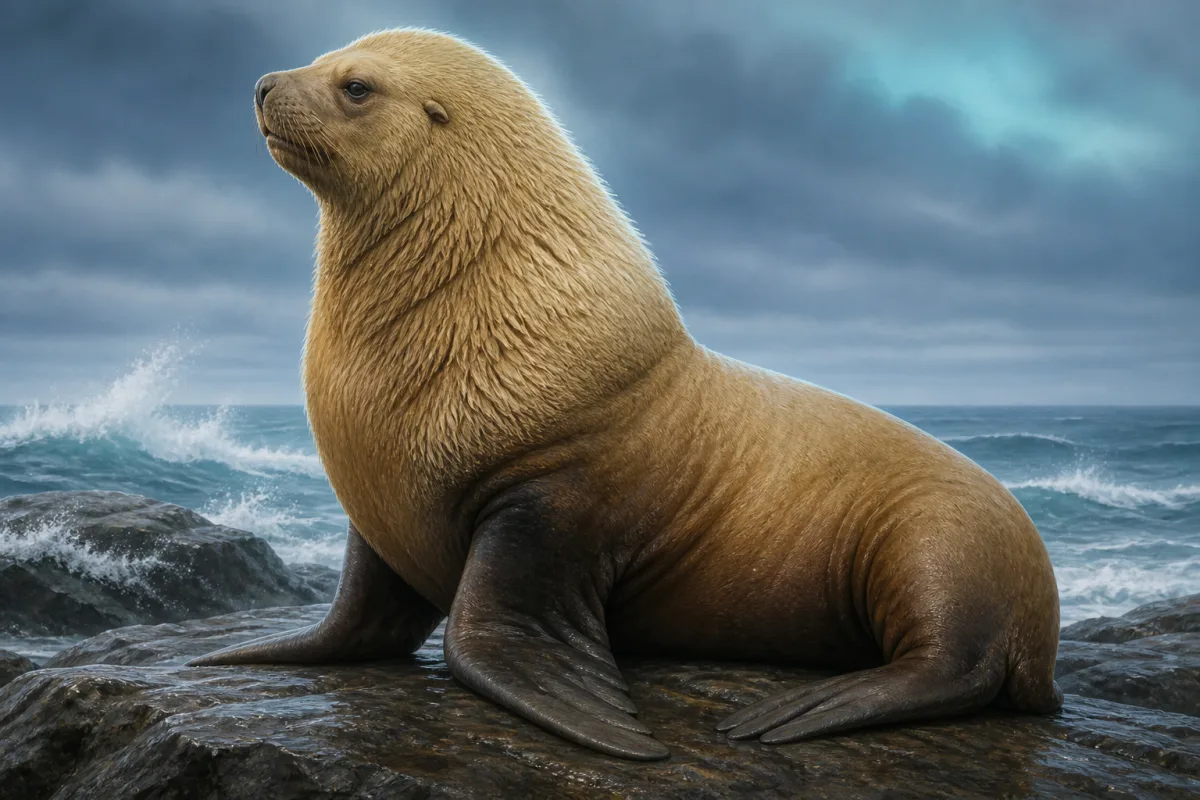
The Steller sea lion is the largest eared seal, and a breeding bull is a genuinely massive animal: about 10 feet long, commonly 1,000 to 2,200 pounds, with a thick neck carrying the coarse mane of longer guard hairs that gives the species its scientific name. Females are far smaller, around 8 feet and 500 to 800 pounds, and lack the mane. Both sexes are a pale tawny brown that looks almost blond when dry and much darker wet, which distinguishes them at a distance from the smaller, near-black California sea lions that share parts of the coast.
The two species are easy to tell apart by sound as well as size. A California sea lion barks, in the rapid honking that carries across a marina; a Steller sea lion produces a low, guttural roar with no bark in it at all. Steller sea lions also keep to more exposed ground, hauling out on rocky offshore islands, reefs and wave-washed ledges rather than on docks and jetties, and they are markedly less tolerant of people nearby.
The species is best known for a decline that remains one of the more contested questions in North Pacific marine science. Between the late 1970s and the early 2000s the population west of Cape Suckling in Alaska fell by roughly eighty percent, in places by more than ninety, and it has recovered only patchily since. The eastern population over the same period grew steadily enough to be removed from the United States endangered species list in 2013. Two stocks of one species, sharing a coastline, moved in opposite directions.
Where it lives
The rim of the North Pacific, from northern Japan and the Kuril Islands through the Sea of Okhotsk and the Russian Far East, across the Aleutian chain and the Bering Sea, and south along the coast of Alaska, British Columbia, Washington and Oregon to the Channel Islands of California. Breeding rookeries are concentrated in the Aleutians and the Gulf of Alaska. Management divides the animals at Cape Suckling in Alaska into a western and an eastern stock, a boundary supported by genetic differences and by the fact that the two have followed opposite trajectories.
Habitat
- Coastal waters
- Continental shelf
- Kelp forests & rocky reefs
- Open ocean
What it eats
Predominantly fish and squid, with the mix varying strongly by region and season. Walleye pollock, Atka mackerel, Pacific herring, capelin, sand lance, salmon, rockfish, cod, halibut and octopus all feature, and in the Aleutians pollock and Atka mackerel dominate. Unusually for a sea lion, individuals occasionally take northern fur seal pups, harbor seal pups and seabirds, though these are a minor part of the diet overall.
- Bony fish
- Squid & octopus
- Marine mammals
- Seabirds
How it hunts
A pursuit hunter that works alone or in loose groups, taking prey in dives that are usually short and shallow relative to what the animal is capable of. Foraging concentrates over the continental shelf, along shelf breaks and around passes between islands where tidal currents concentrate fish. Large eyes adapted to dim water and stiff vibrissae that detect movement close to the body do most of the sensory work. Animals will also take fish from nets and from around processing plants and hatcheries, and they exploit river mouths during salmon runs, which has periodically brought them into conflict with fisheries in the Columbia River system.
Behavior
Social structure: Breeding colonies
Breeding is colonial and polygynous, though less extreme than in the elephant seals. Bulls arrive at rookeries in May, hold territories that include both beach and adjacent water for one to two months while fasting, and defend them by roaring, posturing and occasional serious fighting. Females move freely and are not herded. Outside the breeding season animals gather at haulouts in mixed groups, and the species is gregarious rather than territorial once the rookeries break up.
Active period: Day & night
Foraging trips occur at any hour, with a modest nocturnal bias in some regions because several prey species rise in the water column after dark. Winter trips are longer and deeper than summer ones, and lactating females alternate short trips at sea with periods ashore nursing.
Reproduction
Live birth, milk-fed young.
A single pup weighing about 40 to 50 pounds is born on the rookery between mid-May and mid-July, and the mother mates again roughly two weeks later. The fertilized egg then pauses for around three months before implanting, so total gestation runs close to eleven and a half months. Pups nurse for at least a year and sometimes into a third, an unusually long dependence among sea lions, and females occasionally nurse a yearling and a newborn at the same time. Females first breed at four to six years.
Predators and ecological role
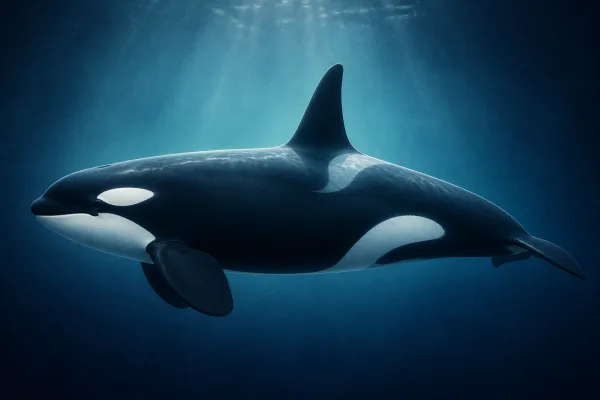
Mammal-hunting orcas are the principal predator, and Pacific sleeper sharks and white sharks take some animals. Pups and juveniles are the most vulnerable. The degree to which orca predation drove the western Alaskan decline is one of the central disputes about this species, since the same predator population also had access to the eastern stock, which grew.
As the largest otariid and a major consumer of groundfish and forage fish across the North Pacific shelf, the species is a significant link between mid-water fish populations and the top of the food web. Its own body condition, pup production and survival are used as indicators of the state of forage fish stocks in the Bering Sea and Gulf of Alaska. Because the western decline coincided with a broad reorganization of the North Pacific ecosystem that also affected fur seals, sea otters and seabirds, the species has become a reference case for how ocean regime shifts propagate upward.
Conservation and threats
Near Threatened Assessed 2015 · population increasing
Globally Near Threatened, reflecting a total population of roughly 160,000 animals that is now increasing overall after the twentieth-century collapse. The global figure conceals a sharp split. The western stock, west of Cape Suckling in Alaska, fell by around eighty percent between the late 1970s and the early 2000s and remains listed as endangered under the United States Endangered Species Act, with recovery uneven and the western Aleutians still declining. The eastern stock recovered sufficiently to be delisted in 2013. The cause of the western decline is still argued over: nutritional stress from a shift in the composition of available prey, orca predation, and competition with fisheries have all been proposed, and the evidence does not clearly settle among them.
Competition with commercial groundfish fisheries for pollock, Atka mackerel and cod is the pressure most often implicated in the western decline, and fishery closures around rookeries in the Aleutians were imposed on that basis. Entanglement in net fragments and packing bands causes slow deaths, and animals are killed incidentally in trawl and gillnet gear. Shooting was legal in parts of the range into the 1970s and still occurs illegally; a regulated subsistence harvest by Alaska Native communities continues. Changes in the distribution of forage fish under warming, disturbance at rookeries, and oil spill risk along tanker routes add further pressure.
Main pressures
- Depletion of prey
- Bycatch in other fisheries
- Entanglement in gear
- Climate change
- Human disturbance
- Hunting & persecution
Notable details
- It is the largest of all sea lions and, among pinnipeds, is exceeded in size only by the elephant seals and the walrus.
- Steller sea lions roar rather than bark, which separates them by ear from the smaller California sea lions that share the coast from British Columbia southward.
- Pups may nurse for a year or more, and a female is occasionally seen feeding a newborn and a yearling at the same time.
- The species is named for Georg Wilhelm Steller, the naturalist on Vitus Bering's 1741 expedition, who described it along with several other North Pacific animals including the sea cow that was hunted to extinction within thirty years.
Sources
-
The IUCN Red List of Threatened Species
International Union for Conservation of Nature
Global conservation assessments, population trends and threat classifications for every species profiled here.
-
Species Directory
NOAA Fisheries
Management-grade biology, distribution and stock information for species in United States waters.
-
Smithsonian Ocean
Smithsonian National Museum of Natural History
Peer-reviewed public science writing on marine life, ecosystems and ocean change.
-
Animal Diversity Web
University of Michigan Museum of Zoology
Referenced accounts of anatomy, reproduction, behavior and life history.
-
U.S. Fish & Wildlife Service
USFWS
Listing decisions and recovery planning for protected marine and coastal species.
Figures on this page were last checked against these sources on .