Overview
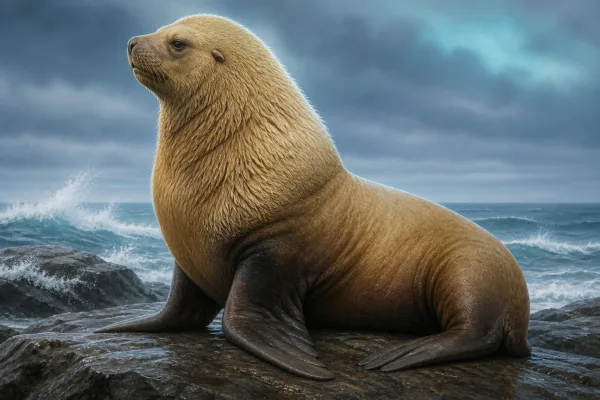
The California sea lion is an eared seal, or otariid, and the animal most people picture when they hear the word sea lion. Adult males reach about 8 feet and 600 to 900 pounds, roughly three times the mass of adult females, and develop a raised bony crest along the top of the skull that gives the forehead its domed profile. Males are dark brown and look almost black when wet; females and juveniles are lighter and tawnier. Both sexes are noisy, and the incessant honking bark of a rookery carries a long way over water.
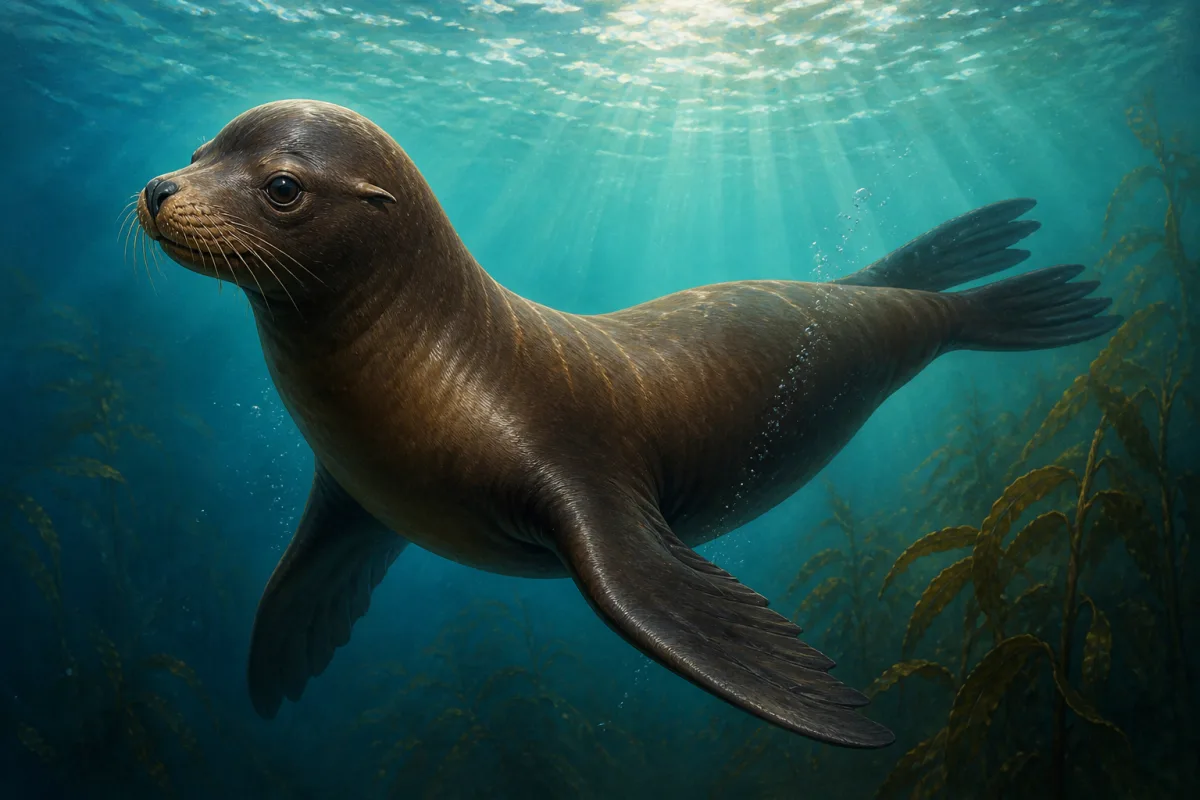
Otariids are built differently from true seals, and the difference is more than the visible ear flaps. A sea lion swims with long, wing-like foreflippers rather than sculling with its hindquarters, and it can rotate its hind flippers forward beneath the body, so it walks and climbs on all fours instead of hauling itself along on its belly. That mobility explains the animals resting on breakwaters, navigation buoys and marina docks, and it lets them climb fish ladders at dams on the Columbia River, well over a hundred miles from the sea.
The species is one of the clearer marine mammal recoveries in United States waters. Hunting and bounty shooting had reduced the population sharply by the early twentieth century; after the Marine Mammal Protection Act of 1972 it grew steadily, and the United States stock is now estimated at more than 250,000 animals, close to what the habitat is thought to support. Recovery has not made life predictable. Warm-water years leave nursing mothers unable to find prey and strand emaciated pups by the thousand, and blooms of the diatom Pseudo-nitzschia poison adults with domoic acid, which causes seizures and lasting brain damage.
Where it lives
The eastern North Pacific, from southeastern Alaska and British Columbia south along the coast of central Mexico and into the Gulf of California. Breeding is concentrated on islands: San Miguel, San Nicolas, Santa Barbara and San Clemente in California's Channel Islands, and Los Coronados, Cedros, the San Benito group and Guadalupe off Baja California. Non-breeding males range far north of the rookeries in fall and winter, which is why the sea lions on docks in Oregon and Washington are almost all male.
Habitat
- Coastal waters
- Kelp forests & rocky reefs
- Continental shelf
- Estuaries & river mouths
What it eats
A generalist that eats whatever is locally abundant. Market squid, northern anchovy, Pacific sardine, jack and Pacific mackerel, hake, rockfish and salmon all feature heavily, and the mix shifts between years as ocean conditions rearrange the prey field. Squid dominate the diet in some seasons and almost disappear from it in others, which is one reason the species is sensitive to warm-water events that push cool-water prey out of reach.
- Bony fish
- Squid & octopus
How it hunts
California sea lions are pursuit hunters rather than ambush predators. They chase individual fish and squid in short, shallow dives, using forward-facing eyes adapted to dim light and stiff vibrissae that register water movement close to the body. Groups often work the same bait aggregation as dolphins, shearwaters and pelicans, and individuals herd schooling fish toward the surface or against a wall of kelp. They also exploit bottlenecks where prey is concentrated by human structures, waiting below fish ladders, weirs and outflows, a habit that puts them into conflict with salmon managers on the Columbia and Willamette rivers.
Behavior
Social structure: Breeding colonies
Breeding is colonial and highly polygynous. Bulls arrive at island rookeries in May, defend small stretches of beach or shoreline water for weeks while fasting, and bark almost continuously; females move freely between territories and are not herded. Outside the breeding season the species remains gregarious for its own sake, packing onto docks, jetties and rafts in mixed groups of dozens to hundreds, most famously at Pier 39 in San Francisco, which sea lions occupied in 1989 and have used ever since.
Active period: Day & night
Foraging trips run at any hour, but dive records show a strong nocturnal bias in many areas because market squid and other prey rise toward the surface after dark. Animals rest ashore between trips, and nursing females alternate short foraging bouts with periods on the beach with their pups.
Reproduction
Live birth, milk-fed young.
A single pup weighing 13 to 20 pounds is born on the rookery in June or early July. The mother mates again within a month, after which the fertilized egg pauses for roughly three months before implanting, making total gestation about eleven months. Pups nurse for at least six months and often close to a year, sometimes into a second year, while the mother alternates two- to three-day foraging trips with visits ashore. Mothers and pups relocate each other by call, and both recognize the other's voice.
Predators and ecological role
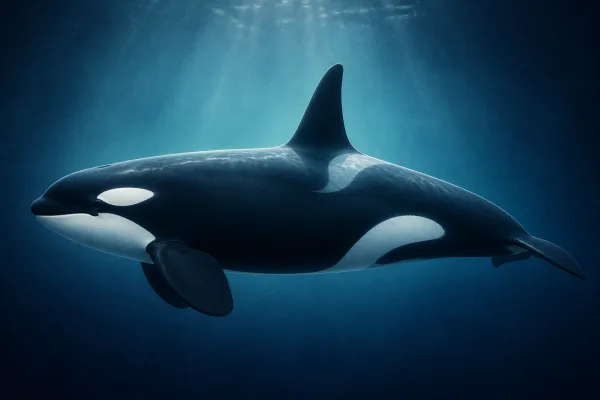
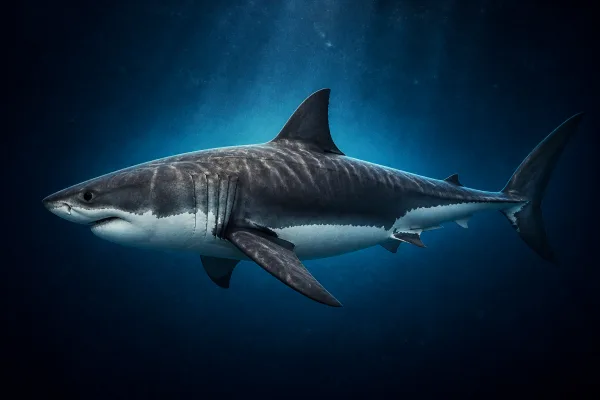
Great white sharks and mammal-hunting orcas are the main predators, and shark-bitten survivors are a regular sight at California rookeries. Pups and juveniles are the most vulnerable, both because of their size and because they forage in shallow water close to shore.
The species sits in the middle of the coastal food web, converting large quantities of squid and schooling fish into food for white sharks and orcas and into nutrients that reach island soils and nearshore waters. Because the population is large, well counted and monitored through stranding networks, its body condition and pup survival serve as a running index of prey availability along the California Current, and unusual mortality events often flag ocean changes before fishery data do.
Conservation and threats
Least Concern Assessed 2015 · population increasing
The population has grown for decades under the Marine Mammal Protection Act, and the United States stock is considered to be at or near the level its habitat can support. The global listing hides a regional exception: numbers in the Gulf of California have fallen at several rookeries, and animals there are treated as a separate management concern. The Galapagos sea lion and the extinct Japanese sea lion were once classed as subspecies of this animal and are now recognized as distinct species.
Harmful algal blooms are the most visible pressure. Domoic acid produced by Pseudo-nitzschia accumulates in anchovy and sardine and causes seizures, disorientation and permanent damage to the hippocampus in sea lions that eat them, with hundreds of animals stranding in bad years. Marine heatwaves and El Nino conditions push prey deeper and farther offshore, which starves pups. Entanglement in net fragments and packing straps, accidental capture in gillnets, gunshot wounds, and authorized lethal removal of individuals that congregate below salmon dams add to the losses.
Main pressures
- Chemical pollution
- Ocean warming
- Entanglement in gear
- Bycatch in other fisheries
- Human disturbance
Notable details
- Rotating hind flippers and powerful foreflippers let a sea lion walk, climb and even hop up staircases and boat ladders, something no true seal can manage.
- Domoic acid poisoning from algal blooms was first linked to sea lion strandings in Monterey Bay in 1998 and has since become a recurring cause of death.
- Adult males grow a sagittal crest, a bony ridge along the midline of the skull that is often topped by a patch of pale fur and appears only at maturity.
- The United States Navy has trained California sea lions to locate and attach recovery lines to objects on the seafloor, taking advantage of their maneuverability and low-light vision.
Sources
-
The IUCN Red List of Threatened Species
International Union for Conservation of Nature
Global conservation assessments, population trends and threat classifications for every species profiled here.
-
Species Directory
NOAA Fisheries
Management-grade biology, distribution and stock information for species in United States waters.
-
Smithsonian Ocean
Smithsonian National Museum of Natural History
Peer-reviewed public science writing on marine life, ecosystems and ocean change.
-
Animal Diversity Web
University of Michigan Museum of Zoology
Referenced accounts of anatomy, reproduction, behavior and life history.
-
Monterey Bay Aquarium
Monterey Bay Aquarium
Husbandry-informed accounts of feeding, growth and behavior for species held in public aquariums.
Figures on this page were last checked against these sources on .