Overview
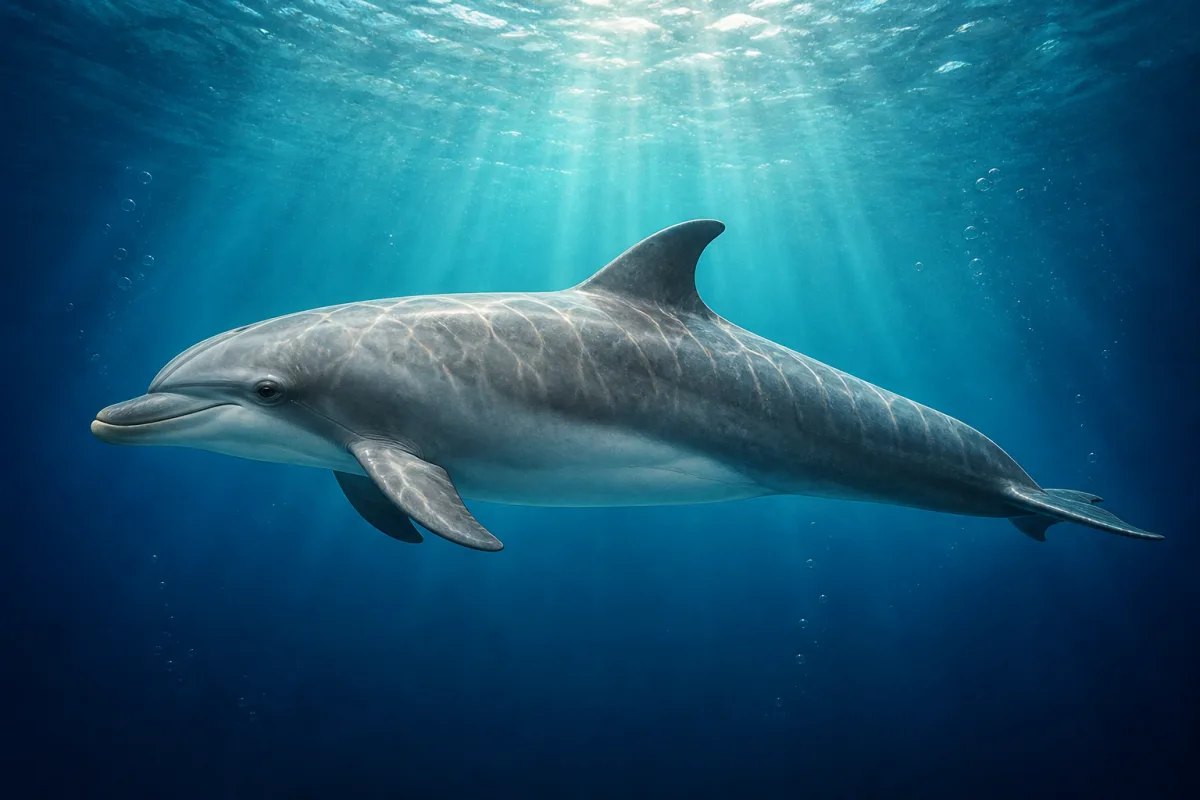
The common bottlenose dolphin is the most familiar cetacean in the world and one of the most variable. Body length runs from about 6 feet in warm inshore waters to 13 feet in cold temperate seas. Nearly every well-studied region holds at least two forms: a smaller coastal type that stays over the shelf and a larger offshore type that ranges into deep water. The two differ in diet, blood chemistry, parasite load and, in several regions, in genetics distinct enough to suggest limited interbreeding.
Bottlenose dolphins live in fission-fusion societies. Group membership shifts from hour to hour, but beneath that fluidity lie long-term relationships, most notably alliances of two or three males that cooperate for years at a time. Each dolphin develops a signature whistle within its first months of life and keeps it for decades. Animals broadcast their own whistle to announce identity and copy the whistles of close associates, which is the nearest thing to naming documented in a wild animal.
Feeding techniques are local traditions rather than species-wide instincts. In Shark Bay, Western Australia, some females carry a marine sponge on the beak to shield it while probing rubble for hidden fish, and the habit passes from mother to daughter. In Florida Bay, dolphins take turns beating the bottom with their flukes to raise a ring of stirred mud that concentrates mullet. Neighboring groups in the same waters may use entirely different methods, or none of them at all.
Where it lives
Temperate and tropical waters worldwide, from bays and estuaries to the open ocean, including the Mediterranean and Black Seas. Absent from polar waters. Resident communities occupy many United States estuaries year-round, among them Sarasota Bay, Tampa Bay, the Indian River Lagoon and the sounds of North Carolina, while other populations range along the shelf edge or far offshore.
Habitat
- Coastal waters
- Estuaries & river mouths
- Continental shelf
- Open ocean
- Sandy flats & seagrass beds
What it eats
Diet is opportunistic and strongly local. Coastal dolphins take mullet, pinfish, croaker, sea trout and other schooling and bottom-dwelling fish, often locating buried prey by sound alone. Offshore animals rely more on squid and on deeper-water fish. Shrimp and other crustaceans appear regularly in stomach contents, and dolphins in some regions follow shrimp trawlers to take fish stirred up or discarded by the gear.
- Bony fish
- Squid & octopus
- Crustaceans
How it hunts
Bottlenose dolphins hunt by echolocation, emitting click trains that resolve targets in murky water and even detect fish buried under sand. Groups frequently herd schooling fish against the surface, a shoreline or one another. Individual techniques are widespread: some dolphins pin a fish against the bottom, some strike prey with the tail, and some follow boats to take advantage of the disturbance. Strand feeding, in which dolphins drive fish onto a mud bank and slide partway out of the water, is limited to a few estuaries in the southeastern United States.
Behavior
Social structure: Pairs & small groups
Typical groups hold two to fifteen animals and change composition constantly, a pattern known as fission-fusion. Stability lies in the relationships rather than the groups: mothers and calves stay together for years, and male pairs and trios can persist for a decade or more. Hundreds of dolphins occasionally gather where food is abundant, but such aggregations disperse quickly.
Active period: Day & night
Active day and night, with foraging peaks that follow the tide in estuaries and the movement of prey offshore. Rest is taken in short periods with one brain hemisphere asleep at a time, so breathing and awareness continue without interruption.
Reproduction
Live birth, milk-fed young.
Gestation lasts about twelve months and produces a single calf roughly 3 to 4 feet long. Nursing continues for 18 months to two years, and calves usually stay with their mother for three to six years, learning where and how to feed before separating. Females first give birth between five and thirteen years of age and calve every three to six years thereafter.
Predators and ecological role
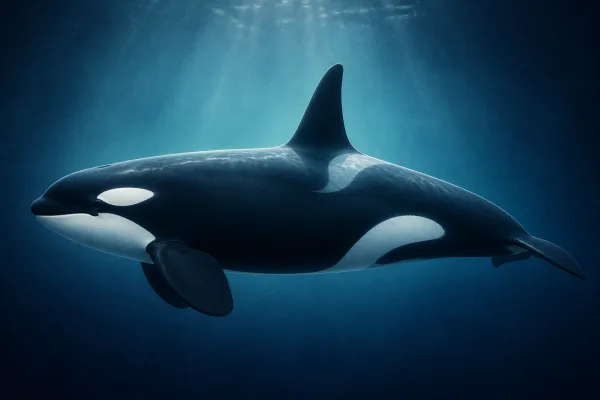
Large sharks are the principal predators, especially bull, tiger and dusky sharks in warm coastal waters. In Sarasota Bay roughly a third of adults carry healed shark bite scars. Orcas take bottlenose dolphins in some parts of the range, though such events are seldom witnessed.
As an abundant mid-to-upper level predator in coastal systems, the bottlenose dolphin influences the distribution and behavior of schooling fish across large stretches of shoreline. Its long life, high position in the food web and residency in specific estuaries also make it a practical indicator of coastal water quality, since contaminant loads in local dolphins track conditions in the bay around them.
Conservation and threats
Least Concern Assessed 2018 · population unknown
The species as a whole is abundant and widespread, but that global category conceals real trouble in specific places. Several United States coastal stocks are designated as depleted or strategic under the Marine Mammal Protection Act, and unusual mortality events, including one linked to the 2010 Deepwater Horizon oil spill, have caused sustained declines in northern Gulf of Mexico populations.
Living close to shore exposes the species to nearly every form of coastal pressure. Dolphins drown in gillnets and trawls, ingest or become tangled in fishing line, and accumulate industrial contaminants that are passed to calves in milk. Feeding by the public is a specific and underappreciated hazard, since dolphins that learn to approach boats for food suffer far higher rates of injury from propellers and gear.
Main pressures
- Bycatch in other fisheries
- Chemical pollution
- Coastal development
- Human disturbance
- Entanglement in gear
Notable details
- Each dolphin invents a signature whistle in its first months of life, uses it to announce its identity, and copies the whistles of close companions to get their attention.
- In the salt marshes of South Carolina and Georgia, dolphins drive fish onto muddy banks and follow them partway out of the water, nearly always rolling onto their right side.
- Echolocation is precise enough for a bottlenose dolphin to detect an object the size of a golf ball from more than 300 feet away.
- Females in Shark Bay, Australia carry marine sponges as protective tools while foraging, a tradition inherited along maternal lines and one of the few confirmed cases of tool use in a wild marine mammal.
Sources
-
The IUCN Red List of Threatened Species
International Union for Conservation of Nature
Global conservation assessments, population trends and threat classifications for every species profiled here.
-
Species Directory
NOAA Fisheries
Management-grade biology, distribution and stock information for species in United States waters.
-
Smithsonian Ocean
Smithsonian National Museum of Natural History
Peer-reviewed public science writing on marine life, ecosystems and ocean change.
-
International Whaling Commission
IWC
Cetacean population status, ship-strike and entanglement reporting.
-
Animal Diversity Web
University of Michigan Museum of Zoology
Referenced accounts of anatomy, reproduction, behavior and life history.
Figures on this page were last checked against these sources on .