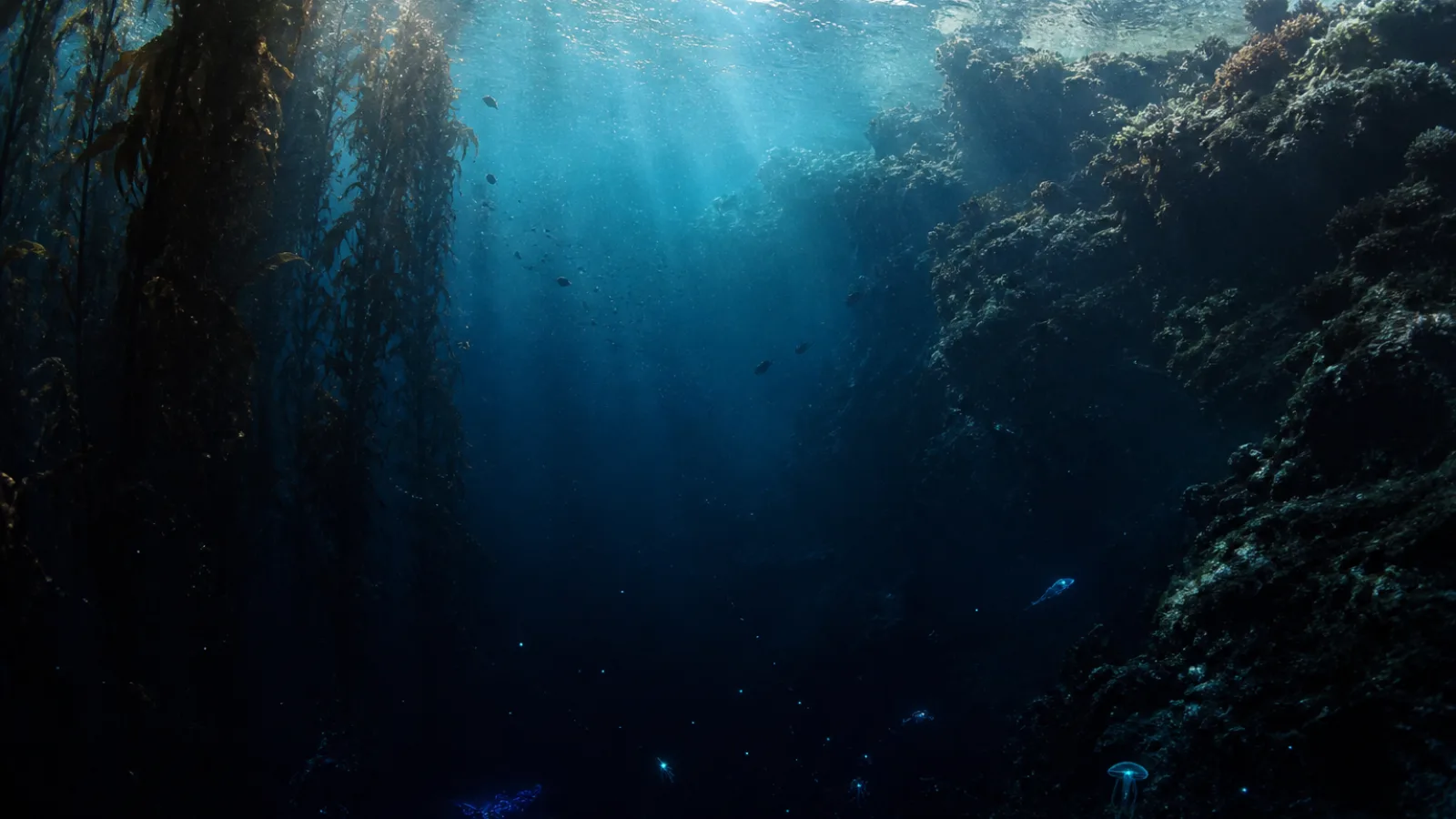
Seen from the deck of a boat, the ocean looks like a single uniform place. Below the surface it is layered as sharply as a mountainside. Light, temperature, pressure and food supply all change dramatically over a few hundred feet of depth, and those gradients are what create distinct communities of animals. A predator built to hunt in bright surface water is generally useless in the permanent darkness half a mile down, and an animal adapted to the deep sea would not last long at the surface.
This guide works through the ocean twice. First vertically, from the sunlit surface layer down through the twilight zone to the trenches, and then horizontally across the habitats that ring the continents and interrupt the open sea: coastal waters, estuaries, mangroves, coral reefs, kelp forests, the continental shelf, seamounts and sea ice. In each case the aim is to explain a mechanism rather than list residents, meaning why a particular set of physical conditions reliably produces a particular kind of hunter.
Light, Pressure and the Vertical Zones
Oceanographers divide the water column into layers defined largely by how much sunlight reaches them, because sunlight is the ocean's energy source and it disappears quickly. Red wavelengths are absorbed within the first 30 feet or so, leaving the blue-green light that gives deeper water its color. In even the clearest open ocean, less than one percent of surface light remains at about 660 feet (200 m). Below that depth photosynthesis is no longer possible, so every calorie has to arrive from somewhere else.
Pressure and temperature change just as steeply. Pressure increases by roughly one atmosphere for every 33 feet (10 m) of depth, so an animal living at 3,300 feet endures about 100 times the pressure at the surface. Temperature drops through a transition layer called the thermocline and then settles between about 32 and 39°F (0-4°C) through most of the deep ocean, regardless of latitude. Averaged across the planet, the sea floor lies more than 2 miles down, which makes cold, dark, food-poor water the ocean's default condition rather than its exception.
The ocean's vertical zones
- Epipelagic, or sunlit zone: the surface down to about 660 feet (200 m). Nearly all marine photosynthesis happens here, and most familiar ocean predators hunt here.
- Mesopelagic, or twilight zone: roughly 660 to 3,300 feet (200-1,000 m). Faint blue light, no photosynthesis, and an enormous biomass of small fish, squid and crustaceans.
- Bathypelagic, or midnight zone: about 3,300 to 13,100 feet (1,000-4,000 m). Completely dark apart from the light animals make themselves.
- Abyssopelagic zone: roughly 13,100 to 19,700 feet (4,000-6,000 m), the water overlying the broad abyssal plains that cover most of the sea floor.
- Hadal zone: deeper than 19,700 feet (6,000 m), confined to trenches and the least explored habitat on Earth.
The Sunlit Surface
The epipelagic zone is warm, well lit, stirred by wind, and by far the most productive part of the open sea. It is also the most exposed habitat in the ocean. There is no rock to hide behind and no shade, so an animal is potentially visible in every direction, including from directly below and directly above. Almost every adaptation of surface predators and their prey follows from that single problem, which is why unrelated groups of animals keep arriving at the same solutions.
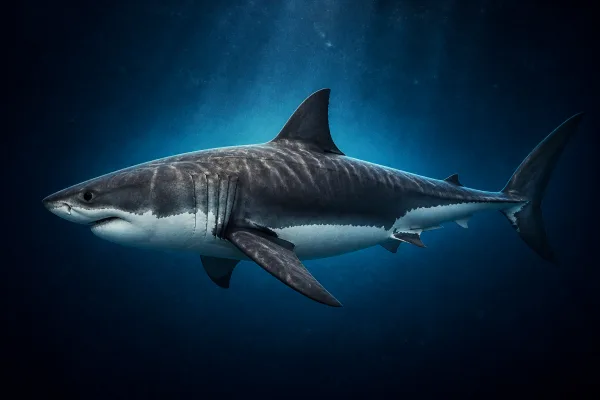
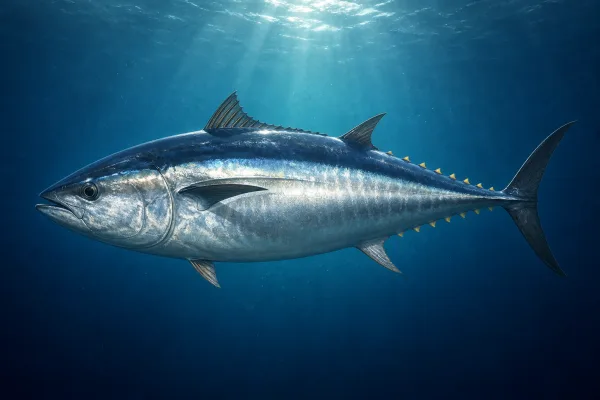
Surface hunters tend to be fast, streamlined and countershaded, with dark backs that blend into deep water when seen from above and pale bellies that disappear against the bright surface when seen from below. Atlantic bluefin tuna and great white sharks share that color scheme and share a tactic to match it: approach from beneath, where prey is silhouetted against the light. Schooling is the corresponding defense, since a single fish in a tight ball of thousands is difficult to isolate, and much surface hunting is really the work of breaking a school apart.
The Twilight Zone and the Deep Scattering Layer
Between roughly 660 and 3,300 feet, light is present but scarce, and the animals living there are shaped by the narrow margin between seeing and being seen. Typical mesopelagic fish have oversized eyes, mirror-like silver flanks that reflect the surrounding blue rather than a body outline, and rows of light organs along the belly that match the dim glow filtering down from above. That last trick, called counterillumination, erases the silhouette that a predator looking upward would otherwise detect.
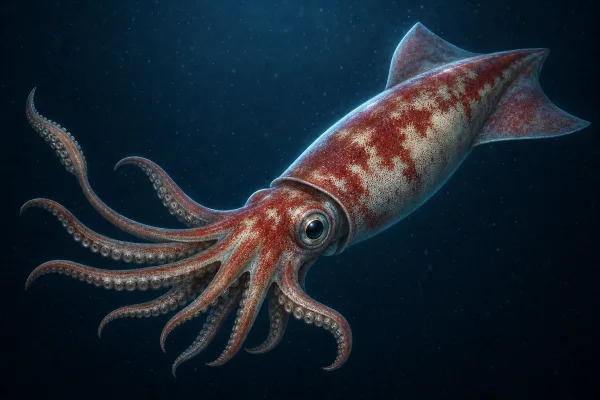
Sonar operators in the 1940s found a false sea floor that rose toward the surface each night and sank again at dawn. It was the twilight zone's animals migrating, and the layer they form is still called the deep scattering layer. Parts of the mesopelagic also hold oxygen minimum zones, water so poor in dissolved oxygen that most large fish avoid it. Humboldt squid tolerate those conditions by suppressing their metabolism, which gives them access to prey and refuge from competitors that cannot follow.
Midnight Water and the Cold Abyss
Below about 3,300 feet the ocean is entirely dark, uniformly cold and desperately short of food. Only a small fraction of the organic matter produced at the surface survives the long sink downward as the drifting particles known as marine snow, and what remains is spread through an immense volume of water. A deep-sea predator may go weeks or months between meals, and cannot count on finding prey by searching, because searching costs energy that may not be recovered.
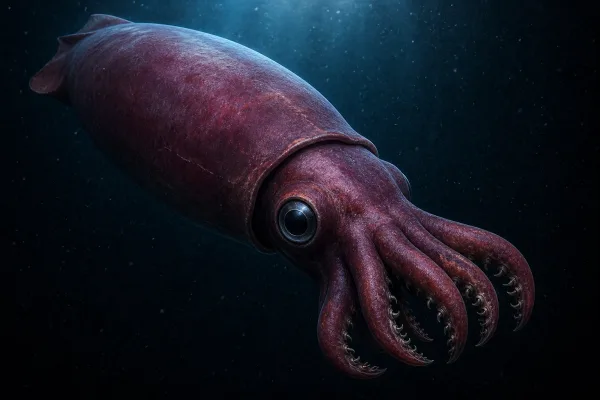
The result is a suite of adaptations that inverts everything the surface rewards. Deep-sea hunters are typically slow, with reduced muscle, watery tissue, low metabolic rates, and mouths and stomachs disproportionate to their bodies so that a rare large meal is never wasted. The colossal squid of the Southern Ocean, possibly the heaviest invertebrate alive, appears to hang almost motionless and ambush whatever drifts within reach of its hooked tentacles. Growth is slow to match, and life spans can be extraordinary: Greenland sharks, which feed in cold deep water across the North Atlantic, have been dated by radiocarbon in their eye lenses to at least 270 years, with wide uncertainty on either side.
Predators That Commute Between Zones
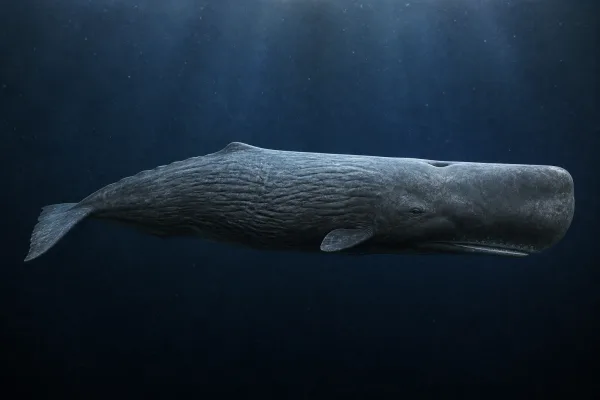
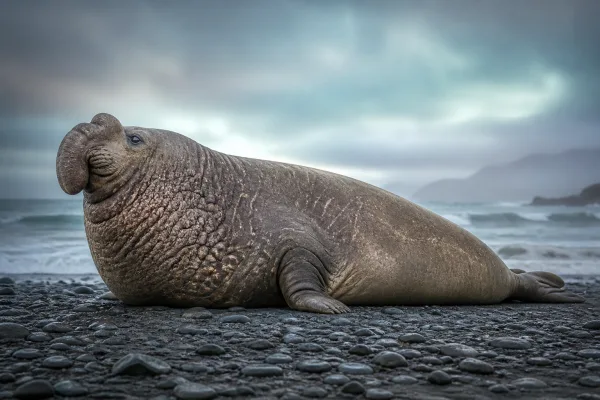
Some of the ocean's most capable hunters do not belong to a single zone at all. Sperm whales feed on deep-water squid and fish, routinely diving past 3,000 feet and sometimes beyond 6,500 feet (2,000 m), but they must return to the surface to breathe every 45 minutes or so. Southern elephant seals do something similar on a smaller scale, spending most of the year at sea and diving repeatedly to mesopelagic depths, with the deepest recorded dives well over a mile. Both animals exploit deep prey while keeping the physiology of a surface breather.
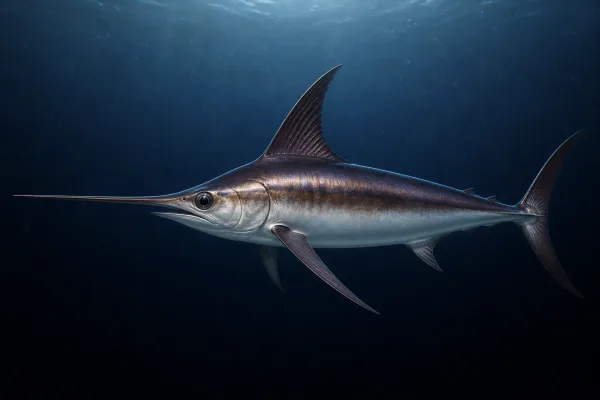
Commuting has costs that a resident deep-sea animal avoids: every dive is limited by oxygen, and time spent traveling is time not spent feeding. What makes it worthwhile is that mesopelagic and bathypelagic prey is abundant, weakly defended and rarely contested. Swordfish work the same boundary from the other direction, hunting squid and fish at depth by day and rising into cooler surface water at night, aided by a heater organ that keeps their eyes and brain warm enough to track fast movement in near-freezing water.
The Productive Edge: Coastal Waters, Estuaries and Mangroves
Continental margins occupy a small share of the ocean's area but support a disproportionate share of its life. Rivers deliver nitrogen, phosphorus and iron; winds drive upwelling that lifts nutrients from deeper water; and shallow depths keep both nutrients and sunlight in the same place. High primary production means dense prey, and dense prey supports predators that would find the open ocean too thin to live in. The trade-off is that coastal water is turbulent, turbid and variable, changing with tides, seasons and storms.
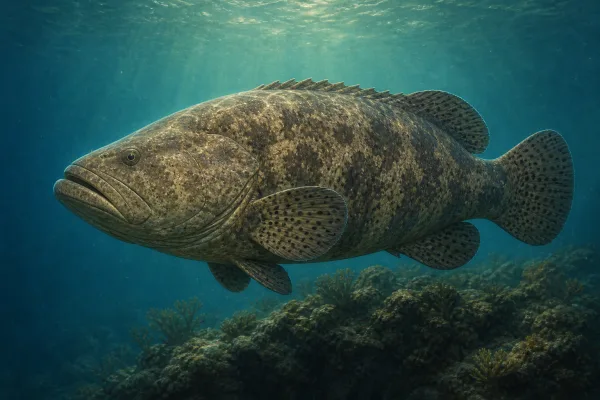
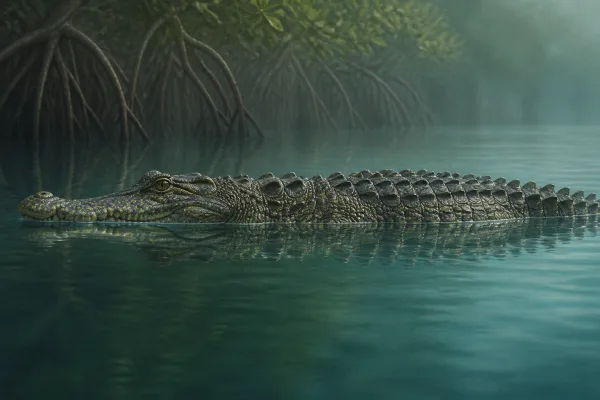
Estuaries and mangroves push that variability further. Salinity in a river mouth can swing from nearly fresh to nearly marine within a single tidal cycle, which excludes most strictly marine species and rewards those that can regulate their internal chemistry. Bull sharks are the best-known example, moving hundreds of miles up rivers. Saltwater crocodiles dominate the same environments across the Indo-Pacific, hunting by ambush in water so murky that vision matters less than pressure and vibration. Mangrove roots also act as a nursery: young Atlantic goliath grouper spend their first years among them before moving out to reefs.
Habitats along the continental margin
- Coastal waters: shallow, nutrient-rich and seasonally variable, supporting the densest concentrations of fish anywhere in the ocean.
- Estuaries and river mouths: fluctuating salinity that filters out most marine species and favors physiological generalists.
- Mangroves and lagoons: root tangles that shelter juveniles from larger predators while trapping sediment and organic matter.
- Sandy flats and seagrass beds: open bottom with little cover, where predators rely on burial, camouflage or speed rather than structure.
- Continental shelf: the gently sloping platform out to roughly 650 feet (200 m), which carries most of the world's fisheries.
Built Habitats: Coral Reefs and Kelp Forests
Coral reefs and kelp forests differ from other marine habitats in one important respect: the habitat itself is made of living organisms. Corals build limestone frameworks over centuries, and kelp grows vertical canopies that can exceed 100 feet. Both convert flat seafloor into three-dimensional space full of crevices, overhangs and shaded corridors. That complexity supports far more species than the same area of open bottom, and it changes what kind of predator succeeds.
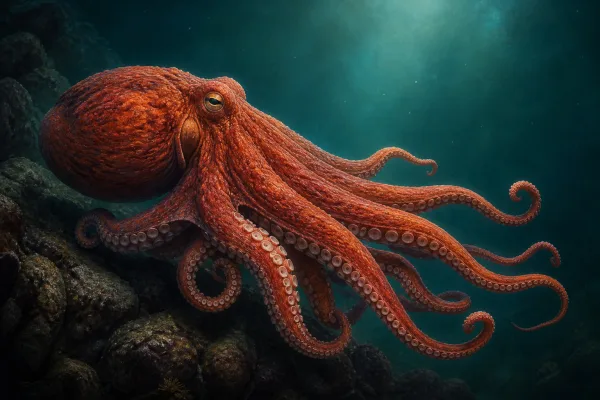
Where cover is abundant, ambush becomes cheap and speed becomes less useful. Giant Pacific octopuses hunt through the rocky reefs and kelp beds of the North Pacific by probing crevices with their arms, using a body that can pass through any opening its beak will fit. Atlantic goliath grouper hold position in reef caves and wrecks and take prey with a sudden suction strike rather than a chase. Great white sharks patrol the edges of California and South African kelp forests, where the seals they hunt must eventually cross open water. In each case the architecture, not the water, sets the tactics.
The Continental Shelf and the Open Ocean
Beyond the shelf break the sea floor drops away and the habitat becomes water and nothing else. Prey is patchy and widely separated, so an open-ocean predator has to cover ground, and the animals that thrive there are built for sustained travel rather than short bursts. Tuna, billfish and mackerel sharks converge on the same design: a stiff fusiform body, a narrow tail stalk, a high crescent-shaped tail that generates thrust with little drag, and pectoral fins that fold flush when not needed.
The less obvious requirement is warmth. Muscle produces more power at higher temperatures, but a fish swimming through cold water loses heat continuously through its gills. Several open-ocean lineages solved this independently with countercurrent heat exchangers, dense networks of small blood vessels that trap metabolic heat before it reaches the gills. Atlantic bluefin tuna and great white sharks both keep their swimming muscles, viscera, brain and eyes several degrees above ambient temperature, which is why both can hunt productively in water near 50°F (10°C) while most fish of comparable size cannot.
Seamounts, Banks and Sea Ice
Seamounts are submarine mountains, most of them extinct volcanoes, and they interrupt the monotony of the open ocean in ways that concentrate life. Currents striking a steep slope are deflected upward, lifting nutrients into lit water and generating local production far above the surrounding sea. Eddies form in the lee and retain plankton and larvae. The result is a reliable oasis, and large mobile predators use seamounts and offshore banks as feeding stops, aggregation sites and apparent navigational waypoints on migrations that may span an ocean basin.
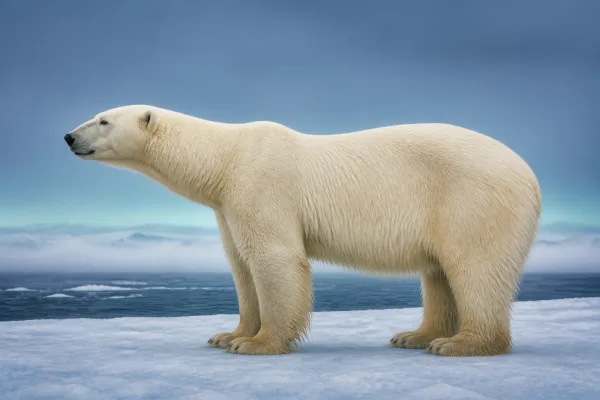
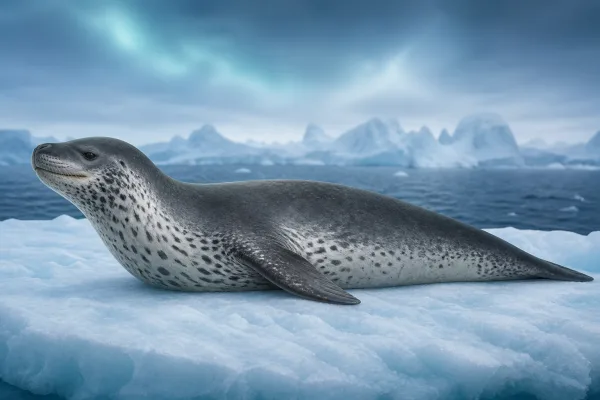
Sea ice works in the opposite direction: it is a habitat made of the surface itself, a moving platform over water that is often thousands of feet deep. Ice supports algae on its underside, which feeds crustaceans and the fish that eat them, and it gives air-breathing hunters a solid surface. Polar bears are the clearest case, since they hunt seals almost entirely from ice and lose access to prey when the ice retreats beyond the shallow shelf. In Antarctic waters leopard seals patrol the ice edge, where penguins and young seals must enter and leave the water at predictable places.
Why Habitat Predicts the Predator
Across all of these environments, four physical variables do most of the explaining. Light determines whether vision is worth investing in, and what other senses must replace it. Temperature sets the ceiling on muscle power and the floor on metabolic cost. The rate at which food arrives decides whether pursuit is affordable or whether patience is the only viable strategy. Structure, or its absence, determines whether ambush is possible at all.
Knowing those four values for a given place predicts a great deal about its predators without knowing anything about the species involved, which is why comparable habitats on opposite sides of the world produce animals that look and behave alike despite being unrelated. It also explains why habitat change matters so much. An animal that is superbly matched to one combination of light, temperature, food supply and structure has few options when that combination shifts, and specialists of the kind this guide describes are precisely the animals with the least room to adjust.
Four variables that shape a marine predator
- Available light: how much a hunter can rely on vision, and what senses substitute for it in darkness or turbid water.
- Temperature: the limit on sustained swimming power, and the reason warm-bodied fish can exploit cold, productive seas.
- Food supply and its reliability: the difference between pursuit predators and animals that wait for prey to come to them.
- Physical structure: reefs, kelp, mangrove roots and ice create cover, while open water offers none and rewards camouflage and speed.
Sources
-
National Ocean Service
NOAA
Reference material on ocean zones, currents, habitats and coastal processes.
-
Smithsonian Ocean
Smithsonian National Museum of Natural History
Peer-reviewed public science writing on marine life, ecosystems and ocean change.
-
Monterey Bay Aquarium Research Institute
MBARI
Deep-sea observations, including remotely operated vehicle records of squid and midwater predators.
-
Species Directory
NOAA Fisheries
Management-grade biology, distribution and stock information for species in United States waters.
-
National Snow and Ice Data Center
NSIDC
Sea ice extent and trend data underlying polar habitat descriptions.
Figures on this page were last checked against these sources on .