Overview
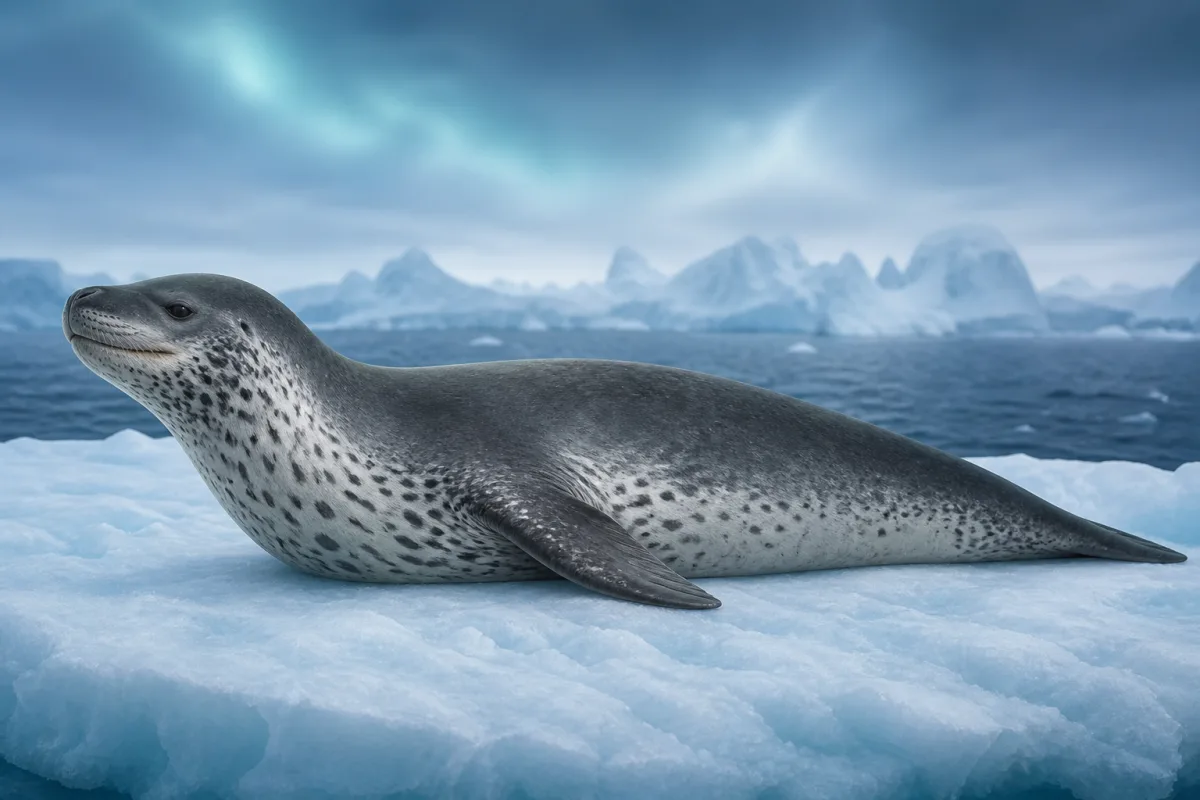
The leopard seal is a true seal of the Antarctic pack ice, named for the dark spotting across its silver-grey throat and flanks. It has a long, muscular body, an unusually large head and a wide gape, and the jaw closes on a set of postcanine teeth shaped quite unlike those of any other seal. Females are the larger sex, reaching roughly 11 feet and occasionally over 1,000 pounds, while males are shorter and lighter. The reversal is common among phocids and stands in contrast to the sea lions, where breeding bulls dwarf the females.
What sets the species apart is the breadth of its diet rather than any single prey item. It is the only seal that regularly takes warm-blooded prey, including Adelie, chinstrap and gentoo penguins and the pups of crabeater, Weddell and fur seals, and the scars on adult crabeater seals across the Southern Ocean are largely the record of failed leopard seal attacks on those animals as pups. Yet the same animal spends much of the year feeding on krill, which in some regions makes up nearly half of what it eats.
That combination is possible because of the teeth. The postcanines are tricuspid, each carrying a tall central point flanked by two smaller cusps, and when the jaws close the cusps of the upper and lower rows interlock to leave only narrow gaps. The seal takes a mouthful of krill-laden water, closes its jaws and forces the water out through those gaps, straining the krill much as a crabeater seal does. The long canines in front handle the other half of the job, so one set of jaws serves both a filter feeder and a hunter of penguins.
Where it lives
Circumpolar in the Southern Ocean, concentrated along the outer fringe of the Antarctic pack ice and around the Antarctic Peninsula, South Georgia, the South Shetland and South Orkney Islands. Younger animals wander much farther north than adults, and vagrants turn up on the coasts of southern Australia, New Zealand, South Africa and South America, occasionally as far north as the Cook Islands. Unlike most Antarctic seals it does not form dense colonies, so its range is better described as thinly occupied than as clustered.
Habitat
- Sea ice & polar shelves
- Coastal waters
- Open ocean
- Continental shelf
What it eats
Antarctic krill, penguins, the pups of other seal species, fish, squid and carrion, in proportions that shift with location and season. Krill can account for something close to half the diet in parts of the range, which makes the leopard seal both a filter feeder and a hunter of warm-blooded animals depending on the month. It also scavenges, and leopard seals have been recorded feeding on the carcasses of dead whales and seals.
- Zooplankton & krill
- Seabirds
- Marine mammals
- Bony fish
- Squid & octopus
- Carrion & whale falls
How it hunts
The species hunts by patrol and ambush rather than by pursuit over long distances. Around a penguin colony a leopard seal waits in the water at the ice edge or in the surf zone, where birds must enter or leave, and takes them as they cross that boundary. A captured penguin is often thrashed violently against the water surface, which separates the skin and feathers from the flesh; the behavior looks gratuitous but appears to be a practical way of handling prey that a seal cannot dismember with its forelimbs. Krill feeding uses the same jaws in a completely different mode, straining swarms through the interlocking cusps of the cheek teeth. Underwater vocalizations carry for long distances, and hunting animals are otherwise notably quiet.
Behavior
Social structure: Mostly solitary
Adults are solitary for most of the year, spread thinly along the pack ice rather than gathered in colonies, and they haul out alone or in small loose groups on floes. There is no territorial defense of beaches as in the sea lions and elephant seals. Sound does much of the social work instead: through the breeding season males produce loud, stereotyped underwater calls for hours at a time, and the call repertoire differs between individuals and regions.
Active period: Day & night
Active by day and night, with hunting shaped more by the movements of prey and the position of the ice edge than by the clock. In the high-latitude summer there is effectively no darkness, and in winter little daylight, so a strict day-night rhythm has limited meaning through much of the range.
Reproduction
Live birth, milk-fed young.
A single pup is born on a drifting ice floe in the Antarctic spring, weighing around 65 to 80 pounds, and nurses for roughly four weeks before the mother leaves. Mating takes place in the water shortly after weaning. Because the species does not breed in colonies, almost nothing has been directly observed of courtship, and much of what is known comes from the timing of male calls and from the condition of animals sampled at sea. Females reach maturity at three to seven years and males a little later.
Predators and ecological role
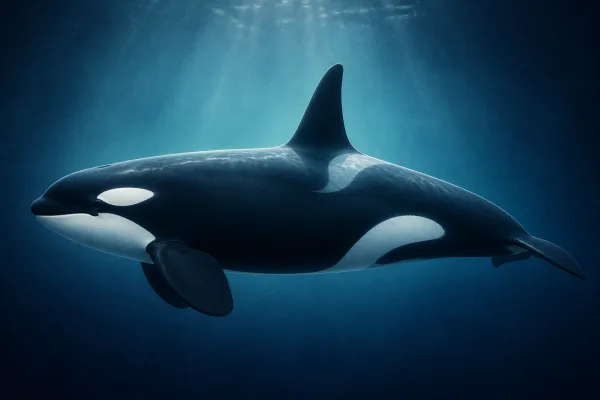
Orcas are the main predator of adults, and large sharks may take animals in the northern part of the range. Pups on ice floes are vulnerable to orcas that wash them off the ice, and leopard seals themselves take the pups of other seal species, so the distinction between predator and prey depends heavily on age.
The leopard seal is one of the few Antarctic predators that draws on two trophic levels at once, moving between krill and warm-blooded prey as conditions change. Its predation is a significant source of mortality for penguin colonies and for the pups of crabeater, Weddell and Antarctic fur seals, and the near-universal scarring on adult crabeaters is a visible measure of that pressure. Because krill also sits at the base of its diet, the species links the fortunes of the krill population directly to the survival of seabirds and other seals in a way few predators do.
Conservation and threats
Least Concern Assessed 2015 · population unknown
Listed as Least Concern because the range is vast and no major decline has been detected, but the population estimate is genuinely uncertain: figures in circulation run from roughly 200,000 to several hundred thousand animals and rest on surveys that are hard to conduct in pack ice. The trend is recorded as unknown rather than stable, since there is no time series good enough to detect change. The species is protected under the Antarctic Treaty System and the Convention for the Conservation of Antarctic Seals.
The pressures on this species act through its habitat and its prey rather than through direct exploitation. Sea ice is the platform on which pups are born and weaned, and its extent and timing around the Antarctic Peninsula have changed markedly. The commercial krill fishery in the Southern Ocean removes the food that supports both the seal directly and the penguins it hunts. Warming has already shifted the balance among penguin species on the Peninsula, which alters the prey field a leopard seal depends on. Growing tourist and research traffic adds localized disturbance.
Main pressures
- Climate change
- Sea ice loss
- Depletion of prey
- Human disturbance
Notable details
- The cheek teeth are tricuspid and interlock when the jaws close, letting the same animal strain krill from a mouthful of water and kill a penguin with the canines in front of them.
- Females are larger than males, the opposite of the pattern in sea lions and elephant seals, and there is no fighting over territory to explain male size.
- Most adult crabeater seals in the Southern Ocean carry paired parallel scars on their flanks, the healed record of leopard seal attacks survived as pups.
- Males sing underwater for hours during the breeding season, producing a small set of stereotyped calls that differ between individuals and between regions.
Sources
-
The IUCN Red List of Threatened Species
International Union for Conservation of Nature
Global conservation assessments, population trends and threat classifications for every species profiled here.
-
British Antarctic Survey
Natural Environment Research Council
Antarctic field research on seals, penguins and Southern Ocean food webs.
-
Smithsonian Ocean
Smithsonian National Museum of Natural History
Peer-reviewed public science writing on marine life, ecosystems and ocean change.
-
Animal Diversity Web
University of Michigan Museum of Zoology
Referenced accounts of anatomy, reproduction, behavior and life history.
-
Australian Museum
Australian Museum
Species accounts for Indo-Pacific fish, reptiles and invertebrates.
Figures on this page were last checked against these sources on .