Overview
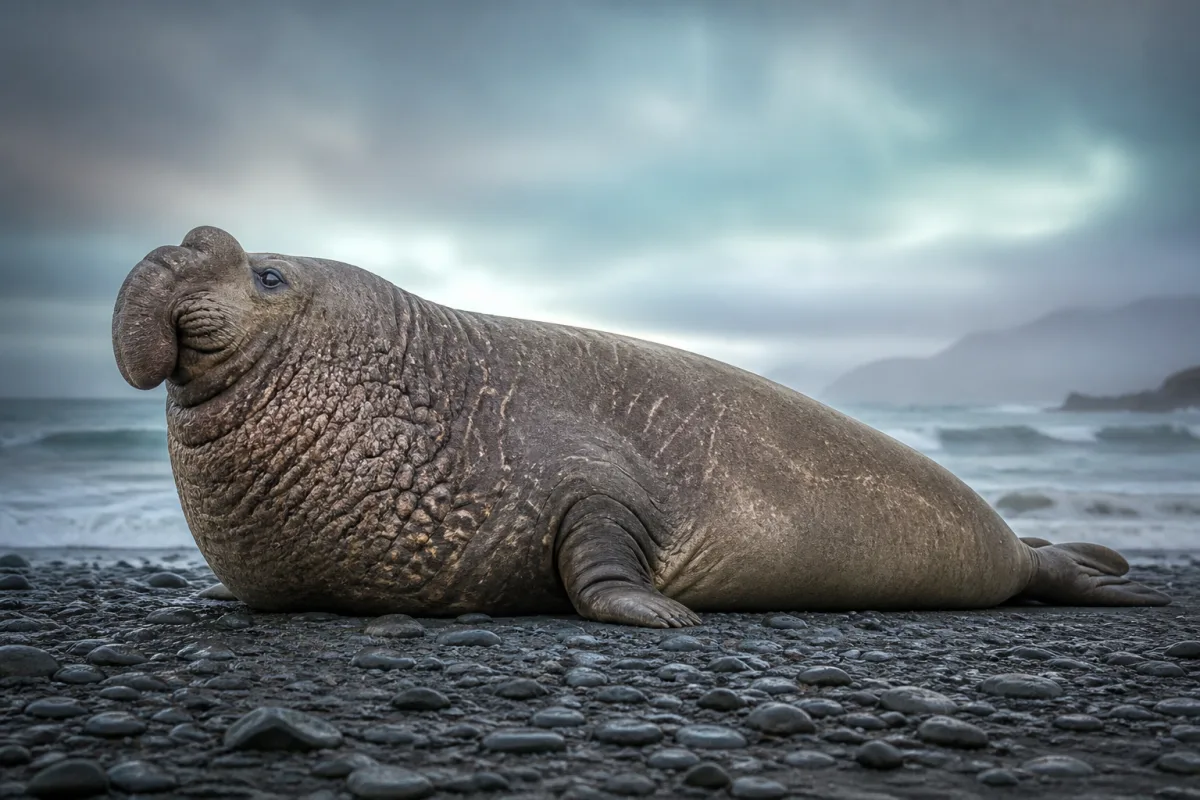
The southern elephant seal is the largest pinniped alive and the most unevenly divided. A breeding bull reaches close to 20 feet and can weigh over four tons, while an adult female is roughly a third as long again as she is heavy in proportion, running about 9 feet and 900 to 1,900 pounds. No other mammal shows a mass difference between the sexes on this scale. Mature males also grow the inflatable proboscis that gives the species its name, a fleshy extension of the nose that hangs over the mouth and amplifies the roaring call used against rivals.
For most of the year the animal is not on a beach at all. Elephant seals spend something like eight to ten months at sea, and while they are there they are submerged around ninety percent of the time, surfacing for two or three minutes between dives that commonly last twenty minutes to an hour. They dive continuously, day and night, for weeks on end. Satellite-tracked animals from South Georgia and Macquarie Island travel thousands of miles into the Southern Ocean and along the Antarctic shelf between breeding and molting.
The diving is exceptional even against other deep-diving seals. Routine foraging takes them to between roughly 1,300 and 3,300 feet, deeper than most whales go, and the deepest reliably recorded dive is a little over 7,000 feet. Dives beyond two hours have been recorded. The physiology behind this includes an enormous blood volume, a spleen that stores oxygenated red cells, muscle heavily loaded with myoglobin, and the ability to collapse the lungs and shut down circulation to non-essential tissue, so the animal runs on stored oxygen rather than on a held breath.
Where it lives
Circumpolar in the Southern Ocean and the southern reaches of the Atlantic, Pacific and Indian Oceans. Breeding is concentrated on a small number of sub-Antarctic islands, with South Georgia holding roughly half the world population and further major colonies at Kerguelen, Heard, Macquarie, the Crozet group, Marion and the Falklands. Foraging animals range south to the Antarctic continental shelf and the edge of the pack ice, and vagrants reach the coasts of South Africa, Australia, New Zealand and South America.
Habitat
- Open ocean
- Deep sea
- Sea ice & polar shelves
- Coastal waters
- Continental shelf
What it eats
Squid and deep-water fish taken in the mesopelagic zone, with the balance differing between individuals and between colonies. Some animals feed mainly in open water over deep ocean, working the layer where squid concentrate; others forage on or near the Antarctic continental shelf and take a higher proportion of fish, including Antarctic toothfish and icefish. Females and males often use different areas entirely, which reduces competition between the sexes.
- Squid & octopus
- Bony fish
How it hunts
Foraging is a matter of endurance rather than speed. The seal dives repeatedly to the depth where prey is concentrated, spends most of the dive at that depth, and returns to the surface only long enough to reload oxygen before descending again, keeping this up for weeks without a meaningful rest. In near-total darkness it relies on very large eyes tuned to dim light and on the bioluminescence of the animals around it, and the stiff vibrissae on the muzzle register the water disturbance left by a moving squid. Prey is taken individually and swallowed whole, and there is no cooperative hunting; a foraging elephant seal is alone.
Behavior
Social structure: Breeding colonies
Intensely social on land for a few weeks and solitary at sea for the rest of the year. Breeding is among the most polygynous of any mammal: a successful bull holds a harem that can exceed fifty females, defends it against challengers for up to two months without feeding, and may sire dozens of pups in a season, while most males of breeding age sire none at all. Fights between evenly matched bulls are bloody, involving reared-up chest-to-chest shoving and slashing bites at the neck, and the thickened chest shield absorbs much of the damage.
Active period: Day & night
At sea the animal dives around the clock with almost no surface rest, and the depth of its dives tracks the daily vertical migration of the prey layer, shallower at night and deeper by day. On land the pattern collapses entirely: breeding and molting animals spend most of the day lying still, conserving energy through a long fast.
Reproduction
Live birth, milk-fed young.
A single pup is born on the beach in the southern spring, weighing about 90 pounds, and is nursed for roughly three weeks on milk that reaches close to half fat. In that time it can quadruple its weight while the mother, who is fasting throughout, loses a third of hers. She then mates and departs, and the weaned pup remains ashore for several weeks living on its blubber before entering the water and learning to dive unaided. Females first breed at three to six years; males may not secure a harem until nine or ten, if ever.
Predators and ecological role
Orcas take animals at sea and in the surf around the breeding islands, and large sharks are a threat in the northern part of the range. Weaned pups making their first trips to sea suffer the heaviest losses, and leopard seals take pups at some colonies. Adult bulls are large enough that few predators attempt them.
Elephant seals move an enormous quantity of biomass from the deep ocean into the coastal zone. A population feeding hundreds of miles offshore at depths of half a mile returns to a handful of islands to breed and molt, depositing nutrients that fertilize island soils and nearshore water. Because they forage where ships and nets rarely go, instrumented seals have become an important scientific tool in their own right: sensors carried by these animals have produced a large share of all oceanographic profiles from beneath the Antarctic sea ice, mapping temperature and salinity in places no research vessel can reach in winter.
Conservation and threats
Least Concern Assessed 2014 · population unknown
Listed as Least Concern with a total population of roughly 650,000 animals, recovered from the nineteenth-century sealing that was driven by the oil rendered from their blubber. The global category conceals opposing regional trends: the South Georgia population, about half the world total, appears broadly stable, while the Macquarie Island and Kerguelen populations have declined substantially since the 1950s for reasons that remain unresolved and are usually attributed to changes in prey availability rather than to direct exploitation. Breeding sites are protected under the Antarctic Treaty System and by national legislation.
No longer hunted, and the pressures it now faces are indirect. Shifts in the position of Southern Ocean fronts alter where prey concentrates, which lengthens foraging trips and appears to be linked to the unexplained declines at Macquarie and Kerguelen. Longline fisheries for Antarctic toothfish target one of the species' prey items and create a risk of interaction. Entanglement in gear and ingestion of debris affect individuals, and disturbance at breeding beaches from tourism and research is a localized concern. Avian influenza reaching sub-Antarctic colonies has emerged as a further worry.
Main pressures
- Climate change
- Ocean warming
- Depletion of prey
- Human disturbance
- Entanglement in gear
Notable details
- The deepest recorded dive by a southern elephant seal is a little over 7,000 feet, deeper than the routine range of a sperm whale, and some dives have lasted more than two hours.
- A breeding bull can weigh five to seven times as much as an adult female, the widest mass difference between the sexes of any mammal.
- Nursing females lose about a third of their body weight in three weeks while feeding a pup milk that approaches fifty percent fat, and neither mother nor pup eats during that time.
- Sensors fitted to elephant seals have collected a substantial share of all oceanographic measurements taken under the Antarctic sea ice, in waters no research ship can sample in winter.
Sources
-
The IUCN Red List of Threatened Species
International Union for Conservation of Nature
Global conservation assessments, population trends and threat classifications for every species profiled here.
-
British Antarctic Survey
Natural Environment Research Council
Antarctic field research on seals, penguins and Southern Ocean food webs.
-
Smithsonian Ocean
Smithsonian National Museum of Natural History
Peer-reviewed public science writing on marine life, ecosystems and ocean change.
-
Animal Diversity Web
University of Michigan Museum of Zoology
Referenced accounts of anatomy, reproduction, behavior and life history.
-
SeaLifeBase
SeaLifeBase Project
Companion database to FishBase covering non-fish marine organisms, including cephalopods.
Figures on this page were last checked against these sources on .